
Enterprise data architectures are notoriously chaotic, often patched together over decades across disparate systems. When engineering teams deploy autonomous AI agents to query these relational databases using natural language, the results are frequently unreliable.
Large language models inherently struggle with cryptic column names, deprecated table structures, and undocumented relationships.
Faced with raw Data Definition Language schemas, models resort to guessing, which inevitably leads to hallucinated SQL queries and compromised analytics.
Recognizing this critical structural bottleneck, NVIDIA has introduced a targeted open-source Python framework designed to function as an intelligent translation mechanism between complex data warehouses and language models.
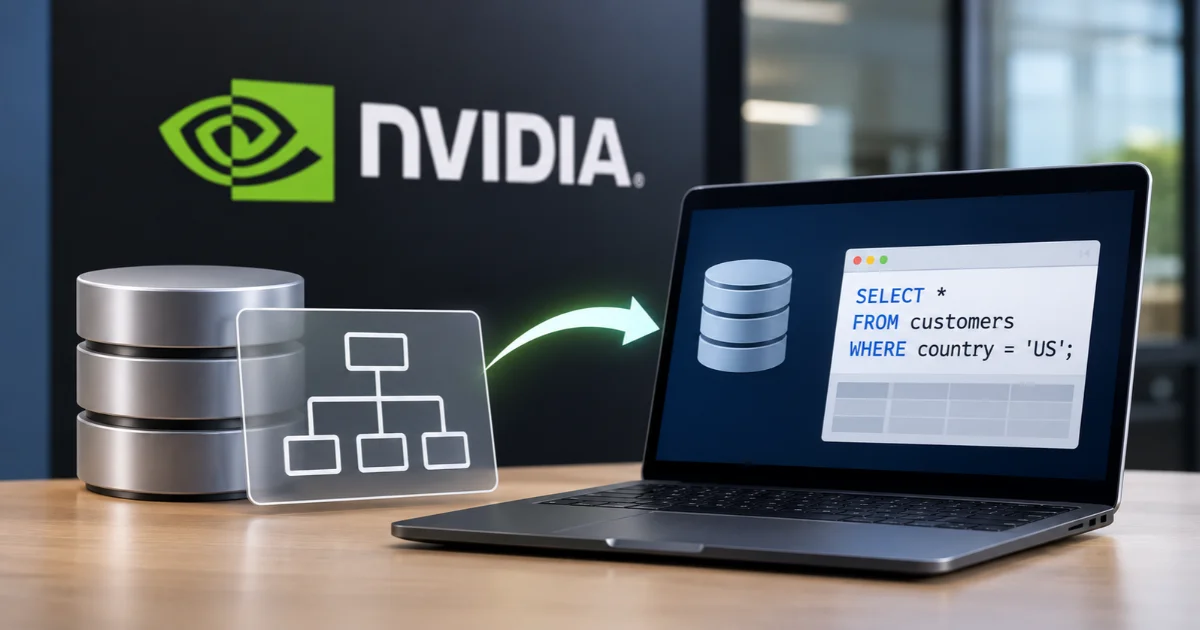
The newly launched Auto Ontology framework actively constructs a certified semantic layer over raw enterprise data, ensuring that autonomous agents generate deterministic, highly accurate queries grounded in verified business definitions rather than probabilistic guesses.
Bridging the Gap Between Raw Schemas and Business Logic
Raw database schemas are rarely self-explanatory. An AI agent scanning an unannotated database might incorrectly assume a legacy identifier represents a primary revenue metric, silently skewing an automated financial report.
Auto Ontology addresses this vulnerability by automatically extracting metadata from existing enterprise catalogs and generating a structured, graph-based map of what the data actually represents.
This semantic layer explicitly dictates which joins are valid and defines the exact business concepts tied to specific tables.
According to a detailed technical overview at Marktechpost, developers can leverage this Apache 2.0 licensed library to provide their agents with an authoritative ground truth.
By forcing the agent to interact exclusively with this curated semantic map instead of the raw relational tables, hallucination rates drop dramatically.
The system systematically validates generated queries against established data governance policies, ensuring that the AI cannot exploit ambiguous metadata to justify incorrect data retrieval.
Furthermore, for organizations operating hybrid data environments, the framework federates context across cloud data warehouses and on-premises legacy systems. This federation capability strictly prevents models from generating rogue queries that incorrectly attempt to bridge incompatible data sources, maintaining the integrity of the output.
Enterprise Deployment and Workflow Integration
Building an accurate semantic map is only valuable if it seamlessly integrates into modern engineering environments. NVIDIA architected Auto Ontology for immediate production deployment, offering flexible hosting options that include local Docker Compose stacks or Kubernetes clusters via Helm.
Rather than forcing development teams into a rigid proprietary ecosystem, the framework serves context to AI models through standard interfaces such as the Model Context Protocol, a Command Line Interface, and dedicated REST API endpoints.
This flexibility allows an agentic workflow to dynamically pull real-time definitions via the Model Context Protocol, while a separate backend service utilizes the API to validate SQL generated by a client-facing application.
The framework handles the heavy lifting of inference through either hosted NVIDIA NIM endpoints or self-hosted configurations, prioritizing enterprise security.
It manages database credentials securely via integrations like HashiCorp Vault and uses a strict token-based authentication system to ensure every query is authorized against the specific user’s role.
Because the architecture intentionally omits any tool for browsing raw schemas directly routing all data access exclusively through the semantic layer metadata governance teams maintain absolute control over the data environment.
This structured approach to context delivery represents a necessary evolution for companies transitioning from experimental chatbots to autonomous agents trusted with sensitive, large-scale data operations.