
Meta AI chief Alexandr Wang has been active on social media lately. He is promoting the company’s newly launched AI assistant, Muse. His timeline on X features memes, feature demos, and playful commentary to spark buzz. However, one specific post caught widespread attention across the tech community before abruptly disappearing.
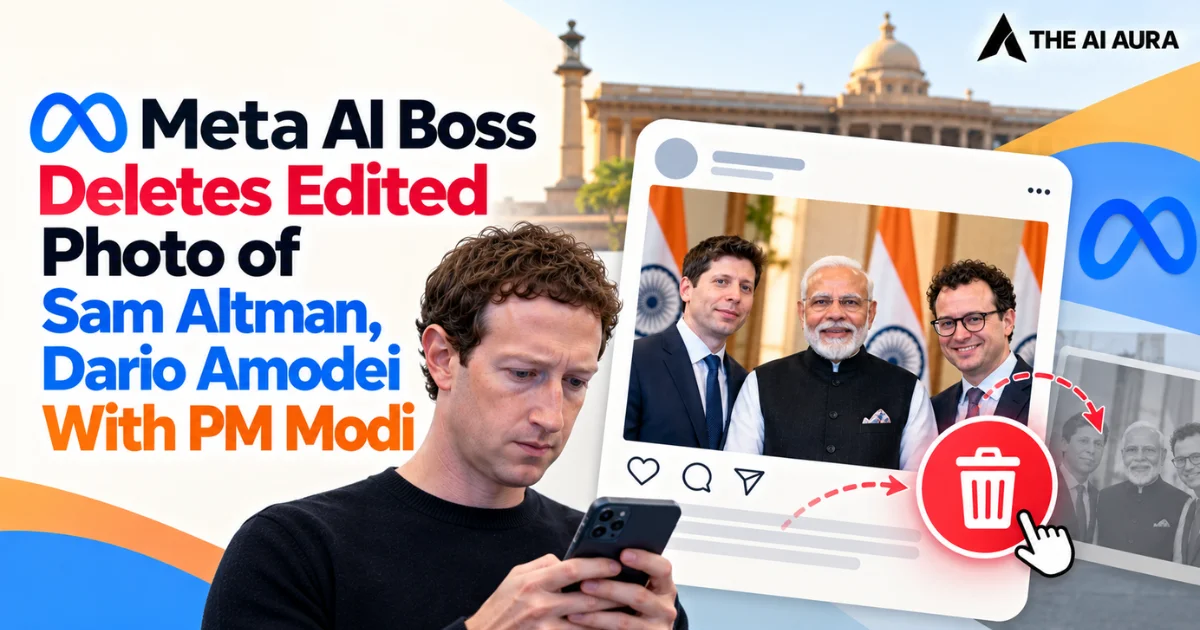
Wang took a playful jab at two major AI figures: OpenAI CEO Sam Altman and Anthropic CEO Dario Amodei. The joke centered on an image from the India AI Impact Summit earlier this year. Indian Prime Minister Narendra Modi prominently attended that event.
During that summit, a defining photograph captured Prime Minister Modi standing on stage alongside several tech executives in a celebratory pose, holding hands to form a unified human chain.
However, a noticeable physical gap was left between Altman and Amodei, who distinctly chose not to hold hands with each other.
The awkward visual immediately became a symbol of the intense, underlying rivalry between OpenAI and Anthropic, two frontrunners locked in a fierce battle for industry dominance a dynamic made even more tense by the fact that Anthropic was founded by former OpenAI researchers who splintered off from Altman’s leadership.
A Playful Jab at Industry Rivals
Wang quickly inserted Meta’s new mascot into the viral moment. He shared a digitally altered version of the summit photograph. In the edit, Meta’s furry Muse mascot stands squarely between Altman and Amodei.
The mascot cheerfully grasps their hands, completing the chain. The visual gag carried a clear marketing message. Wang jokingly implied that Muse can even unite Silicon Valley’s fiercest rivals.
According to a detailed report by NDTV, Wang shared the doctored image with a caption simply asking, “What can’t Muse do?” He then leaned into the joke even further, following up with a subsequent comment asking his followers where the Muse mascot could go to pick up a Nobel Peace Prize.
Many viewed the posts as smart marketing wrapped in friendly banter. Despite strong viral engagement, Wang deleted the image a few hours later. Meta gave no official reason for the removal. However, observers believe the company wanted to avoid diplomatic friction over altering a photo of a world leader.
The Push for Everyday Superintelligence
Beyond the social media antics and deleted memes, the launch of Muse represents a major strategic shift for Mark Zuckerberg’s empire. Positioned as a foundational tool for bringing “personal superintelligence” to the masses, the assistant is engineered to handle complex, continuous everyday tasks rather than simply answering basic search queries.
Muse runs on the open-source OpenClaw architecture. As a result, it integrates deeply into everyday consumer workflows. The assistant can manage health tracking, shopping lists, email, digital payments, and smart home devices.
Currently, Meta is rolling out Muse only to users in the United States. The company emphasizes privacy and gives individuals granular control over third-party app permissions. Users can also revoke app access instantly at any time. Additionally, Meta plans to integrate Muse into its popular smart glasses.
This move will turn the wearable devices into hands-free assistants that understand real-world surroundings. Meta has not announced global release dates yet. Even so, Wang’s aggressive marketing signals Meta’s ambition to disrupt rivals in the consumer AI race.