
The intersection of artificial intelligence and physical automation is a major engineering challenge today. For years, the robotics industry has faced a serious talent bottleneck. Software engineers know how to train advanced machine learning models. Similarly, mechanical engineers can design precise kinematic hardware.
However, finding professionals who can seamlessly merge both fields remains difficult. Historically, universities taught these subjects in isolated departments without practical overlap.
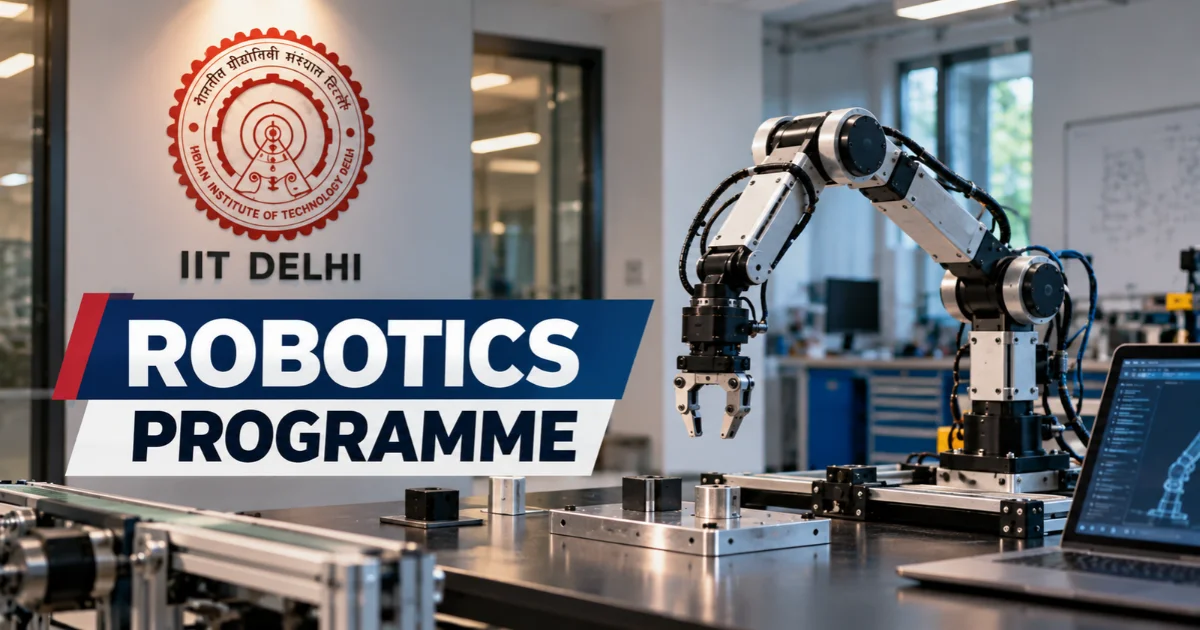
Therefore, the latest initiative from IIT Delhi addresses this critical gap directly. The institute recently launched the fourth batch of its Executive Programme in Robotics. This initiative marks a crucial shift in technical education for working professionals.
Bridging the Gap Between Theoretical Frameworks and Practical Robotics
From a research standpoint, studying robotics on a chalkboard or purely through software simulation only takes you so far. The real friction happens when code meets physical hardware. Sensors deal with noise, actuators experience latency, and real-world environments introduce unpredictable variables that theoretical models often ignore.
This new academic offering seems expressly designed to tackle this friction head-on. By prioritizing hands-on experience, the curriculum demands that learners move beyond basic conceptual understanding and grapple with actual hardware constraints.
According to a recent report by NDTV, covering the IIT Delhi robotics programme, the five-month continuing education course adopts a heavily skewed 60 percent practical learning approach.
This is an essential structural choice. Participants are required to build a functional robot, which forces them to navigate the messy reality of embedded systems, sensor integration, and motion control.
Designed for graduates with baseline academic credentials, the online weekend format allows industry professionals to upskill without pausing their careers. When engineers are forced to physically wire components and write the control logic to make a robotic arm move smoothly, they develop an intuitive understanding of system dynamics that no textbook can provide.
The focus here is clearly on applied engineering, helping teams transition from an AI prototype to a scalable product that translates directly to the factory floor or the research lab.
Why AI and Control Systems Are Changing the Landscape
Historically, industrial robots were essentially blind, repetitive machines. They executed rigid, pre-programmed trajectories within highly controlled environments. If a part was misplaced by a millimeter, the entire production line would halt. Today, the integration of artificial intelligence is fundamentally changing that architecture.
We are moving from deterministic machines to autonomous agents capable of doing the work in dynamic environments.
By embedding machine learning directly into robot control loops, we allow these systems to perceive their environment, learn from localized data, and adjust their movements in real-time. This is the exact technological shift that modern training programs must address to remain relevant.
The heavy emphasis on artificial intelligence within this newly announced curriculum reflects a broader industry consensus. As we develop more sophisticated robotic applications in healthcare, agriculture, and smart manufacturing, the ability to fuse advanced machine learning models with robust control systems is becoming the baseline requirement for innovation.
An engineer who understands both the neural network processing the visual feed and the PID controller managing the wheel motors is incredibly valuable. They can troubleshoot across the entire technology stack.
By pushing this interdisciplinary knowledge out to the professional workforce through an accessible executive format, we are actively expanding our capacity to build intelligent, autonomous systems.
The barrier to entry for advanced robotics is gradually lowering, and it is highly encouraging to see academic institutions moving rapidly to supply the complex, hybrid skill sets that the next generation of automation will inevitably require.