
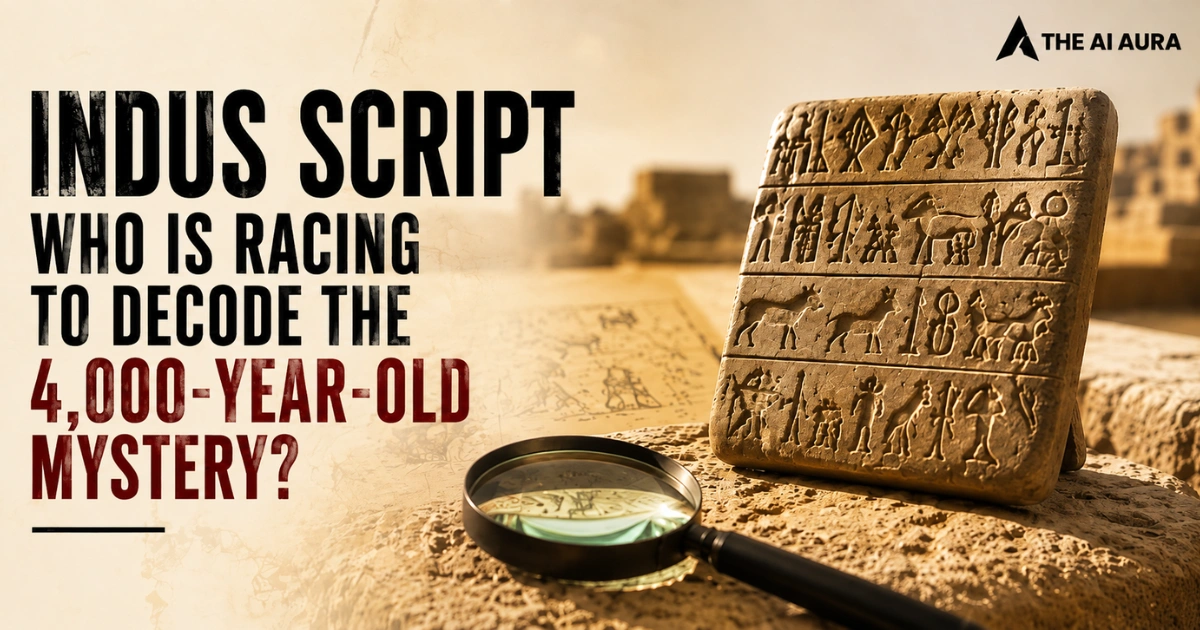

The Indus Valley Civilization was a Bronze Age superpower. Spanning more than a million square kilometres across present-day India and Pakistan, it built standardized weights, complex urban systems and trade networks that reached Mesopotamia.
Yet the Harappans left behind one major mystery: their writing. For more than a century, researchers have studied thousands of tiny steatite seals covered with symbols.
The goal is simple but difficult decode the Indus Script and understand what its creators were trying to say.
There is no Rosetta Stone for the Indus Valley. No bilingual texts have survived to provide a translation key. Researchers also do not know with certainty which language the civilization spoke.
That has turned the Indus Script into an unusually difficult puzzle. Today, the race to decode it is no longer limited to traditional linguists and historians.
Computer scientists, software engineers and AI researchers are using machine learning to search for patterns hidden inside the ancient symbols.
The Machine Learning Revolution in Archaeology
Deciphering the Indus script poses a unique statistical nightmare. Most recovered inscriptions are frustratingly brief, averaging just five characters. This brevity, combined with a fragmented corpus of around 4,000 surviving artifacts, makes pattern recognition excruciatingly difficult for the human brain.
Early heavyweights in the field, like the late Indian epigraphist Iravatham Mahadevan, painstakingly built visual concordances of the roughly 400 known signs.
Today, computational scientists such as Rajesh P.N. Rao have taken those foundational datasets and subjected them to rigorous machine learning and statistical entropy analysis.
Rather than guessing phonetic valuesa trap that has ensnared hundreds of eager amateurs researchers are asking algorithms to measure the predictability of sign sequences.
By mapping how often a “fish” symbol follows a specific geometric mark, neural networks can determine whether the script behaves like a spoken language or a non-linguistic symbol system.
While advanced tools are already interpolating missing characters in ancient Greek and translating Akkadian cuneiform, the Indus problem remains distinct. AI models require massive datasets to train effectively.
To compensate for the small sample size, contemporary researchers are feeding specialized algorithms structural constraints, stroke numerals, and cross-cultural data from Mesopotamian and early Indian scripts, hoping brute computational force can finally expose the underlying syntax.
Rethinking the “Language” Paradigm
What if a century of brilliant minds failed to decode the script simply because they were asking the wrong question? The most profound shift in this race comes from scholars and data scientists who suggest we might not be looking at a spoken language at all.
Researchers like Bahata Ansumali Mukhopadhyay, alongside recent AI-assisted studies led by data investigators like Boris Kriger, have proposed a radical reframing.
Their computational analyses indicate the script’s strict positional constraints do not match the fluid grammar of spoken sentences. Instead, they strongly mimic a structured registration code. Under this framework, the seals functioned as institutional credit instruments, trade licenses, and tax records.
Think of them as Bronze Age credit cards. The sequence of signs likely served as a unique account number or commodity identifier, while the prominent animal motif be it a unicorn or a bull acted as an institutional issuer logo.
The clay impressions left by these seals were early transaction slips in a sophisticated, cashless economic network.
The current race to decode this 4,000-year-old mystery is pivoting away from finding hidden poetry, religious incantations, or royal names. It is moving toward reconstructing the world’s first structured information system.
The true breakthrough may not lie in learning how the Harappans spoke, but in uncovering how they managed a vast empire through pure administrative genius.
Source: Official The Indian Express, "The Indus Code: Who Is in the Race to Crack a 4,000-Year-Old Script?"