
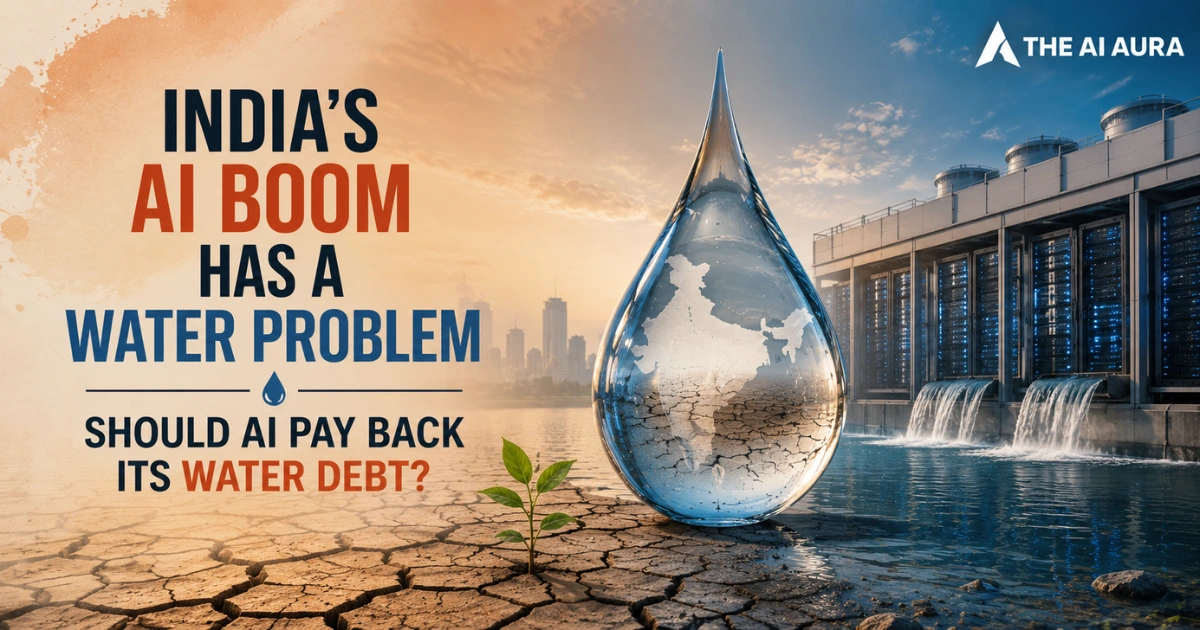

Imagine two neighbors drawing from the exact same aquifer in rural India. One is a farmer whose family has relied on this water for three generations to grow crops.
The other is a sprawling, multi-billion-dollar data center humming loudly as it processes the complex models and algorithms fueling India’s artificial intelligence ambitions.
Both absolutely depend on that water to survive. Yet, society still instinctively describes the tech industry as living harmlessly up in “the cloud.”
This is the great, uncomfortable contradiction of our digital era. AI might feel weightless and invisible when you’re typing a quick prompt into a chatbot on your phone, but the infrastructure making it happen is profoundly, heavily physical.
How the Cloud Actually Drinks Water
To understand why artificial intelligence is so thirsty, we have to look at the mechanics of machine learning.
Whenever an AI model trains on large datasets or processes a query, thousands of servers packed densely into warehouse-sized buildings spring into action. These machines work incredibly hard, and in doing so, they generate extreme amounts of heat.
To prevent catastrophic hardware meltdowns, data centers rely on massive industrial cooling systems. While some newer facilities use air-cooling techniques, the most efficient and widely used systems rely heavily on water evaporation.
They pull millions of gallons from local municipal systems or direct groundwater sources to keep temperatures stable.
But direct cooling is just the first layer of consumption. The electricity required to keep these facilities running 24/7 carries its own massive, hidden water footprint. Most of this power is drawn from thermoelectric power plants, which boil and evaporate vast quantities of water just to generate electricity.
Add the intensely resource-heavy semiconductor manufacturing process required to build the AI chips themselves, and you have a supply chain practically drowning in water consumption. We are trading our most vital, life-sustaining natural resource for computational abundance.
Calculating AI’s Imminent Water Debt
The sheer scale of this consumption demands immediate attention, particularly in a country where water scarcity is already a volatile issue of daily survival. The numbers paint a stark picture of what is coming.
According to estimates by the Council on Energy, Environment and Water (CEEW), data centers in India consumed roughly 150 billion liters of water in 2025. With the rapid acceleration of AI adoption, that figure is projected to more than double by the end of the decade.
Globally, researchers at Quantive Advisory estimate AI-related water withdrawals could hit an astonishing 6.6 billion cubic meters annually by 2027.
India has undeniably compelling economic reasons to aggressively expand its data center ecosystem. Digital sovereignty, cloud services, and technological innovation are non-negotiable for a growing economy.
Ironically, AI itself is heavily touted as a tool to help optimize agriculture, manage healthcare, and build climate adaptation models.
However, the fundamental question remains: who bears the ecological cost of this progress? If tech giants are drawing from the exact same finite aquifers as local farming communities, the concept of an AI “water debt” isn’t merely an abstract corporate buzzword; it’s an urgent policy requirement.
Making AI pay back its water debt means forcing an industry-wide pivot. It requires mandating that new data centers invest heavily in localized water replenishment projects and transition rapidly to closed-loop cooling systems that recycle their intake.
Tech companies cannot simply buy their way out of local droughts with generic sustainability credits. To truly earn their place in India’s future, the AI industry must figure out how to replenish the exact aquifers it drains, drop for drop.
Source: Official The Economic Times, "When the Cloud Gets Thirsty: Should India Make AI Pay Back Its Water Debt?"