
The AI landscape is undergoing a massive regulatory shift, and Anthropic is moving early to adapt. If you use Claude for daily writing, drafting, or coding, you might be wondering how the newly announced text watermark will actually affect your workflow.
Driven by the recent EU AI Act requirements, Anthropic is rolling out a global watermarking system across its future models.
But before you worry about invisible trackers ruining your carefully crafted copy or compromising your privacy, let’s break down exactly what this technology is and why it operates completely under the radar.
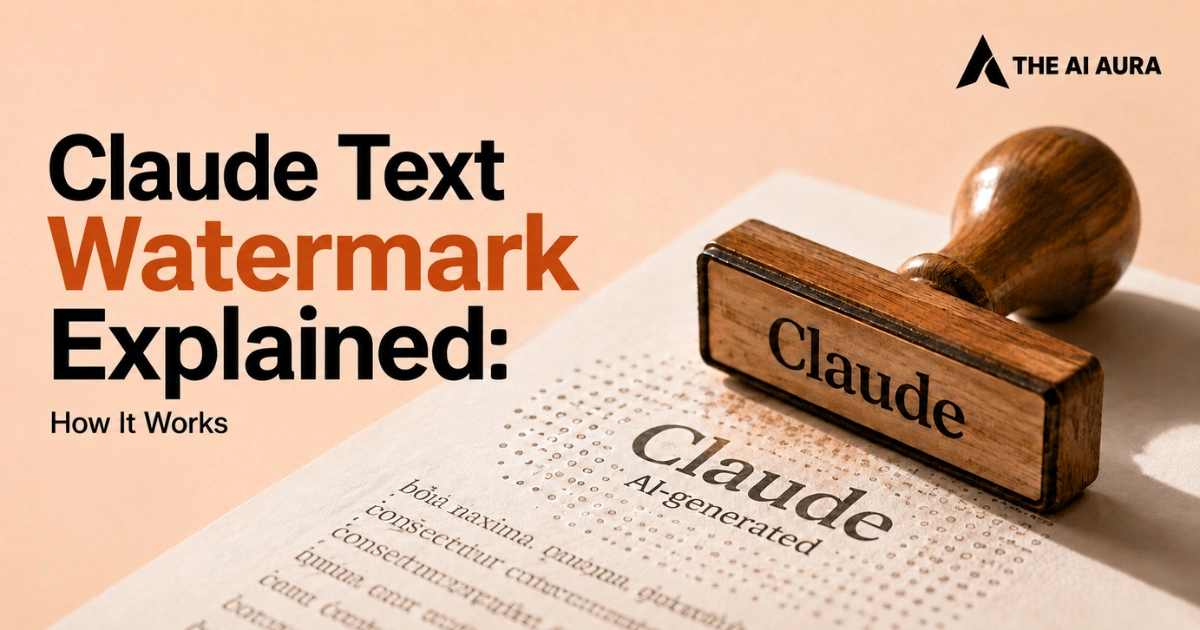
Unlike physical watermarks or digital image tags, text watermarking in large language models doesn’t insert hidden characters, tweak your formatting, or bloat your word count.
Instead, it operates on the underlying mathematical probabilities of word selection.
Anthropic is leveraging a variation of Google DeepMind’s SynthID-Text, a sophisticated method that alters the source of the randomness used when Claude generates responses, rather than altering the vocabulary itself.
The Mechanics Behind the Invisible Pattern
To understand how this watermark functions, you have to look at how Claude writes: one token at a time.
When generating a sentence, the model constantly weighs a list of sensible next words. If the sentence is “The weather today was cold and…”, Claude knows “sugary” makes no sense, but “overcast” and “grey” are both highly probable.
Normally, an arbitrary random number generator picks between these equally valid, low-stakes options.
With the watermark active, that random number is replaced by a specific cryptographic key. The model still picks naturally between “overcast” and “grey,” but it makes that choice based on the key and the sequence of preceding words. To the naked eye, the text reads exactly as it always has.
However, someone holding the correct key can analyze the completed text and determine if the sequence of word choices aligns with the statistical pattern that the key dictates.
Think of it less like a stamp on a document and more like a subtle statistical fingerprint. Because this system relies on having a wide array of word choices, the watermark becomes significantly stronger and more detectable the longer the generated text is.
Conversely, if you ask Claude to write a single sentence, or merely proofread a paragraph of your own human-written text, there simply aren’t enough generated word choices for the pattern to take hold.
Real-World Impact on Quality and Code
The immediate concern for any power user is whether this regulatory update degrades output quality. Based on extensive controlled studies including DeepMind’s own large-scale trials the answer is a definitive no.
Because the watermark only nudges the model between words it was already going to use, it doesn’t force Claude to adopt an unnatural or obscure vocabulary. Your copy won’t suddenly sound robotic, and the API won’t cost more or run slower, as absolutely no extra tokens are generated.
Privacy is another major factor Anthropic has clearly addressed. This watermark only identifies that the text was likely generated by a Claude model. It carries zero user-specific metadata. No one can trace a watermarked paragraph back to your specific account, your organization, or your private chat history.
Interestingly, the watermark naturally disables itself in scenarios requiring high precision. Take coding or factual historical summaries. If Claude is writing a Python script or detailing a specific mathematical formula, there is often only one correct next token.
You cannot swap a specific variable or function name for a “synonym” without breaking the code. Because the model has no arbitrary choices to make in these rigid contexts, the watermark simply has nothing to act on. It relies entirely on the flexibility of natural language to exist.
Source: Official Anthropic, "How Claude’s Text Watermark Works"