
The push toward fully autonomous agentic workflows has consistently hit a wall when it comes to data privacy and API compute costs. Sending proprietary codebases to cloud-hosted models for rigorous auditing or continuous generation is often a non-starter for enterprise environments and security-conscious developers.
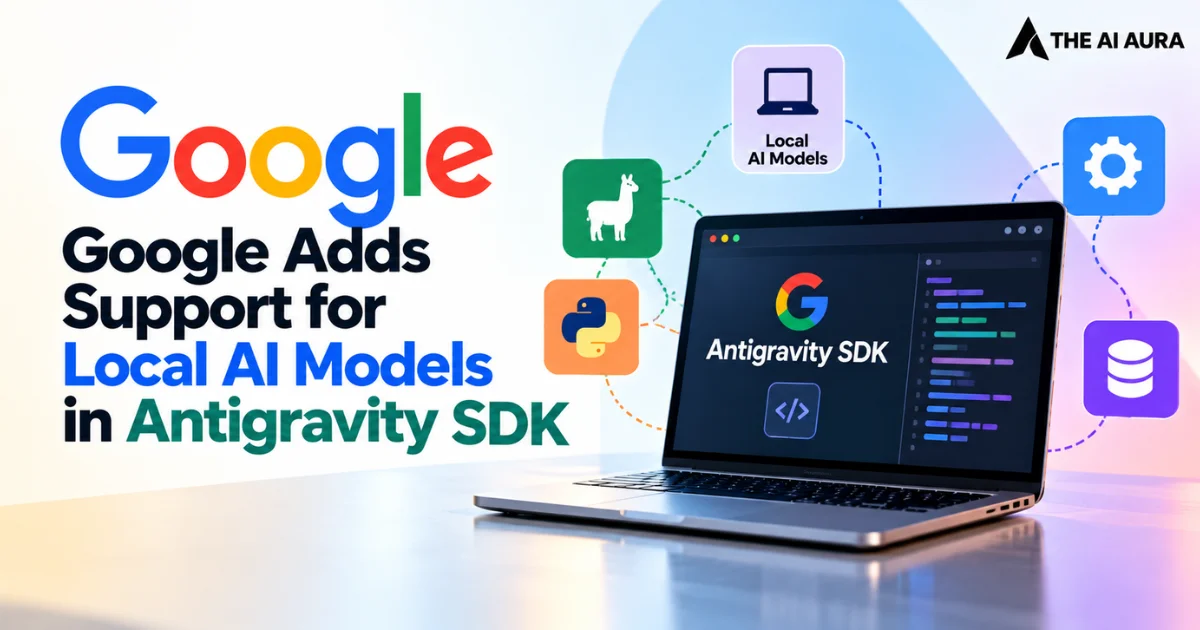
Google is directly addressing this infrastructure gap by bringing local execution capabilities to the Antigravity SDK.
By integrating support for local AI models, starting with the highly capable Gemma 4 26B A4B running on Google AI Edge’s LiteRT, developers can now build and deploy autonomous agents completely offline.
This architectural shift allows engineering teams to keep sensitive operations entirely on local hardware, maximizing offline resiliency while completely bypassing cloud rate limits.
Taking an AI application from prompt to production usually involves significant cost management hurdles, but executing these intensive agentic loops locally redefines the return on investment for automated development.
It ensures that data remains locked down, all while delivering the same high-level reasoning capabilities previously reserved for strictly cloud-based environments.
Architecting Hybrid Cloud-to-Local Orchestration
The most compelling aspect of this update is how it handles the orchestration bottlenecks that typically plague complex AI systems. Rather than forcing a binary choice between cloud scale and edge privacy, the SDK facilitates a sophisticated hybrid Architect-Builder pattern.
According to the official technical announcement on the Google Developers Blog, this setup allows a highly capable cloud model to act as the primary conductor while local instances handle the heavy computing labor.
In a practical deployment scenario, a cloud model like Gemini 3.8 Flash can evaluate task descriptions and basic filenames to plan a comprehensive security audit, consuming a negligible amount of cloud tokens in the process.
The execution then seamlessly hands off to a local swarm of Gemma 4 26B models. These local agents iteratively reproduce vulnerabilities, write candidate patches, critique their own code to reduce system hallucinations, and validate fixes against regression suites using the host machine’s GPU.
By keeping the actual source code strictly on-device, organizations achieve massive data privacy wins while offloading over 97 percent of token generation to local hardware, fundamentally driving down the operational costs of maintaining continuous AI assistants.
Expanding Edge Capabilities and Infrastructure Flexibility
Executing these localized workflows effectively does require capable hardware, with Google recommending machines equipped with upwards
A single prompt can instruct a local agent to autonomously generate a live-updating system resource monitor, write the Python script using specific libraries, map out the requirement files, and test its own executable code without ever pinging an external server.
This localized capability ensures that the AI’s reasoning, tool use, and execution happen securely within the host environment, insulating the project from network instability.
Furthermore, the updated Antigravity SDK does not lock developers into a single proprietary ecosystem. It offers seamless, plug-and-play support for popular OpenAI-compatible local inference servers, including Ollama, LM Studio, and vLLM.
This structural flexibility allows engineering teams to aggressively experiment with various local inference backends while keeping their established agentic workflows, custom tools, and routing logic completely intact.
The result is a robust, production-ready environment where developers can leverage the exact right model for the specific task at hand, perfectly balancing localized data security with advanced agentic reasoning.