
The landscape of software engineering and technical assessment is undergoing a massive architectural shift. For decades, the industry standard for evaluating talent relied heavily on grueling, syntax-focused coding tests. Candidates were routinely expected to memorize complex algorithms and write flawless logic on a whiteboard or in a sterile, disconnected text editor.
Generative AI now reshapes actual development work. Because of this, old testing methods are rapidly becoming obsolete.
Grinding through boilerplate code is no longer the primary indicator of technical proficiency. Instead, the focus shifts toward how effectively engineers collaborate with artificial intelligence.
AI acts as a thinking partner and transforms the assessment process. It turns traditional exams into dynamic evaluations of human judgment.
The Shift from Syntax to Strategic Judgment
The mechanics of this new evaluation model reflect the reality of modern programming workflows. Rather than stripping candidates of their tools, the testing environment intentionally pairs them with advanced models like Gemini, which act as a personal technical tutor and pair programmer.
The AI handles the heavy lifting of generating initial code. It also suggests alternative functions and outlines complex data models.
The actual test begins after the AI outputs its suggestions. The human operator must filter, critique, and modify those suggestions before implementation. AI can produce a functional working model in seconds.
Therefore, the technical challenge is no longer about raw generation. What actually matters is whether the individual exercises critical oversight.
According to a recent technical overview detailing the use of Gemini within Google Colab, the assessment intentionally forces users to question the AI’s logic and justify every final modeling decision they make. It is a fundamental redesign of the testing environment.
Candidates must justify every final modeling decision they make. Candidates need deep foundational knowledge to spot errors immediately. They must notice when the AI hallucinates a variable or applies inefficient algorithms.
They also need to catch unhandled edge cases in massive datasets. This approach authenticates meaningful human-AI teaming. It proves the user actively guides the tool instead of blindly relying on it.
Defending Decisions in Verbal AI Interviews
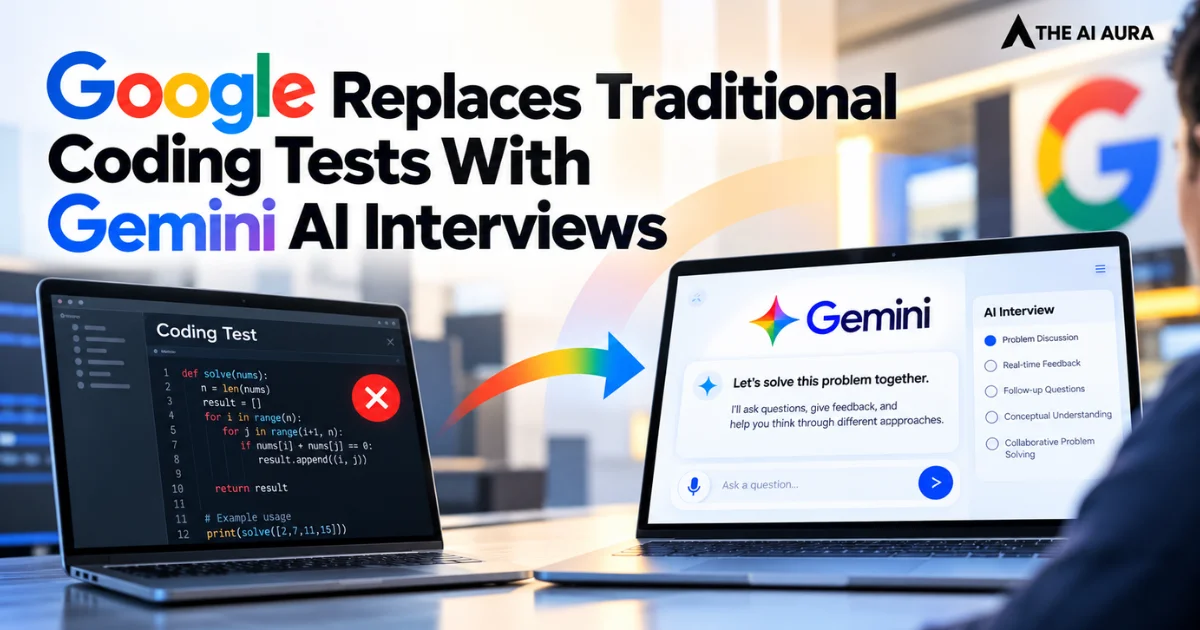
Intensive verbal interviews replace traditional automated pass-fail tests. This change effectively measures the new collaborative skill set. Once the candidate and the AI produce a working solution, a defense phase begins.
Evaluators sit down with the candidate to dissect the final codebase line by line. Evaluators ask candidates to explain the system architecture. Candidates must pinpoint exactly where the AI’s recommendations failed. They also explain how they navigated early roadblocks.
Candidates actively troubleshoot the AI’s logic in real-time. They defend their choices to accept, reject, or rewrite specific code blocks. This verbal defense mechanism proves that the human remains the absolute master of logic.
Evaluators use systems like Gemini Canvas and Gemini Notebook behind the scenes. These tools analyze complex interactions and scale the assessment process efficiently.
Balancing technical education and industry application reveals a vital core belief. We are not replacing human learning with artificial intelligence. Google intentionally redesigns the entire gauntlet to build lasting human capability.
This new process sharpens critical thinking. It ensures the next generation develops mastery over machines rather than quiet dependency.