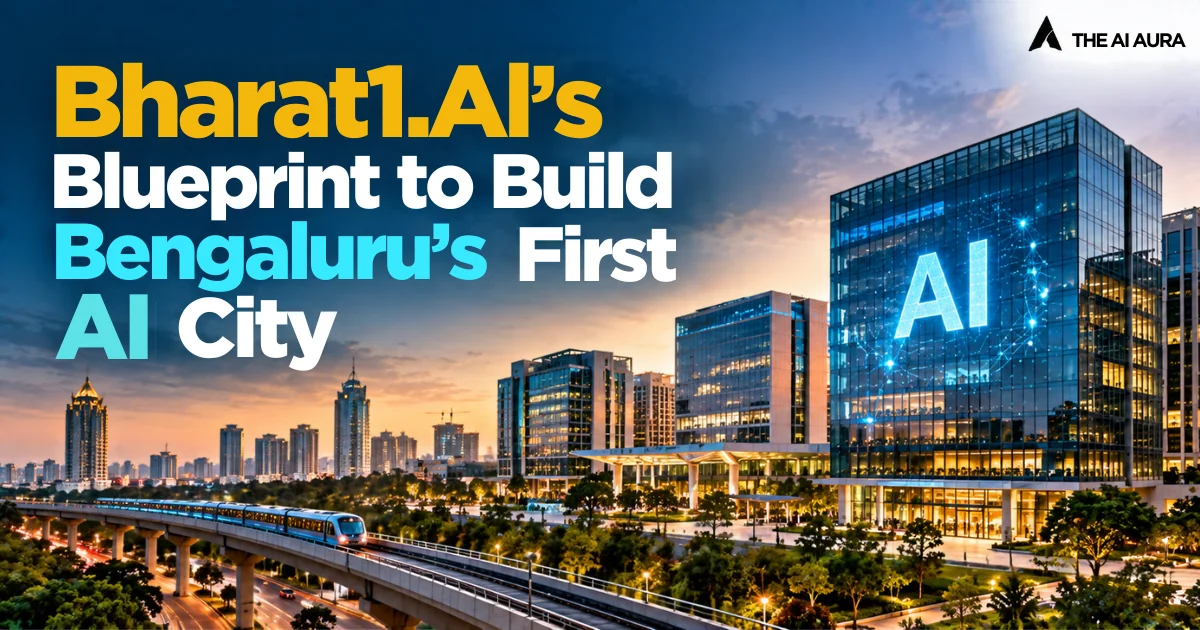

Bengaluru is the undisputed capital of Indian software development. For years, enterprise IT services, e-commerce giants, and SaaS platforms have dominated the city. However, the city is currently undergoing a profound architectural and cognitive shift.
Consequently, focus is increasingly pivoting toward foundational artificial intelligence infrastructure instead of conventional coding environments. At the vanguard of this transition is Bharat1.AI. Specifically, this initiative aims to construct the world’s first humanity-centric AI city.
This is not merely another corporate tech park. Furthermore, it is not just an expansive data center designed for endless rows of quiet servers. Instead, founders envision an ambitious 70-acre physical and digital sandbox.
Here, they can securely ground advanced AI models in real-world complexities. The project builds an environment where cutting-edge hardware, massive computing power, and human researchers seamlessly interact. As a result, it attempts to push the boundaries of domestic AI innovation.
Designing an Ecosystem for Humanity-Centric Intelligence
The philosophy driving Bharat1.AI is built on the premise that the next generation of artificial intelligence cannot be responsibly developed in isolated software silos. It requires a tangible, deeply integrated ecosystem where cross-disciplinary teams can collaborate physically.
The initiative is kicking off with the B1 AI Superpark, a massive 500,000-square-foot campus strategically positioned to act as the nerve center for this industry convergence.
According to a recent inside look at the facility by Money control, the second floor is already fully operational, presenting a brightly colored, sprawling environment that initially masquerades as a standard, high-energy co-working hub. Dozens of tech founders and engineers are scattered across open workstations, intensely focused on building foundational intelligence systems.
Yet, the atmosphere shifts dramatically once you move past the surface-level startup aesthetics. Behind the facility’s translucent glass walls lies the core of Bharat1.AI’s mission. Here, engineers and researchers are actively running rigorous tests on robotic AI models and hardware prototypes that have been quietly under development for months.
The overarching goal is to move the industry away from models that simply generate probabilistic text outputs and toward agentic systems capable of reliable, physical interactions.
By bringing venture capitalists, policymakers, university researchers, and enterprise leaders under one roof, the campus effectively collapses the traditional barriers between theoretical research and commercial deployment.
It creates a unified cognitive infrastructure that prioritizes AI safety, ensuring that as these highly capable systems scale, they remain aligned with societal needs and human well-being.
Moving Beyond Software to Physical Artificial Intelligence
Undeniably, the true differentiator of the Bharat1.AI blueprint is its intense focus on physical artificial intelligence. Building large language models primarily requires data and computing power. Conversely, developing systems that actively interact with the physical world introduces immense friction.
Hardware constraints, sensor latency, and unpredictable physical environments present unique challenges. Therefore, robotics and agentic AI require highly specialized testing grounds.
A traditional software office space simply cannot support these rigorous demands. For instance, developers need dedicated spaces for tuning robotic spatial awareness or testing multi-agent physical coordination. Thus, this massive new campus solves that exact infrastructure deficit for Indian startups.
The hub provides direct access to advanced graphical processing units, sophisticated robotics laboratories, and real-time data streams.
Because of this, engineers can iterate at unprecedented speeds within the domestic ecosystem. Developers can seamlessly move an AI model from a digital simulation into a physical robotic framework. Afterward, they can immediately stress-test its capabilities against real-world physics.
This immediate, hands-on feedback loop is absolutely crucial. Ultimately, it builds systems that are intelligent, operationally resilient, and safe for public environments. Establishing this sovereign AI infrastructure in Bengaluru signals major maturity in the local tech ecosystem.
In short, it transitions the region from an offshore execution engine to a primary theater for frontier research. Here, innovators are actively pouring the architecture for a sustainable and safe man-machine future into concrete.