

Generative AI has made it trivially cheap to produce ad creative that never touched a camera, a couch photographed in a studio and a couch rendered entirely by a model now look identical to the person scrolling past it.
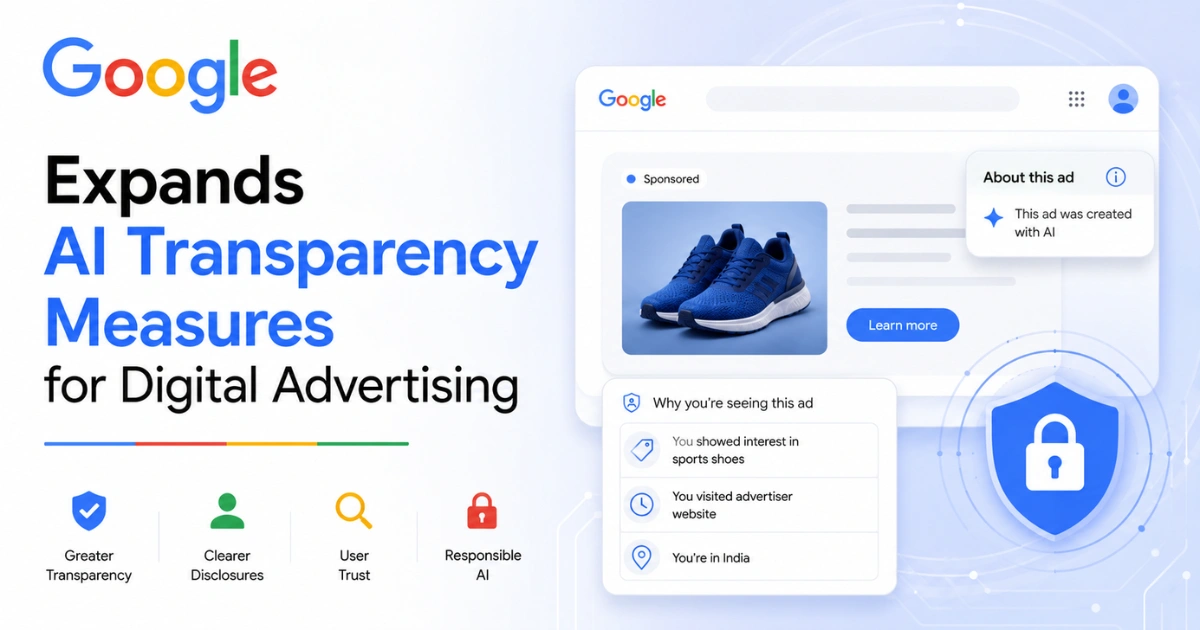
Many AI-generated ads now look almost identical to traditional ads. To improve transparency, Google introduced a disclosure layer inside the ad. Keerat Sharma, VP and General Manager of Ads Privacy and Safety, said the new “How this ad was made” panel explains when generative AI helped create the advertisement.
How the disclosure actually works
The panel lives inside My Ad Center, reachable globally through the three-dot menu or info icon on any ad across Search, YouTube, and Discover.
For ads built with Google’s own generative AI advertising tools, the disclosure is automatic, no advertiser action required, and Google says it’s using SynthID, its imperceptible AI-content watermark, along with C2PA metadata standards to track provenance.
Advertisers using AI tools outside Google’s ecosystem can now manually indicate when generative AI was used. Depending on local regulations, Google may also display a visible AI label directly on the ad instead of limiting the disclosure to the information panel.
This builds on a policy Google has run since 2023, when it began requiring disclosure of synthetic or digitally altered content specifically in election advertising, now extended across ordinary commercial ads at global scale.
The gap between disclosure and enforcement
The honest limitation sits in that split between automatic and manual disclosure. Google can reliably detect and label AI use in ads built through its own tools, because it controls the generation pipeline and embeds SynthID at creation.
Ads made with third-party AI tools depend on the advertiser choosing to flag them, and outside of markets with specific legal disclosure requirements, that flag is closer to an honor system than an enforcement mechanism.
Google treats third-party AI disclosures as optional rather than mandatory. As a result, advertisers using external AI tools can choose not to enable the disclosure. Existing policies against deceptive advertising still apply, but they already existed before this update.
The biggest change is greater transparency for viewers. However, that transparency depends on whether the AI tool or advertiser provides accurate disclosure.
For everyday users, the practical value is straightforward. Anyone curious whether a strikingly polished product shot is real now has a place to check, one click away on ads that already appear across the platforms people use daily.
Whether third-party advertisers actually use the disclosure toggle in the absence of a legal mandate is the detail worth watching as this rolls out.
Source: Official Google Ads & Commerce Blog, "Helping People Identify AI-Generated Content in Ads"