

Meta shipped its second model from Meta Superintelligence Labs on July 9, just two days after launching Muse Image, its first standalone image generator. Muse Spark 1.1 is a different animal entirely: a multimodal reasoning model built to plan, delegate, and operate tools and computers on a user’s behalf, rather than to generate pictures itself.
The two models are designed to work together. Muse Spark handles reasoning and task orchestration, while Muse Image generates the visual output. This approach supports complex agentic workflows from start to finish.
What Muse Spark 1.1 Actually Does
The core upgrade from the original Muse Spark, released in April, is agentic capability. The model can act as a main agent, gathering context, building a plan, and delegating pieces of a task to parallel subagents, or as a subagent that sticks to its assigned job and escalates back when it hits a wall.
It manages a 1-million-token context window actively, remembering earlier actions and compacting history so long workflows don’t lose critical steps.
For coding tasks, Meta says Muse Spark can diagnose bugs, implement new features, and manage code migrations across large enterprise codebases. It also works with popular agentic coding frameworks, eliminating the need for a custom integration.
Its computer-use behavior is arguably the more distinctive piece: rather than clicking through every step of an interface one at a time, it decides when scripting a task is faster than direct interaction, demonstrated in Meta’s own examples through tasks like building a Facebook Marketplace listing directly from a phone video.
Where It Stands Against Rivals, and the Bigger Business Shift
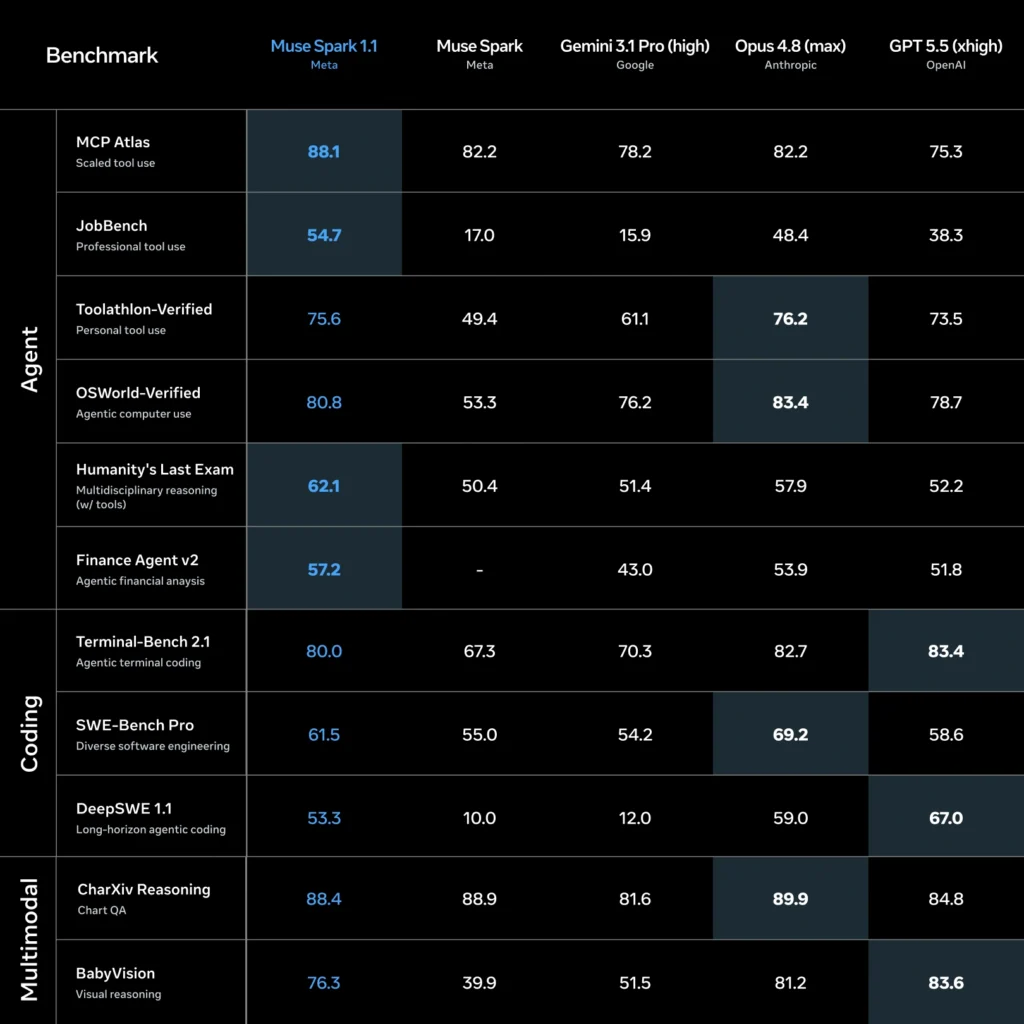
Independent benchmark reads paint a narrower picture than Meta’s own framing suggests.
Muse Spark 1.1 leads on tool-use and orchestration-focused evaluations, but on straightforward coding and multimodal reasoning benchmarks, both GPT-5.5 and Claude Opus 4.8 score ahead of it, and its long-horizon agentic performance still trails those same two models.
The more consequential news may be structural rather than technical: this is the first time Meta is charging developers to access one of its own models.
After years of Meta positioning itself as the open-weight alternative to closed labs through the Llama family, Muse Spark 1.1 launches closed, hosted, and metered through the new Meta Model API, in direct competition with the same paid-API business Anthropic and OpenAI have run for years. Meta is leaning on aggressive pricing to make that pitch land.
The model also went through safety evaluation under Meta’s Advanced AI Scaling Framework across chemical and biological risk, cybersecurity, and loss-of-control scenarios, with Meta reporting it stayed within safe margins on all three.
Read together, the two launches this week say more about Meta’s strategy than either model does alone: an image generator built to draw people in through Instagram, and a reasoning model built to keep developers paying once they’re building on top of it.
Source: Official Meta AI announcement, "Introducing Muse Spark 1.1 and the Meta Model API"