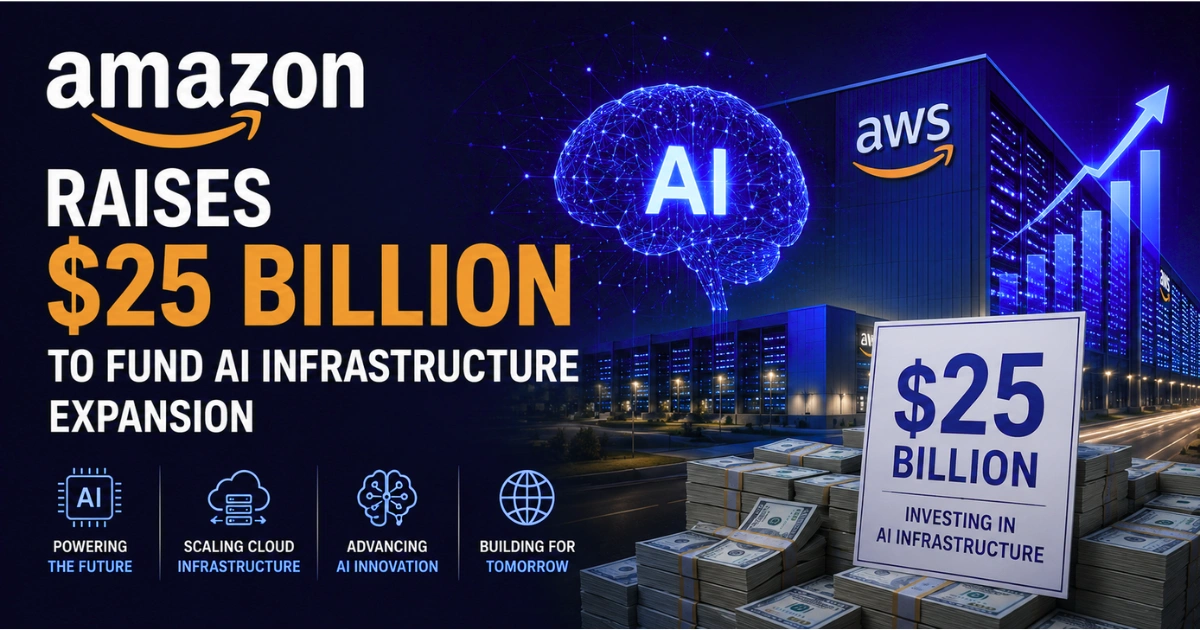

When a trillion-dollar company heads to the debt market to borrow $25 billion, the underlying motive is rarely routine maintenance. Amazon’s recent blockbuster bond sale signals an aggressive, uncompromising land grab in the artificial intelligence sector.
Capital expenditure at the e-commerce and cloud computing giant is expected to reach an eye-watering $200 billion in 2026. That is a sharp increase from $131 billion the previous year.
To put this spending into perspective, it exceeds Google parent Alphabet’s projected $195 billion to $205 billion. It also dwarfs Meta’s expected $125 billion to $145 billion budget.
At the heart of this financial strategy is a simple reality. Building the physical infrastructure needed for generative AI requires huge upfront investment. Even Big Tech companies prefer not to fund all of it from their operational cash reserves.
The Mechanics of Debt-Fueled AI Expansion
Issuing corporate bonds to fund capital expenditure (CapEx) is a standard fiscal strategy, but the sheer scale of this $25 billion raise rewrites the tech industry playbook. By tapping the debt markets, Amazon achieves a critical structural advantage.
It preserves its operational cash flow to sustain its sprawling logistics network and retail margins, while locking in dedicated capital for the heaviest lifting in modern technology: constructing hyperscale AI data centers.
These new facilities operate on a completely different paradigm than traditional cloud server farms.
They demand specialized high-density power grids, advanced liquid cooling mechanisms, and massive clusters of highly expensive custom silicon.
Building out this infrastructure fast enough to train next-generation models and host enterprise-grade AI applications requires immediate, front-loaded capital.
Recently, Wall Street investors have grown jittery about the extended timeline for AI profitability, raising concerns regarding how long it will take to generate meaningful returns on these hardware outlays.
Yet, the bond market’s willingness to quickly absorb a $25 billion issuance indicates deep institutional confidence.
Creditors are betting that Amazon’s cloud division, AWS, will generate more than enough future revenue from AI workloads to service this debt.
Jassy’s High-Stakes Bet Against the Bubble
Amazon CEO Andy Jassy is not mincing words about the risk-reward ratio of this infrastructure race. Defending the strategy to shareholders, Jassy characterized generative AI as a “once-in-a-lifetime opportunity,” explicitly dismissing industry chatter about an impending AI investment bubble.
The mechanics of this aggressive expansion are rooted in ecosystem lock-in and historical precedent. Financial analysts note that Amazon’s unprecedented spending spree is driven by the sheer fear of missing a fundamental paradigm shift.
Tech history is littered with dominant companies that hesitated during major platform transitions from desktop to mobile, or on-premises to cloud and permanently lost their market leadership. Amazon sees AI as an existential shift it cannot afford to underfund, even if the financial payoff is years away.
Jassy’s blueprint assumes that artificial intelligence will reinvent the baseline customer experience across every digital touchpoint.
By spending $200 billion in 2026 to ensure AWS has the most robust, scalable computing infrastructure on the planet, Amazon is effectively subsidizing the future of the internet.
If developers, startups, and Fortune 500 enterprises build and deploy their foundational models on Amazon’s infrastructure today, the operational switching costs become nearly insurmountable tomorrow.
The company is actively choosing the friction of heavy debt issuance and massive CapEx today to guarantee it dictates the terms of the AI economy for the next decade.
Source: The Times of India, "Amazon Sells $25 Billion in Bonds for What CEO Andy Jassy Calls 'Once in a Lifetime Opportunity'"