

At first glance, the S&P 500’s strong performance over the past two years may suggest broad economic growth. However, the reality is more complex. Beneath the index’s record highs lies a significant shift in how investors allocate capital across the global economy.
Artificial intelligence has become a major driver of market gains. Rather than lifting companies across all sectors, the rally increasingly favors a handful of businesses leading the AI race.
The global push to build AI infrastructure is reshaping corporate fortunes and concentrating investor returns. As a result, traditional portfolio diversification may offer less protection than investors expect when so much market growth depends on a relatively small group of companies.
The Mechanics Behind the AI Concentration
To understand why a small group of stocks is driving most of the market’s gains, we need to examine institutional investment and corporate spending. Investors are increasingly favoring companies that develop foundational AI models, manufacture specialized semiconductors, or provide the cloud infrastructure needed to run generative AI systems.
To see how these architectural layers interlock, understanding the AI stack across models, vector databases, and infrastructure reveals why foundational suppliers absorb the bulk of enterprise spending.
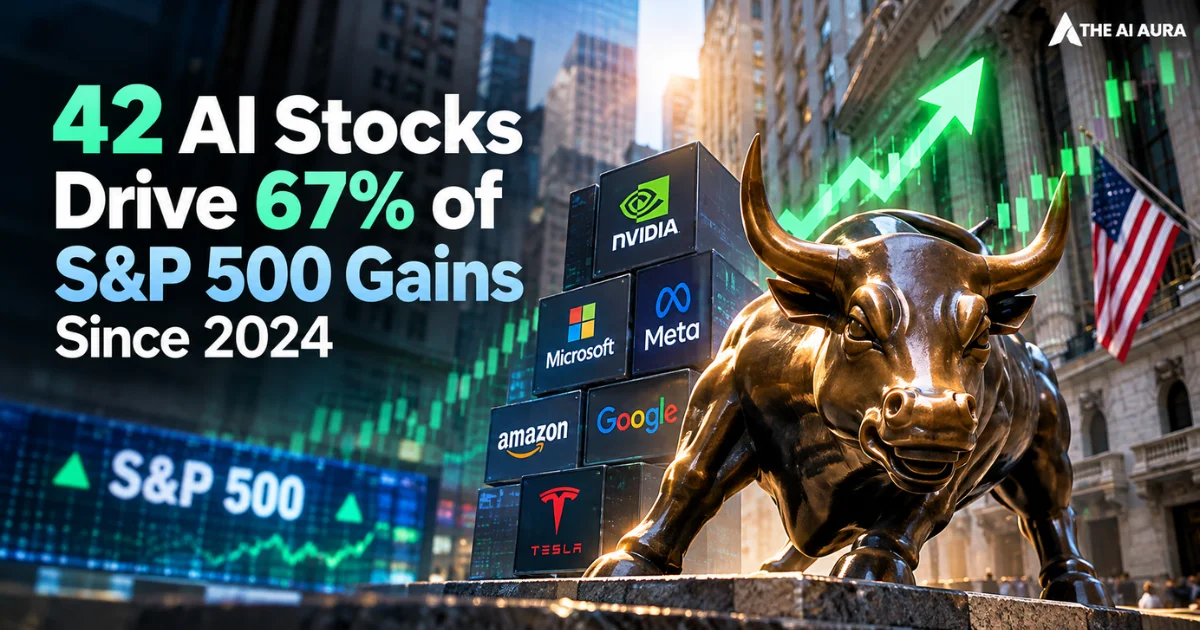
According to a recent market analysis published at Money control, just 42 artificial intelligence-linked stocks have been responsible for a staggering 67 percent of the S&P 500’s total gains since the start of 2024.
This is not a random trading anomaly. It is the direct result of a powerful feedback loop where massive upfront capital expenditures by mega-cap technology firms validate the immediate revenue streams of hardware providers, which in turn drives up their market valuations.
Institutional investors are directing substantial capital toward these businesses, attracted by the scale of spending on AI development and infrastructure. As these companies grow, their influence on the broader market increases.
The S&P 500 is weighted by market capitalization, meaning companies with larger valuations have a greater impact on the index’s performance. As these 42 AI-related stocks gain value, their price movements exert greater influence on overall returns.
This creates a reinforcing cycle. Passive index funds allocate more money to companies as their market valuations rise, further concentrating the index’s exposure to these stocks. Meanwhile, companies outside this group may contribute less to overall market gains, leaving the broader rally increasingly dependent on a relatively small number of major players.
The Disconnect Between Hype and Actual Earnings
Unlike previous technology bubbles, which often relied on speculative promises about future consumer behavior or internet growth, today’s AI-driven market concentration is supported by substantial earnings growth.
Leading companies in this sector are doing more than promoting future possibilities to investors. Many are already generating significant quarterly profits, backed by strong demand for AI chips, cloud computing, and data center infrastructure.
The market has shifted away from speculative experiments, reflecting a broader trend where the proof-of-concept era is dead and AI budgets are directed toward production-ready returns.
The stock market is showing a clear divergence as investors reassess traditional valuation metrics for AI companies. These businesses continue to exceed Wall Street’s earnings expectations, prompting investors to place greater value on their growth potential.
This trend changes how investors should evaluate their risk exposure. A standard S&P 500 index fund may appear to offer broad diversification across hundreds of companies. However, a relatively small group of technology giants and their AI infrastructure businesses increasingly drive portfolio performance.
Many other companies continue to face conventional economic pressures, including changing consumer demand and broader market uncertainty. Meanwhile, leading AI companies are benefiting from massive corporate investments as businesses race to remain competitive.
Investors are increasingly treating AI infrastructure as a major long-term growth opportunity. Strong earnings and rising demand among key players have reinforced this trend, although concentrated exposure can also increase portfolio risk if market expectations change.



