
Spiritual legacy and generative artificial intelligence recently merged in New Delhi. This event blurred lines in unprecedented ways. During the Chinmaya Amrit Mahotsav Global Sammelan, attendees saw a unique convergence.
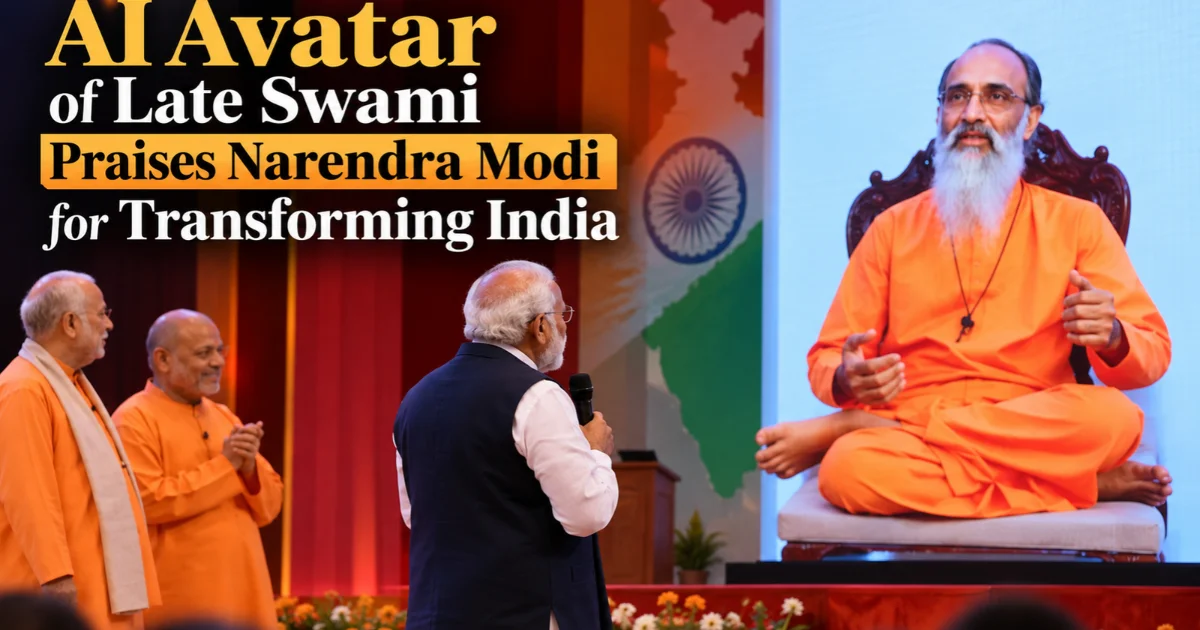
Prime Minister Narendra Modi interacted with an AI-generated holographic avatar. This avatar represented the late Swami Chinmayananda Saraswati. It was not a static video playback.
The digital likeness spoke directly to the Prime Minister. It addressed him by name and praised his administration. It highlighted efforts in transforming education and restoring temples. The avatar also noted his work fortifying the domestic economy.
The broadcast felt deeply futuristic and intensely nostalgic. Prime Minister Modi noted the profound emotional weight of this spectacle. He recalled his last physical meeting with the spiritual leader in 1993. The sheer realism made him feel transported back three decades.
The Engineering Behind Digital Resurrection
Creating a highly realistic, conversational avatar of a deceased historical figure requires a sophisticated orchestration of several underlying generative technologies. At its core, this kind of digital resurrection relies on heavy archival data processing and multimodal machine learning.
Engineers compile hundreds of hours of historical audio and video recordings to train deep neural networks. Voice cloning algorithms extract the unique phonetic inflections, cadence, and tonal warmth of the original speaker to synthesize entirely new audio that sounds indistinguishable from the real person.
Simultaneously, natural language processing frameworks are utilized to generate the dialogue. In this specific instance, the avatar’s script was heavily tailored to contemporary political milestones.
According to a detailed report on the event Siasat, the avatar went on to praise the Prime Minister for realizing the Swami’s vision with indomitable strength and courage while urging him to continue preaching the message of the Bhagavad Gita. To bring this generated audio and script into the physical space, developers rely on advanced spatial projection techniques.
This usually involves high-transparency LED mesh screens or modern variations of the classic Pepper’s Ghost illusion, utilizing angled reflective surfaces and controlled stage lighting to give the 3D rendered model a convincing sense of volume and physical presence.
The result is a seamless, lifelike apparition that maintains the visual authority of the original figure while delivering a modern, highly targeted message.
Ethical Complexities in AI-Driven Public Relations
While the technical execution of the New Delhi event is undeniably impressive, it immediately triggered a fierce debate regarding the ethical boundaries of artificial intelligence. On one side of the spectrum, tech enthusiasts and political supporters view the hologram as a brilliant cultural homage and a masterclass in modern communication.
They argue that using generative technology to keep the teachings and presence of a revered leader accessible is a massive leap forward for cultural preservation. It makes history interactive, dynamic, and visually engaging for a younger, digitally native generation.
However, this specific application of artificial intelligence crosses a delicate line for many critics. The friction arises entirely from the generated script. Putting explicitly political endorsements into the mouth of a deceased religious figure ventures into murky ethical territory.
Skeptics and opposition commentators argue that repurposing a spiritual leader’s likeness to generate political public relations and self-praise essentially strips the original figure of their historical autonomy.
Since the dead cannot consent to the words spoken by their digital replicas, utilizing their avatars to validate modern political agendas opens up a dangerous avenue for misinformation.
The underlying technology might be a marvel of modern software engineering, but it forces society to confront uncomfortable questions about who owns a legacy once a person is gone, and how easily historical neutrality can be rewritten through generative algorithms.