

We have spent the last two years navigating endless promises about artificial intelligence revolutionizing the modern enterprise. Yet, when we look past the aggressive marketing campaigns and examine actual corporate balance sheets, a glaring economic divide emerges.
The financial payoff from generative AI integration is currently highly concentrated. While the technology sector continues to reap the rewards of this compute boom, mainstream corporate America is quietly realizing that deploying large language models does not automatically translate to increased organizational output or wider profit margins.
The prevailing narrative of universal AI-driven efficiency is actively colliding with hard economic realities, revealing that massive capital investments do not inherently guarantee operational success.
The Disconnect Between Token Spending and Corporate ROI
There is a distinct, widening split in how different sectors approach the underlying cost of artificial intelligence. Venture-backed startups and the Magnificent Seven are aggressively scaling their infrastructure, driving up token consumption as they build out autonomous agentic systems and train frontier models.
For these specific organizations, revenue per worker and operational profit margins are clearly trending upward. However, the broader market landscape tells a completely different story.
Mainstream enterprises are beginning to view API calls and mounting token spending not as engines for exponential growth, but as unpredictable cost centers that actively weigh down their existing margins a core factor behind the AI cost trap: what companies don’t budget for.
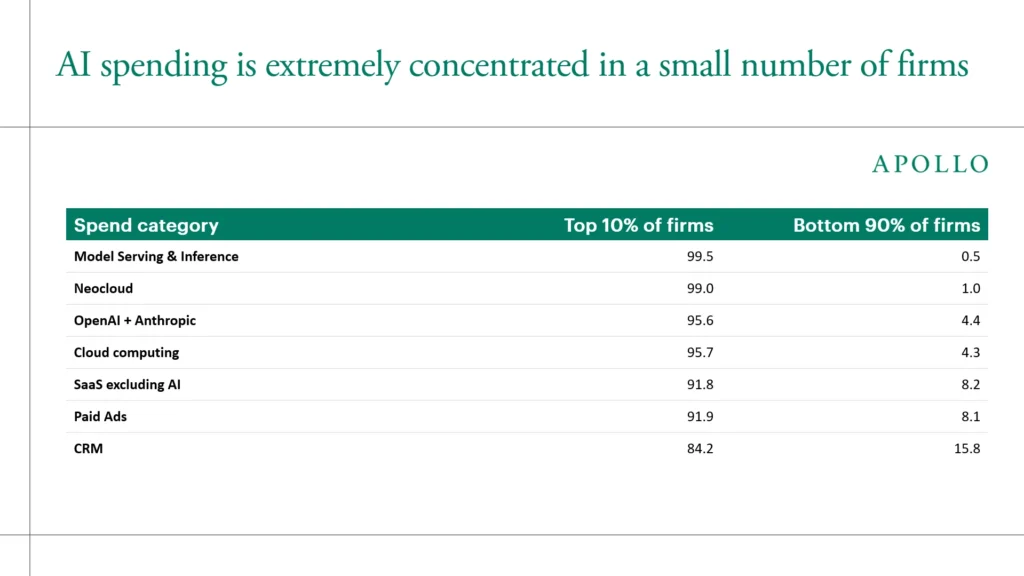
Img source: Apollo
According to recent market analysis tracking the lack of AI payoff outside the tech sector by Apollo, there are still no tangible macroeconomic signs of AI boosting aggregate productivity growth.
This leaves the S&P 493 facing completely flat revenue per worker despite their initial experimentation with these tools.
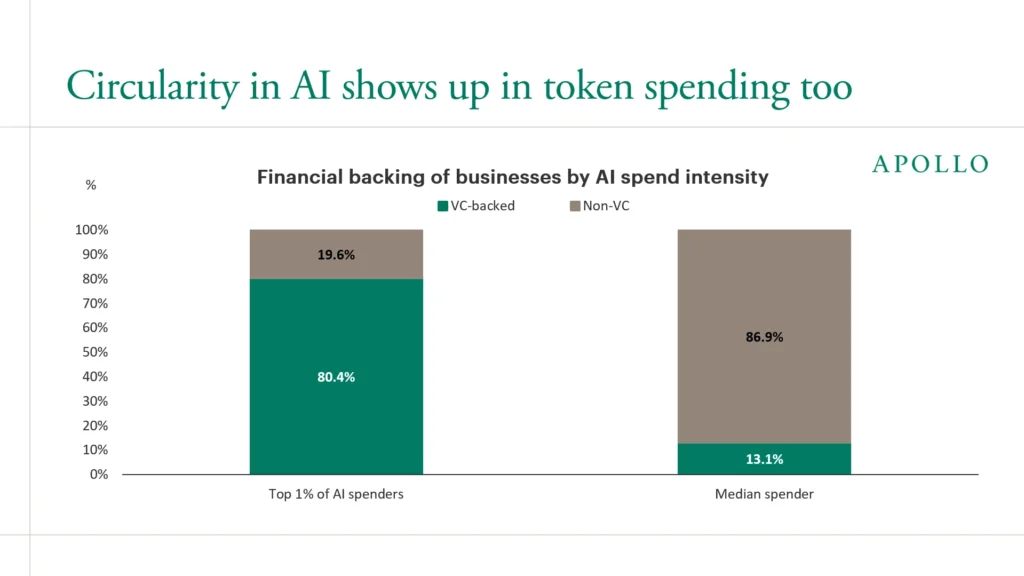
Img source: Apollo
Traditional corporate infrastructures simply do not require the massive reasoning capabilities of the newest, most computationally expensive models to handle their daily operational workflows. Consequently, leadership teams are increasingly unwilling to pay the premium required to maintain enterprise-grade access.
As long as heavy token spending and advanced agentic AI usage remain isolated within a small fraction of the tech economy, the broader macroeconomic impact of this technology will remain severely limited.
Why Raw Machine Intelligence Cannot Replace Business Context
The core architectural and strategic challenge moving forward is whether traditional corporations can eventually translate increasingly commoditized machine intelligence into actual revenue growth.
This transition is proving much harder than vendor pitches suggest because it exposes a fundamental misunderstanding of what actually drives corporate value.
Language models operate as highly sophisticated statistical calculators, but daily enterprise operations rely heavily on nuanced human judgment rather than pure logic, clearly illustrating the automation ceiling: where AI actually stops adding business value.
Making a critical business decision requires deep contextual awareness that varies drastically depending on the specific stakeholders, market conditions, and historical precedents involved.
An AI model can draft a polished proposal in seconds. However, it cannot navigate complex boardroom politics or weigh the ethical nuances of pricing changes.
Ultimately, Wall Street will not judge AI by chip sales alone. The true proving ground is the S&P 493. Until non-tech businesses bridge the gap between raw compute and practical judgment, the promised revolution remains on hold.