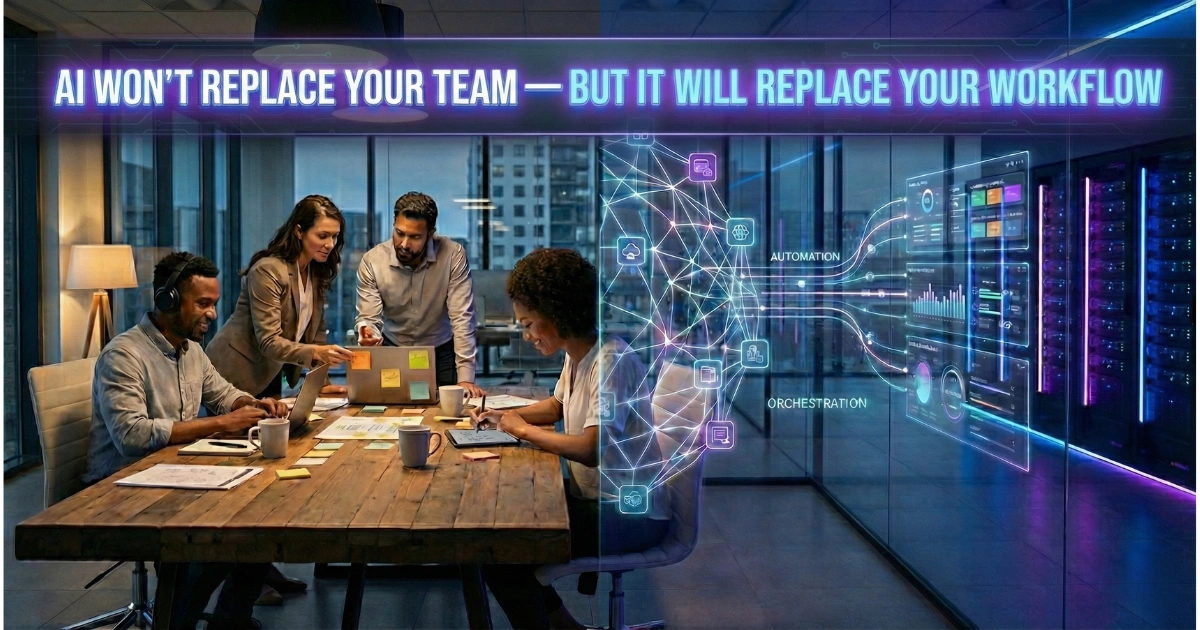
AI Won’t Replace Your Team — But It Will Replace Your Workflow

Executive Summary

The dominant anxiety among corporate leadership is that artificial intelligence will eliminate entire departments. This is a fundamental miscalculation. AI is not a wholesale replacement for human capital; it is a catalyst for workflow obsolescence.

Organizations that achieve a true AI competitive advantage do so by deconstructing legacy processes and rebuilding them around AI’s capacity for rapid data synthesis and pattern recognition.

This requires shifting human talent from generative administrative tasks to editorial, systems analysis, and strategic validation roles. Businesses that merely layer AI over existing workflows will realize marginal gains, while those that re-engineer their operational architecture will capture unprecedented efficiency and scalability.

The Real Impact of AI on Business Operations

The current discourse surrounding enterprise AI implementation is trapped in a binary of extreme job displacement or infinite productivity. Both perspectives miss the structural reality of how businesses actually operate. A company is not simply a collection of employees; it is a complex network of workflows.

Many organizations fall victim to The AI Adoption Illusion: Why Most Companies Are Doing It Wrong because they approach AI for business strategy with the intent of reducing headcount.

They purchase licenses for large language models, hand them to their teams, and expect immediate cost reductions. Instead, they encounter friction. Outputs are inconsistent, hallucinations erode trust, and the return on investment remains elusive.

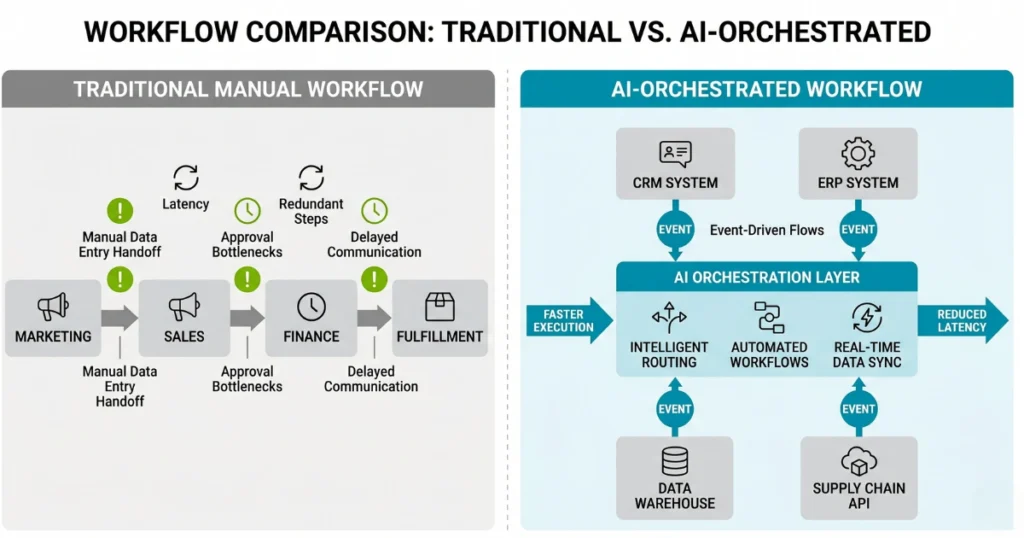
The error lies in the application. You cannot effectively insert a non-deterministic, probabilistic system into a linear, deterministic workflow without redesigning the workflow itself. True AI-driven business transformation requires atomizing your current processes, isolating the cognitive bottlenecks, and deploying AI specifically where it outperforms legacy methods.

The Core Misunderstanding in Enterprise AI Implementation

Enterprise AI implementation is the systematic integration of artificial intelligence models into core business operations to accelerate data processing, enhance decision-making, and automate repetitive cognitive tasks.

Many organizations treat AI as a plug-and-play tool, similar to adopting a new CRM. This misunderstanding leads to the “wrapper” approach: wrapping an AI chatbot around an inefficient process. If a documentation workflow takes three weeks because of complex approval routing and poor data visibility, having an AI summarize the delayed emails does not fix the underlying operational decay.

To capture value, leaders must shift their perspective from labor substitution to process re-engineering. AI excels at specific cognitive nodes—extracting entities from unstructured text, summarizing historical data, or generating initial drafts based on rigid parameters. It struggles with final-stage strategic execution, systems alignment, and guaranteeing absolute factual accuracy without human oversight.

Therefore, the objective of operational AI automation is to strip away the data-gathering and preliminary synthesis layers of a knowledge worker’s day. This eliminates the “blank page” bottleneck, signaling The End of “Blank Page Syndrome”: How AI is rewriting Business Productivity, and elevating their role to that of an analyst, editor, and final decision-maker.

Deconstructing Operational AI Automation

Operational AI automation requires breaking down complex departmental functions into micro-tasks.

When workflows are redesigned for AI, the model handles the ingestion of massive datasets to identify patterns and compile initial drafts based on historical company data. The human team member steps in exclusively for verification, alignment, and final negotiation.

Comparison: Legacy Workflow vs. AI-Augmented Workflow

Workflow ComponentLegacy Human-Driven ModelAI-Augmented ModelPrimary Benefit
Data IngestionManual reading of reports, logs, and notes.AI processes entire data repositories simultaneously.Drastic reduction in cognitive load and time-to-insight.
Initial DraftingStarting from blank pages or static templates.AI generates highly contextual first drafts based on prompts.Eliminates the “blank page” bottleneck; accelerates output.
Quality ControlPeer review loops and manual fact-checking.Human functions as an editor and systems aligner.Shifts human effort from creation to high-value validation.
Decision ExecutionHuman initiates the final action.Human reviews the AI recommendation and authorizes execution.Maintains strategic control while maximizing operational velocity.

The Invisible Bottlenecks: Context Windows, Hallucinations, and the Black Box

Building an effective AI workflow requires confronting the technical realities of the models themselves. As a systems architecture principle, integrating AI introduces new variables of risk, specifically regarding predictability and alignment.

LLMs operate as a black box—a challenge further explored in The “Black Box” Problem: Why We Can’t Audit AI. We can observe the inputs and outputs, but the exact probabilistic pathway the model took to reach a specific conclusion cannot be perfectly mapped or audited in real-time. In highly regulated or technically dense business environments, this lack of transparency is a liability.

Simultaneously, the rapid expansion of AI context windows has created a false sense of security, which is why many fall into The Token Trap: Why “Unlimited Context” is a Lie. It is now possible to feed an AI hundreds of pages of technical architecture, financial histories, or system logs. The assumption is that with more context, the model will produce flawless analysis.

This is where workflows often break. Deep context does not eliminate the risk of AI hallucinations (as detailed in It’s Just Math, Stupid: Why AI “Hallucinations” Are a Feature, Not a Bug). In fact, burying an AI in dense, contradictory enterprise data can sometimes induce hallucinations that are much harder for a human to detect because the output sounds highly authoritative.

To mitigate this, an effective AI for business strategy must mandate “human-in-the-loop” validation at critical junctures. You do not deploy AI to autonomously rewrite your technical documentation or execute financial trades.

You deploy it to parse the system architecture, identify anomalies or missing documentation, and propose the updates to a senior analyst who verifies the logic and ensures alignment, raising the vital operational question of RLHF: Who Actually “Aligned” Your AI? before it goes live.

Real-World Scenarios: Enterprise AI Implementation in Practice

Understanding workflow replacement requires concrete business scenarios where the unit economics of a process are fundamentally altered.

Scenario A: Technical Documentation and Systems Analysis

Historically, keeping enterprise software documentation up to date has been a lagging, resource-intensive process. A technical writer might spend hours interviewing engineers, deciphering code commits, and manually drafting updates to bridge the gap between human understanding and machine operation.

  • The Workflow Shift: Instead of humans hunting for updates, the workflow is inverted. From Chatbots to Agents: Why 2026 is the Year AI Does the Work for You illustrates how AI agents now monitor code repositories and ticketing systems. When a new feature is merged, the AI uses its context window to analyze the codebase changes against the existing documentation. It drafts the necessary technical updates and flags potential architectural inconsistencies. The technical writer no longer writes from scratch; they function as a systems analyst. They review the AI’s diffs, validate the logic against the product roadmap, ensure alignment, and publish. The team size remains the same, but the documentation velocity and accuracy increase tenfold.

Scenario B: Complex RFP (Request for Proposal) Responses

Enterprise teams burn thousands of hours annually answering exhaustive RFPs. The traditional workflow involves querying internal subject matter experts, digging through old proposals, and cobbling together answers.

  • The Workflow Shift: The organization builds an internal AI application grounded solely in their verified, proprietary data, avoiding broad models (a choice examined in Specialized vs. Generalist AI: Which Model Wins the Generative War?). When a 200-question RFP arrives, the AI parses the document, matches questions to the internal knowledge base, and generates a fully cited first draft in minutes. The team then reviews the document, focusing entirely on customizing the strategic narrative. The workflow transitions from an administrative scavenger hunt to a purely strategic editing exercise.

The Actionable Implementation Framework

To achieve an AI competitive advantage, executives should discard ad-hoc experimentation in favor of a structured deployment framework.

  1. Isolate the High-Friction Workflows: Do not attempt to automate your core product immediately. Identify internal operational bottlenecks characterized by high data volume, low strategic value, and high human fatigue.
  2. Atomize the Process: Map every single step of the identified workflow. Distinguish between tasks that require generative output and tasks that require definitive human judgment and systems alignment.
  3. Deploy Constrained AI Solutions: Avoid giving general-purpose AI broad access to your systems. Implement AI with narrow constraints tied to verified internal sources, sidestepping pitfalls outlined in Fine-Tuning vs. RAG: The $50,000 Mistake. Constrained environments limit the “black box” unpredictability and drastically reduce hallucination rates.
  4. Redesign the Human Role (The Validator Shift): Once the AI is handling the generative layer, explicitly redefine the expectations for your team. Their job description changes from “creator” to “validator and analyst.” Measure performance on the speed and accuracy of their editorial oversight.

Key Takeaways

  • Workflow over Workforce: AI is an infrastructure upgrade, not an automated workforce. The goal is to retire outdated processes, not people.
  • Atomization is Mandatory: Apply AI to specific cognitive tasks within a deconstructed workflow, not a general business function.
  • Embrace the Validator Model: The highest-leverage role for human employees is functioning as the critical editor, ensuring the model’s outputs align with reality.
  • Manage the Black Box: Acknowledge the probabilistic nature of AI. Design workflows that capture speed while utilizing human oversight to catch hallucinations.
  • Context Requires Guardrails: Massive context windows require rigorous data hygiene to prevent the system from confidently generating incorrect insights based on outdated internal data.

Frequently Asked Questions

What is the first step in enterprise AI implementation?

The first step is conducting a workflow audit. Identify processes bogged down by repetitive data synthesis or routine drafting. Before selecting a vendor, map the exact administrative bottlenecks where AI can seamlessly inject speed without requiring autonomous decision-making.

How does AI operational automation reduce costs?

It reduces costs by altering unit economics. Instead of paying highly skilled workers to spend hours gathering data, AI compresses these tasks into seconds. This allows the same team to manage significantly higher volumes of complex work without expanding headcount.

Why shouldn’t companies use AI to replace human workers entirely?

AI models operate as probabilistic engines; they lack true understanding, strategic foresight, and accountability. Removing humans entirely exposes the business to unmitigated risks from the black box problem, hallucinations, and deteriorating client trust.

How do we manage the risk of AI hallucinations in workflows?

Hallucinations are managed through structural guardrails. Limit the data the AI can draw from to verified internal sources, write highly constrained prompts, and mandate human-in-the-loop review for any output that triggers a final business action.

What is the most common mistake in AI-driven business transformation?

The most common mistake is applying AI to a broken legacy process without changing the process itself. If you use AI to speed up a workflow that is already inefficient or strategically flawed, you simply scale your organizational dysfunction faster.

Kavichselvan S
Kavichselvan S
Articles: 10

Leave a Reply

Your email address will not be published. Required fields are marked *