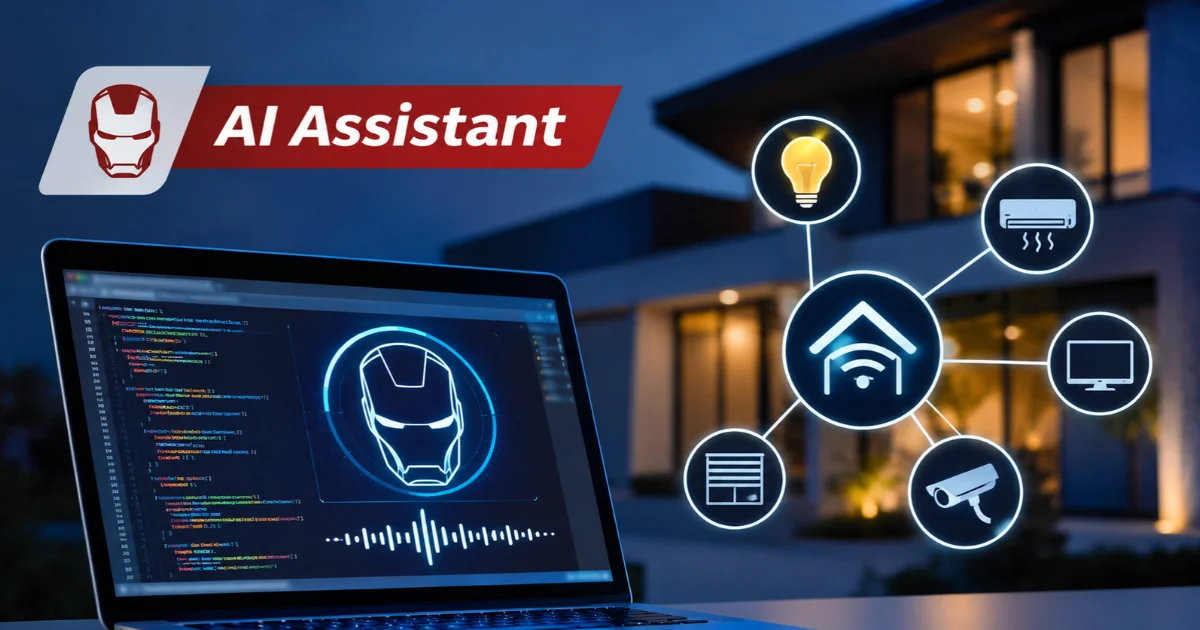

For years, moviegoers have watched Tony Stark effortlessly converse with JARVIS. This highly advanced artificial intelligence controls everything from Stark’s sprawling mansion to his armored suits.
What was once purely the domain of Hollywood special effects is rapidly becoming a tangible reality. This shift is largely driven by a new generation of self-taught developers.
Recently, a 16-year-old technology enthusiast decided that waiting for the future simply was not an option.
Driven by a fascination with the Marvel cinematic universe, the teenager engineered a fully functional, personalized AI assistant capable of managing his household through natural voice commands.
This impressive feat of smart home automation proves that the gap between science fiction and everyday consumer technology is shrinking at an unprecedented pace.
Bridging the Gap Between Hollywood and Hardware
In the blockbuster films, JARVIS serves as an invisible yet omnipresent technological butler. It processes complex verbal requests and executes them seamlessly. While millions of fans simply consume this entertainment, this young innovator viewed the fictional AI as a legitimate engineering blueprint.
Instead of settling for off-the-shelf commercial voice assistants, he set out to build a highly responsive system. These commercial systems often offer rigid, pre-programmed, and sometimes frustrating interactions.
However, his custom system is tailored exactly to his physical environment. By treating his own home as a live laboratory, the teenager bridged the massive divide between passive imagination and active coding.
Furthermore, this project moves far beyond the basic novelty of asking a generic smart speaker for the daily weather forecast. It represents a cohesive domestic ecosystem where the infrastructure actually listens, interprets, and reacts dynamically to its owner’s voice.
The sheer ambition required to design this custom framework highlights a remarkable shift. It shows how accessible advanced automation tools have become for independent developers.
The Mechanics Behind the Voice Automation
Creating a bespoke virtual assistant requires connecting disparate hardware protocols with a central processing logic. This logic must be capable of rapidly understanding human speech.
To achieve this, the teenager developed a custom automation framework that actively listens for specific vocal triggers. Then, it processes the language data and routes execution signals to connected smart relays positioned across the house.
When a command is spoken, the AI parses the audio input and determines the core intent. Subsequently, it instantly triggers the corresponding electrical switches to manage the household lighting and everyday appliances.
According to a detailed report on the young developer’s breakthrough at Times of India, this grassroots project has captured widespread attention precisely because it strips away the heavy corporate polish of major tech brands to deliver a raw, highly effective localized system.
The setup relies on a local network of smart microcontrollers integrated directly into the home’s electrical grid.
By handling a significant portion of the processing locally and optimizing the software for his specific voice patterns, the customized JARVIS system achieves the kind of rapid, low-latency response times necessary to make the interaction feel completely organic.
The software essentially maps vocal frequencies to hardcoded physical actions, allowing a simple, casually spoken sentence to dim a room, power down external devices, or shift the entire atmosphere of the house in a matter of seconds.