
Artificial intelligence is currently on a collision course with the physical limits of our global power infrastructure.
The warehouse-scale data centers required to train and run modern AI models operate on gigawatt-scale energy demands, revealing a massive hidden cost of AI in business while forcing grid operators to scramble for new power plants and sparking fierce pushback from local communities.
We are effectively trying to brute-force complex mathematical equations using classical hardware that is fundamentally inefficient for the task. The solution to this escalating energy crisis might not come from building more power generation facilities, but from entirely rethinking the baseline hardware we use to process machine learning algorithms.
Shifting the Computational Burden
The hardware pivot necessary to sustain tech advancement is already moving out of theoretical physics labs and into commercial reality. Traditional servers consume massive amounts of electricity just to manage the sheer volume of sequential calculations required for deep learning.
Every parameter checked and every node activated in a massive neural network draws power and generates immense heat, which in turn requires even more energy to run industrial cooling systems.
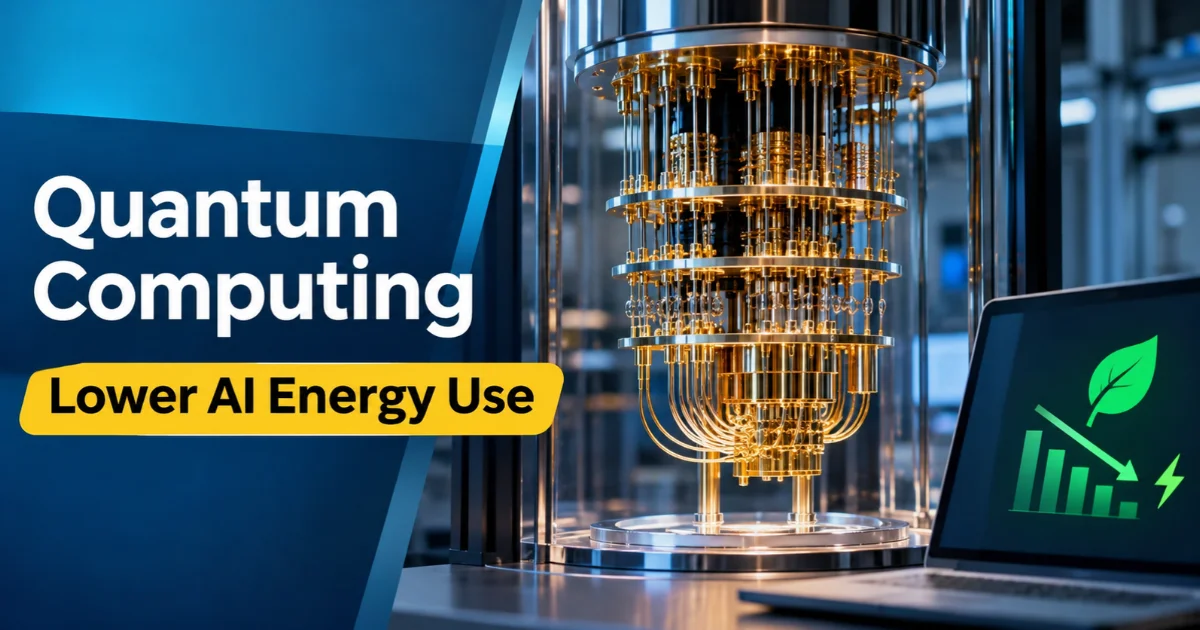
An Australian startup named Diraq has initiated a critical milestone to disrupt this cycle by installing a compact, silicon-chip-based quantum computer directly inside a commercial data center in Sydney. This represents the first real-world field test of its kind, designed to bridge the gap between academic research and everyday enterprise infrastructure.
According to a recent industry report published at Phys, this deployment signals a major shift in how the tech sector views quantum utility. Instead of treating these machines as isolated, highly sensitive research projects, engineers are actively testing how they can seamlessly integrate alongside conventional server racks.
The goal is to intelligently route specific mathematical workloads to the quantum chip, directly addressing the unsustainable grid pressure caused by the rapid expansion of artificial intelligence tools.
Silicon Chips and the Five-Year Horizon
The mechanics of why this transition is so critical come down to the nature of the math driving next-generation AI. As models become more advanced even as the industry is beginning to learn why bigger AI models don’t always mean better AI they are increasingly tasked with solving high-dimensional optimization and complex probability problems.
Classical computers struggle to handle these efficiently. They process standard bits strictly as ones or zeros. This forces the machine to calculate every possible outcome sequentially. Andrew Dzurak is the founder of Diraq.
He notes that AI models consume exorbitant power because of their math. The specific problems they solve inherently fit quantum calculations better than classical ones.
Quantum systems utilize qubits that leverage the physics principle of superposition. This allows them to exist in multiple states simultaneously. A quantum machine can process vast, multi-variable probabilities in parallel.
It solves problems in seconds that would take a classical supercomputer massive amounts of time. Furthermore, it does this with a fraction of the electrical draw. The manufacturing approach makes this particular development commercially viable. Diraq utilizes standard silicon chips.
They use the exact same CMOS fabrication techniques found in standard semiconductor manufacturing. Therefore, scaling these machines is much smoother than using highly exotic quantum technologies.
Dzurak anticipates robust silicon-based quantum hardware within five years. These machines will shoulder the heaviest computational burdens inside global data centers. This provides a realistic pathway to decouple AI advancement from its crippling energy consumption.