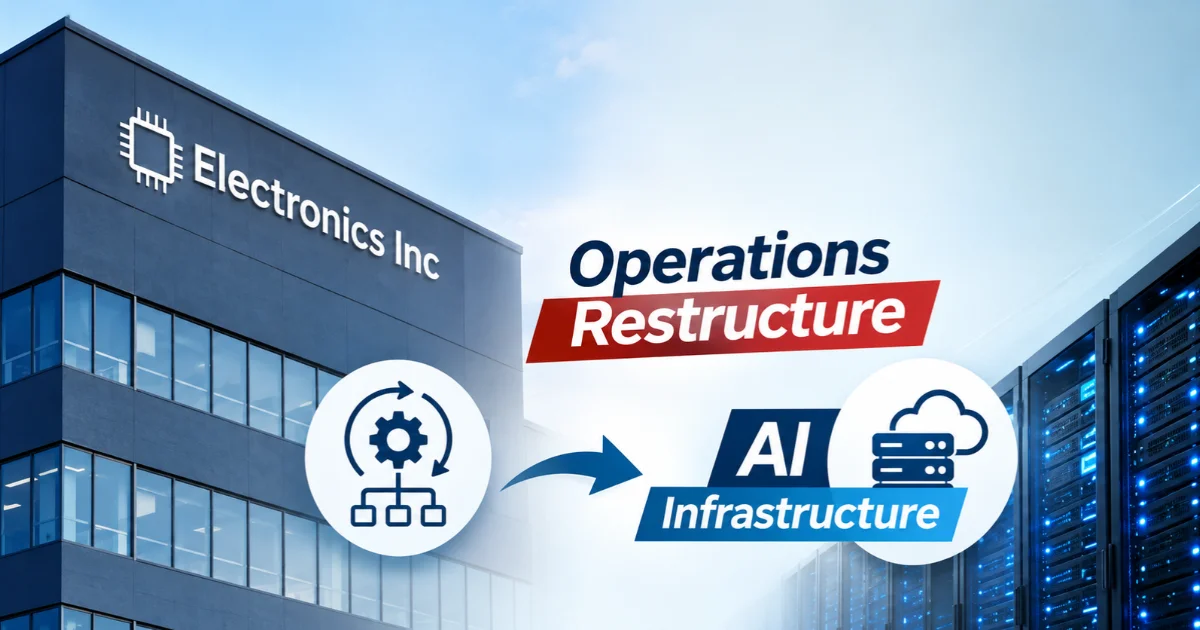

The global electronics manufacturing landscape is undergoing a massive structural pivot. The relentless expansion of artificial intelligence drives this change.
For years, consumer devices were the industry’s primary growth engines. Smartphone assembly and early semiconductor fabrication dominated the supply chain. Today, however, companies are fundamentally re-engineering production floors to meet a new reality.
The sheer computational weight of modern machine learning models requires physical infrastructure that older supply chains simply cannot support.
As a result, we are seeing a decisive move up the value chain. The focus has shifted from consumer electronics to colossal server environments. These massive servers power generative AI.
Furthermore, this restructuring is not just about producing different items. Instead, it completely reimagines factory environments. These next-generation data processing facilities demand incredible precision, scale, and complexity. Consequently, manufacturers are pouring capital into retooling lines.
They are also aggressively retraining their workforces. They bet heavily that enterprise AI will soon dwarf traditional consumer tech.
Shifting the Value Chain Toward Data Centers
Building the physical backbone of artificial intelligence requires solving massive engineering bottlenecks, the most pressing of which is thermal management.
AI processors, particularly graphics processing units running complex training algorithms, generate an extraordinary amount of heat, making legacy server cooling systems entirely obsolete.
Recognizing this structural shift, major electronics manufacturers are aggressively pivoting their commercial operations to meet the surging global demand for specialized environmental infrastructure.
Multinationals like Samsung and LG, alongside established regional players such as Voltas, Blue Star, and PG Electroplast, have essentially retooled their heavy equipment production lines to enter the market for specialized heating, ventilation, and air-conditioning systems.
These are not standard commercial HVAC units, but highly engineered liquid and air cooling controls critical for preventing catastrophic hardware failures in dense AI data centers.
According to recent market analysis published at The Economic Times, these specialized components are being rapidly developed to cater to both skyrocketing domestic infrastructure needs and lucrative export markets.
This operational pivot reflects a deeper strategic realization among hardware executives: controlling the auxiliary infrastructure of AI computing is proving to be just as profitable as manufacturing the silicon itself.
By focusing on the environmental stability of these massive facilities, electronics firms are securing long-term enterprise contracts.
The Optical Domain and Global Export Strategy
The restructuring of electronics manufacturing operations goes far beyond advanced cooling systems, extending deep into the very physical layer of how data is transmitted between server racks.
As AI models grow exponentially larger, the traditional copper wiring used in older data centers creates unacceptable latency bottlenecks. Consequently, the entire networking technology stack is now shifting toward the optical domain.
Data must travel via light over advanced fiber optics to achieve the sheer bandwidth and speed required for real-time machine learning inference and model training.
Industry leaders have pointed out that the most significant buoyancy in electronics manufacturing today is firmly rooted in this transition.
To capitalize on the optical networking boom, production facilities are significantly upgrading their clean rooms, precision assembly protocols, and testing environments to handle delicate photonics, transceivers, and high-density server architectures.
This represents a highly calculated move by manufacturers to capture a substantial share of the global supply chain before vendor lock-in occurs.
By building out this deeply specialized manufacturing capacity right now, regional industries are successfully setting the stage to become dominant export hubs for the exact hardware the rest of the world is desperately trying to acquire.