
Most medical AI systems built over the past three years share the same fundamental architectural flaw. They operate as monolithic data-processing engines relying on a blunt, all-at-once approach.
Developers typically feed them a massive dump of a patient’s symptoms, historical lab results, and imaging studies, expecting the model to instantly synthesize an accurate diagnosis.
While this looks impressive in a controlled sandbox demo, it fundamentally misunderstands how clinical medicine actually functions in the wild. Medicine is not a static data extraction problem. It is a dynamic, sequential investigation.
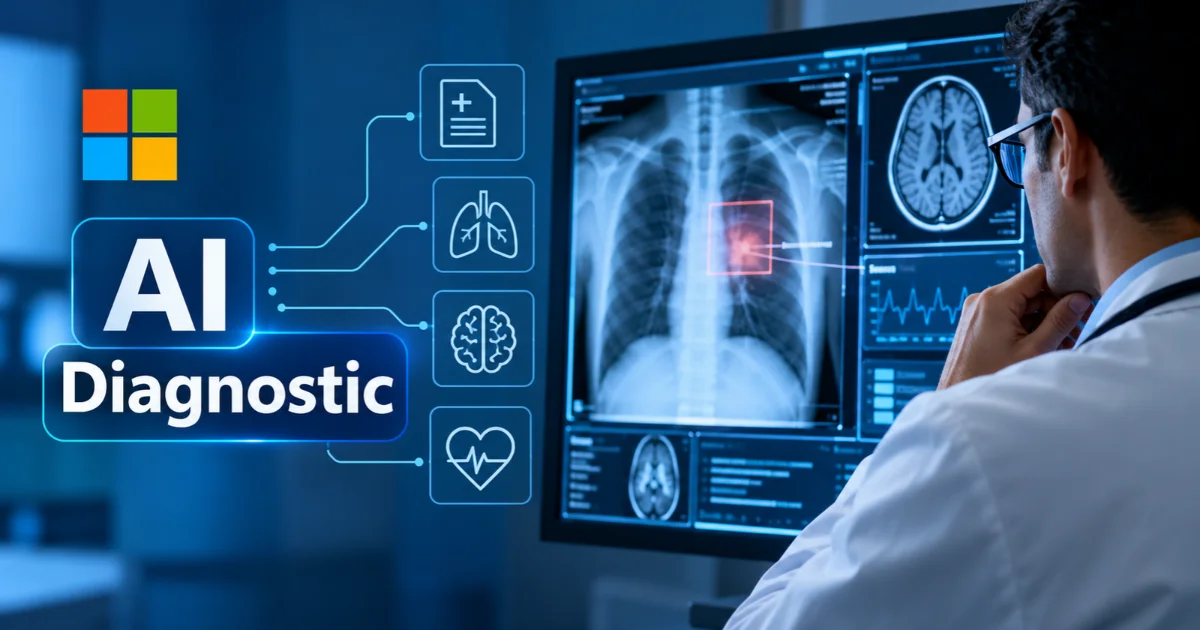
Microsoft is finally forcing a necessary pivot in this space. Their latest diagnostic model abandons the single-pass prompt architecture in favor of something much closer to actual human clinical reasoning.
Instead of trying to guess the disease from a disorganized data dump, the system acts as an orchestrator, coordinating a simulated panel of clinical experts to work through complex cases step by step.
The Mechanics of Sequential Orchestration
The core engineering breakthrough here is the transition from passive pattern matching to active inquiry. When a patient presents a problem, the AI orchestrator does not immediately jump to an endpoint.
It first decides what specific historical questions need answering. Based on those isolated variables, it identifies exactly what physical exam findings would be significant. Only then does it determine which diagnostic tests to order.
This dynamic routing is critical because it mirrors the actual friction of a hospital floor. The system evaluates incoming test results in real time, updates its working hypotheses, and pivots its plan if the new data contradicts its initial assumptions.
According to a recent study covered by Reuters, this orchestrated step-by-step approach proved more than twice as accurate as general physicians when tasked with solving over 300 highly confusing medical dilemmas.
The model also consistently outperformed human doctors when tested against complex scenarios pulled directly from major emergency room admission databases.
The industry has spent years testing legacy AI models against multiple-choice medical exams, completely ignoring the reality of the clinical environment. Dr. Dominic King, corporate vice president of the health unit at Microsoft AI, accurately pointed out the absurdity of these textbook benchmarks.
Hitting a perfect pass rate on a structured exam means very little when dealing with a live emergency room admission. Real patients never arrive with perfectly summarized case histories. They arrive with fragmented, contradictory information that requires deliberate, methodical interrogation to untangle.
This evolution mirrors a broader shift across the industry exploring AI agents vs prompt engineering shows why static inputs fail in unpredictable environments where multi-step reasoning is required.
Real-World Economics and Diagnostic Efficiency
This architectural shift does more than just boost diagnostic accuracy on paper. It fundamentally alters the operational economics of patient care. When an AI model processes everything at once, it often triggers a shotgun approach to testing. An orchestrator framework forces judicious resource allocation.
Because the system actively dictates its scope based on sequential reasoning, it avoids unnecessary downstream testing. The research data indicates that the overall diagnostic process costs significantly less when the orchestrator is in control of the clinical work-up compared to a human physician.
The system does not order a blind panel of bloodwork or an immediate MRI just because a symptom is vague; it orders the specific localized test required to validate or eliminate its current leading hypothesis.
Harsha Nori, head of AI at Microsoft AI Health, noted that the true metric of success isn’t just raw accuracy, but how carefully the system navigates the entire diagnostic sequence. This is where enterprise AI in healthcare must head to survive deployment. We are moving past the era of simple chat interfaces guessing at medical conditions based on probability algorithms.
Understanding how to build reliable AI agents in production highlights the importance of dynamic coordination, state management, and error correction.
By structuring the AI to tackle problems sequentially through a simulated expert panel, Microsoft is deploying an architecture that respects the mechanical realities, operational costs, and inherent friction of real-world medicine.