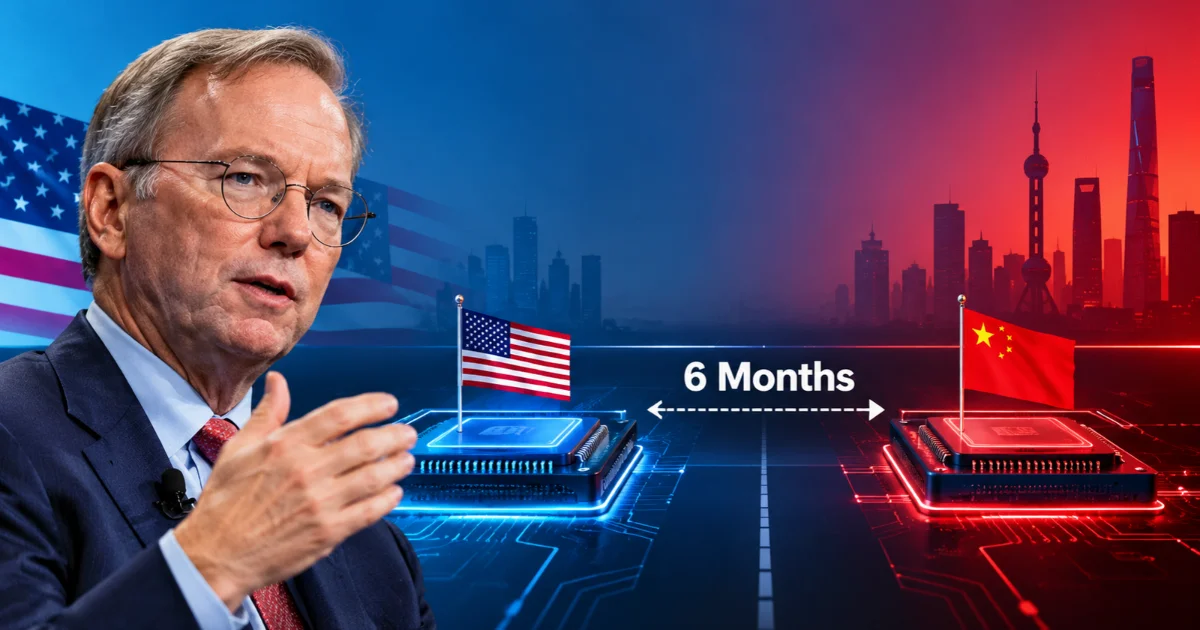

The global artificial intelligence landscape often looks like a clear-cut contest where the United States holds a comfortable lead. However, former Google CEO Eric Schmidt recently shattered this narrative. Speaking on a recent podcast, Schmidt offered a sobering reality check.
China now sits merely six months behind the US in frontier AI capabilities. Just a short time ago, industry insiders estimated this gap at one to two years. Rapid Chinese acceleration has fundamentally altered the competitive timeline. Yet, raw technical capability tells only half the story.
Schmidt’s assessment alarms Western tech giants for another major reason: completely different rollout strategies. American companies focus on massive, expensive subscription models.
They want to recoup billions of dollars spent on infrastructure. In stark contrast, Chinese developers prioritize rapid adoption over immediate profits. This playbook could upend the global software market and disrupt premium incumbents.
The Threat of the Free AI Business Model
The most disruptive element of this international tech rivalry lies in the pricing structures being exported to the rest of the world. Chinese tech firms are aggressively rolling out highly capable artificial intelligence tools at virtually no cost to the end user.
This aggressive approach is designed to capture market share rapidly, particularly in emerging markets where premium subscriptions are simply out of reach for average consumers and local businesses.
According to coverage of Schmidt’s remarks detailed by The Times of India, the former executive bluntly noted that if Chinese developers remain even slightly behind the bleeding edge but offer their products for free, the US is already losing the adoption war.
This dynamic is amplified by the proliferation of open-weight models, reigniting the debate over open vs closed AI models and which architecture will dominate global distribution.
When a user or a business in a developing economy has to choose between a costly Western AI subscription and a remarkably capable Chinese alternative that costs nothing, the choice becomes strictly economic rather than technological.
Businesses evaluate software investments by comparing them to human labor costs. If an enterprise can deploy a highly functional AI agent for free, the absolute superiority of an American model becomes largely irrelevant. The focus shifts entirely from having the smartest system in the room to having the most accessible one.
How China Closed the Gap So Quickly
Many geopolitical analysts believed US export bans on advanced chips would halt China’s AI progress. Schmidt argues this barrier remains porous. Cutting-edge hardware continues to enter the country through diversion and smuggling channels.
More importantly, Chinese teams mastered AI model distillation. They query advanced Western systems and use those answers to train their own models. Through this shortcut, they leapfrog years of foundational research. Clever software engineering shrank a multi-year lag into mere months.
While some Wall Street skeptics continue to label the current artificial intelligence boom as a speculative bubble, Schmidt strongly disagrees. Pointing to the massive revenue growth of companies like Anthropic, he argues that the financial performance is driven by concrete customer demand rather than empty hype.
The money is real, and the utility is undeniable. For organizations navigating this evolving landscape, establishing a clear AI strategy for businesses will be essential to capitalize on practical tools without wasting budget.
Ultimately, the global AI race might not be won by the company that builds the most expensive, hyper-advanced system. It is much more likely to be dominated by developers who can deliver practical, cost-effective solutions, proving that accessibility will always rival pure performance on the global stage.