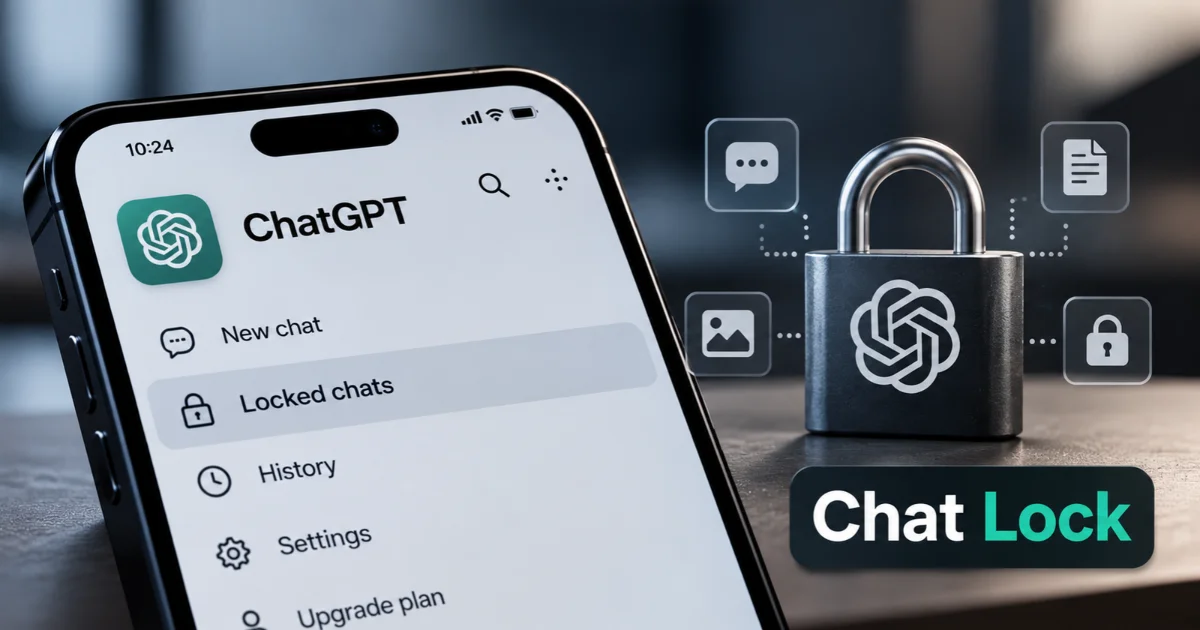

We treat large language models as digital confidants. Daily, we pour unpolished business strategies, sensitive code snippets, and private inquiries into the prompt box. Yet the devices we rely on remain inherently social. Handing an unlocked phone to a colleague or family member can quickly trigger privacy concerns if confidential project details appear on screen.
OpenAI recognized this friction between shared hardware and personal data privacy. To solve it, the team rolled out a new safeguard. Users can now lock specific conversations behind a secure barrier. This feature keeps sensitive dialogues hidden, even when someone else handles your unlocked device.
The setup relies entirely on native device security rather than new credentials. You can secure these sessions with a custom four-digit PIN or standard biometric authentication, such as Face ID and Touch ID. It represents a vital evolution for a tool that quickly grew from a novelty chatbot into an indispensable personal and professional utility.
The Architecture of Partitioned Conversations
This new system operates differently than the ephemeral Temporary Chats function, which leaves no trace once the window closes. A secured thread remains fully persistent, allowing you to return to the dialogue days or weeks later.
When you apply the lock, the conversation is immediately migrated off the primary interface into a dedicated repository. It vanishes from your standard chat history, pinned lists, and even the internal search index.
The most compelling engineering choice here involves how the model handles contextual memory. The developers essentially built a walled garden for machine memory. Context provided inside a secured space updates a localized memory bank that operates independently from your primary profile.
That means highly specific, sensitive details discussed in private will never spontaneously leak into your everyday prompts a major relief given the complexities of how AI memory works and why chatbots forget or retain information.
According to a recent breakdown by TechCrunch, if you ever decide to reset the PIN, the system triggers a permanent deletion protocol that instantly wipes all protected chats, uploaded files, and stored context tied to that specific passcode. It functions as a rapid kill switch for localized data.
Security Boundaries and Enterprise Realities
While this interface update provides immediate relief against shoulder surfing and casual snooping, it is crucial to understand where the privacy perimeter actually ends. Placing a PIN on a conversation does not transform the application into an encrypted vault.
The update does not introduce end-to-end encryption, nor does it modify OpenAI’s underlying data retention timelines. For developers and enterprises monitoring technical vulnerabilities, broader safeguards are covered in our breakdown of AI security, prompt injection, and preventing data leaks.
If you have your settings configured to allow your inputs to train future iterations of the model, securing the thread locally does not override that permission. The server-side reality remains identical to a standard public chat.
The rollout spans almost the entire ecosystem, reaching users on the Free, Plus, Pro, Business, Enterprise, and Edu tiers. However, the system architecture dictates several logical exclusions.
You cannot secure active group collaborations, sessions generated from shared web links, or environments actively handling scheduled tasks and meeting recordings.
Notably, the Healthcare tier is entirely excluded from this update, likely because organizations operating under strict HIPAA compliance require far more rigid, top-down administrative controls rather than user-managed local locks.
This addition is a highly effective usability upgrade for managing local physical access, provided users understand it is an interface shield rather than a cryptographic one.