
The landscape of open-weight speech models is aggressively competitive right now. Enterprise developers constantly weigh transcription accuracy against hardware demands.
I have been closely tracking this space, and the recent introduction of Granite Speech 5.0 2B by IBM represents a calculated shift toward practical deployments.
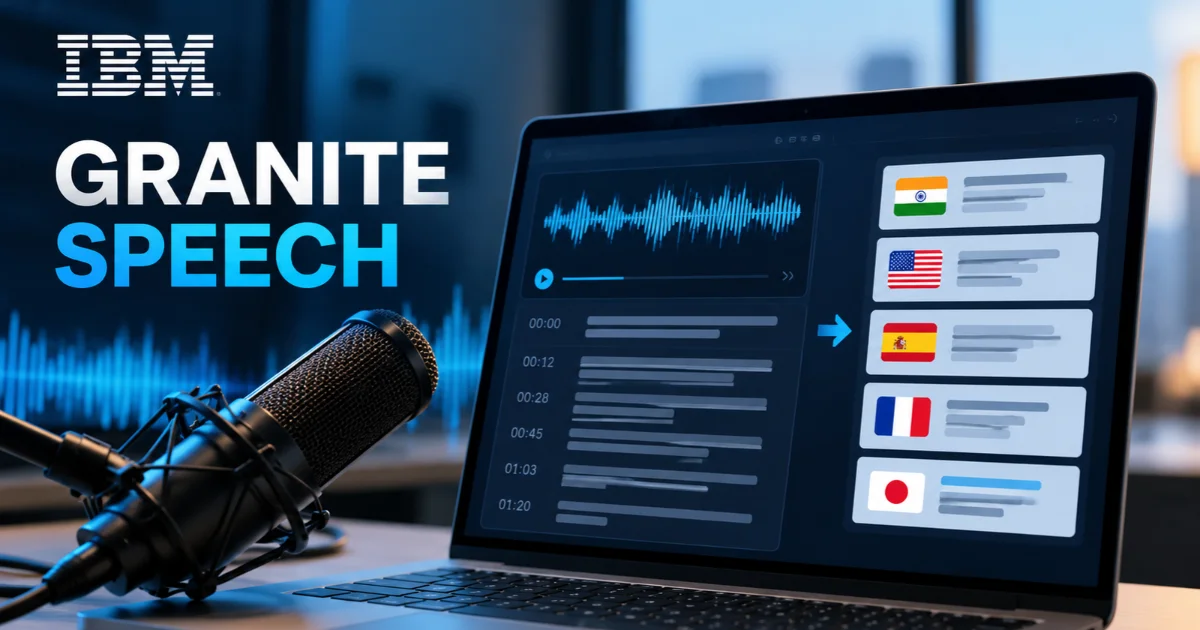
Unlike massive closed-source models that require heavy cloud dependencies, this two-billion parameter model ships under the permissive Apache 2.0 license. What makes this release relevant for enterprise builders is its dual focus on transcription and translation across six core languages.
It is not just about raw accuracy anymore. It is about building an architecture that runs efficiently where developers need it most. IBM recognizes that modern AI pipelines demand flexibility, so they optimized this model to handle complex audio environments without demanding excessive computational power.
Architectural Mechanics Behind the Acoustic Processing
Achieving this level of performance with a compact two-billion-parameter model requires an efficient architecture. The system relies on three primary components.
The first is a speech encoder built from 16 Conformer blocks trained using Connectionist Temporal Classification (CTC). It uses block attention over four-second audio windows to establish a strong acoustic baseline.
The next component is a two-layer window Q-Former. It projects and downsamples the acoustic embeddings by a factor of 10.
This reduces the computational load while preserving important audio information. As a result, the embeddings reach the large language model (LLM) backbone at a manageable rate of 10 Hz.
The backbone is based on an intermediate checkpoint of the Granite-4.0-1B-Base model, which IBM has extensively modified. The company extended its context window to 16,000 positions using YaRN. It also refined the pipeline with Low-Rank Adaptation (LoRA) adapters.
Together, these architectural improvements enable the model to process audio segments of up to two minutes natively. They also help it maintain a strong contextual understanding of spoken content.
Training an architecture like this requires massive, diverse datasets to prevent the model from failing in noisy, real-world environments. IBM pushed this system through three hundred and ninety thousand hours of public audio, deliberately mixing in synthetic data to aggressively target challenging areas like Japanese speech recognition and complex translation tasks.
The results of this training regimen are highly competitive in the current open-source ecosystem, particularly when compared against existing AI transcription tools for interviews and meetings.
According to a recent release overview on MarkTechPost, Granite Speech 5.0 2B achieves a 5.68 percent average English Word Error Rate on the Open ASR Leaderboard, officially securing the number two spot among open-weight models.
The model particularly shines in its keyword biasing capabilities, allowing developers to feed it lists of up to two thousand specific terms like niche product names or complex corporate acronyms to actively steer the transcription accuracy.
Even when faced with challenging acoustic environments or distant microphones, the model manages to maintain high fidelity, proving that the focused synthetic data training successfully bridged the gap between clean laboratory audio and messy real-world recordings.
Real-World Deployment and Hardware Adaptability
The true test of any open-weight model is how easily engineering teams can integrate it into existing software stacks. IBM has ensured that this release is incredibly versatile across different hardware profiles, breaking away from strict data center requirements.
For engineering teams exploring how to deploy an LLM application to production successfully, the model runs smoothly on standard GPUs using Transformers or vLLM, but it also natively supports Apple Silicon through mlx-audio.
For teams needing hyper-local, offline deployments, it executes efficiently on local CPUs via the llama.cpp GGUF format. Eight-bit quantization is recommended here to retain accuracy on longer audio files.
Alongside the primary model, IBM updated its broader ecosystem. They refined the edge-focused Turbo CTC model to process seven languages with high real-time factors in throughput.
They also deployed a drop-in weight update for their diarization model, reducing timestamp shifts and long-form error rates. This multi-tiered approach gives developers an adaptable toolkit for edge computing and conversational analysis.