
The artificial intelligence landscape is currently stuck in a frustrating phase of fragmented experimentation. Walk into almost any major enterprise today, and you will find isolated AI workflows operating strictly on the margins.
A specialized generative model handling customer service queries here, a predictive analytics tool forecasting supply chain bottleneck there. While these isolated deployments certainly deliver immediate value, they only scratch the surface of what is computationally possible, resulting in marginal gains rather than total transformation.
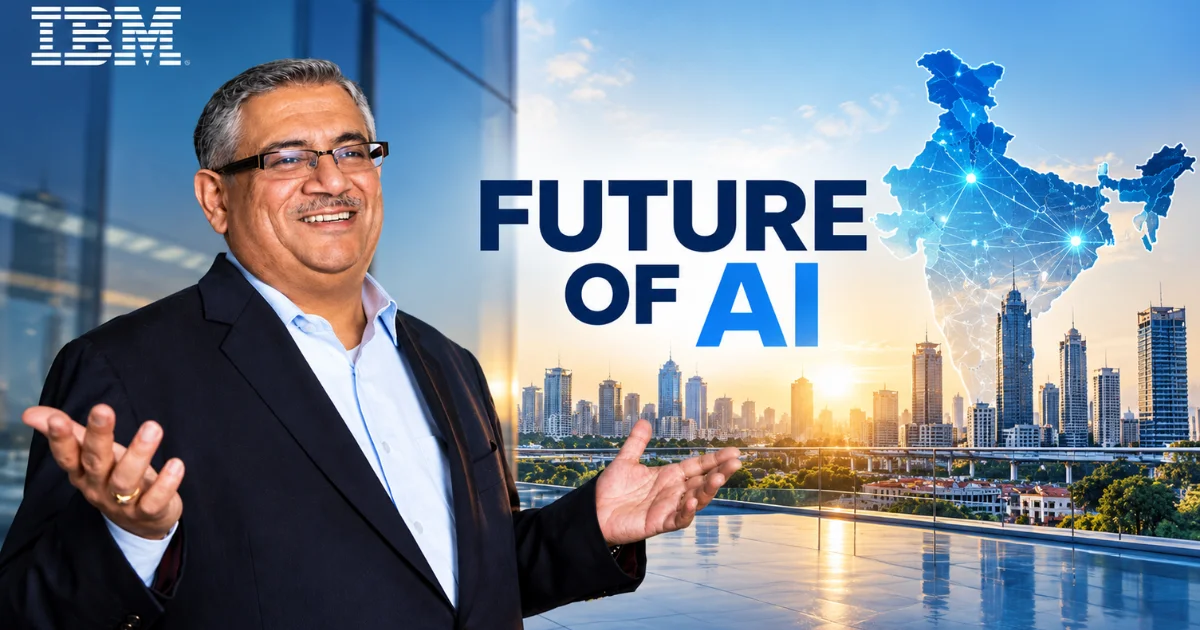
Speaking at the IBM Think 2026 event in Mumbai, IBM India and South Asia Managing Director Sandip Patel articulated a much larger, more aggressive vision for the subcontinent.
We are still at day zero of this technological revolution, and capturing its full potential requires addressing the systemic disconnect where why most companies are doing AI adoption wrong leaves them trapped in endless pilots.
According to recent coverage at People matters, detailing Patel’s keynote address, the country sits at a defining juncture to dictate the trajectory of exponential technologies because building for a billion-plus population inherently forces technical solutions to scale globally.
Redesigning the Enterprise Around Autonomous Systems
The companies that ultimately dominate the next decade will not win simply by licensing more frontier models or throwing raw computing power at legacy software. Winning demands a complete architectural redesign centered entirely around autonomous agents and real-time data streams.
Right now, a significant bottleneck in enterprise AI deployment is the heavy reliance on stagnant information. A fraud-detection agent processing yesterday’s batch data is practically useless against today’s dynamic threat vectors, regardless of how sophisticated its underlying neural network might be. Overcoming this friction requires fusing data at rest with data in motion, ensuring insights do not lose their value within nanoseconds.
This operational shift explains why massive infrastructure moves designed to unite varied data states such as the integration of platforms like watsonx.data are critical for maintaining governed, instantaneous information flows across all application layers.
Instead of treating artificial intelligence as a bolt-on accessory, organizations must weave it into the very fabric of their hybrid architectures. It means transitioning from human-prompted tools to proactive, AI-led business models where enterprises implement patterns to build reliable AI agents that work in production, enabling systems to autonomously communicate, execute complex decisions, and optimize workflows.
This level of automation heavily depends on building unshakeable trust in the underlying infrastructure. As models ingest increasingly sensitive operational data, the security vulnerabilities scale just as exponentially as the system’s capabilities.
Operationalizing Digital Sovereignty and Ecosystem Growth
That inherent risk brings us to a critical operational concept Patel aptly refers to as “digital swaraj,” or digital sovereignty. Business leaders are growing increasingly anxious about shifting geopolitical winds and regulatory frameworks that could suddenly restrict access to vital cloud operations. True digital sovereignty is not merely a political talking point; it is a strict enterprise mandate.
Organizations need granular control over their operating environments, data residency, and AI execution layers without sacrificing the agility required to iterate. Technologies designed around sovereign cores provide this exact balance, ensuring that privacy and localized oversight act as catalysts for secure scaling rather than technical bottlenecks.
To cement this localized control and foster homegrown innovation, IBM is actively embedding its architecture into India’s grassroots technology sector. A newly minted memorandum of understanding with the MeitY Startup Hub aims to aggressively accelerate deep tech development, pushing beyond established metropolitan hubs to identify technical innovators in Tier 2 and Tier 3 cities.
Founders tapping into this ecosystem gain direct access to enterprise-grade tools, ranging from the watsonx platform to specialized enterprise tools like IBM Bob and the AI-ready Sovereign Core software stack.
By focusing heavily on sovereign AI innovation and open-source ecosystem development, this collaboration effectively creates a proving ground for complex enterprise proofs of concept.
The immediate objective is to build secure, indigenous deep tech capabilities that address local national challenges while simultaneously engineering autonomous solutions robust enough to export to the global market.