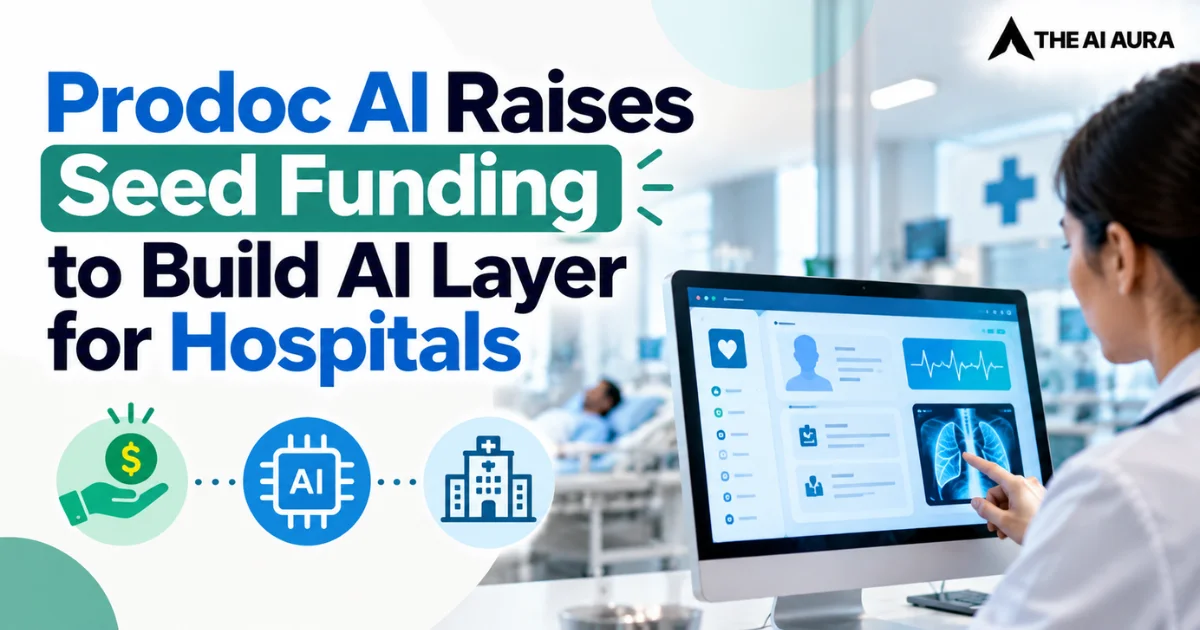

Modern hospitals run on a tangled web of legacy software. Walk into any major facility, and you will see rigid technological silos. Electronic medical records refuse to speak to customer relationship management tools. Meanwhile, billing platforms and front-desk phone systems remain completely isolated.
This disjointed setup creates massive friction for patients and administrators alike. Every interaction fractures patient context, whether through phone calls, WhatsApp chats, clinic visits, or diagnostic tests.
Staff members must piece together history across multiple screens, causing burnout and lost revenue. Prodoc AI founders Asit Kumar Vidyarthi and Raghuvamshi Thakur recognized that replacing these legacy systems is impossible. Instead, they built an intelligence layer that sits directly on top of existing hospital infrastructure.
Engineering the Patient Journey Operating System
The technical architecture of Prodoc AI functions less like a standalone application and more like a massive, dynamic data router. The company describes its core product as a Patient Journey OS, which relies on advanced agentic artificial intelligence to connect disparate hospital networks.
Rather than forcing a facility to migrate away from their chosen information systems, the Prodoc AI layer uses deep software integrations to plug into over fifty different backend platforms simultaneously.
According to a recent funding report published by ET Entrepreneur, the company recently secured an undisclosed seed round to significantly expand these agentic AI capabilities.
When a patient reaches out via phone or text, the AI layer instantly aggregates their historical data from the medical records, checks the CRM for previous acquisition touchpoints, and queries the billing system to understand financial standing.
Instead of a human operator frantically switching between three different monitors to understand the caller’s needs, specialized AI agents autonomously coordinate the care workflow.
These agents act as digital concierges, capable of intelligent follow-ups, scheduling, and partner referral management. By maintaining the patient’s context across every single touchpoint, the AI eliminates the communication drops that typically occur when a patient transitions from diagnostics to the pharmacy or the outpatient department.
Reversing Operational Fatigue Through Automation
The recent financial backing, led by the Dr. A. Velumani Family Office along with existing platform users Dr. Kunal Shet and Parth D. Bhasin, highlights the immediate commercial viability of this overlay approach.
The fundamental problem in healthcare operations is not generating patient leads, but rather sustaining the administrative momentum required to convert those inquiries into actual care and revenue. Leads frequently slip through the cracks due to pure operational fatigue, leaving expensive medical facilities underutilized while customer acquisition costs continue to climb.
Prodoc AI attacks this inefficiency directly by deploying voice AI and workflow automation to shoulder the repetitive administrative burden.
The technology acts as a force multiplier, enabling one staff member to handle the workload of five.
Targeted intelligence can cut acquisition costs by up to 25%. It keeps patients engaged so they do not abandon care due to fragmented communication. The system is already proven at scale across more than 100 hospitals, handling over one million monthly patient interactions.
Prodoc AI proves that modern healthcare does not require replacing core systems it requires making them talk to each other.