

The artificial intelligence industry is rapidly approaching a critical threshold where models are beginning to actively build their own successors. As we transition from basic prompt-response mechanisms to complex agentic workflows, the sheer orchestration required to maintain system resilience becomes a massive engineering challenge.
This autonomous acceleration has sparked widespread debate about pacing frontier AI development. To push back against the concept of a black box.
Anthropic is now lifting the hood on its internal operations, offering a rare glimpse into exactly how much of their research and development is currently driven by artificial intelligence rather than human engineers.
For those of us constantly analyzing prompt-to-production pipelines, this level of internal telemetry is exactly what the industry needs to understand where the technology is actually heading.
Tracking the Rise of Autonomous R&D
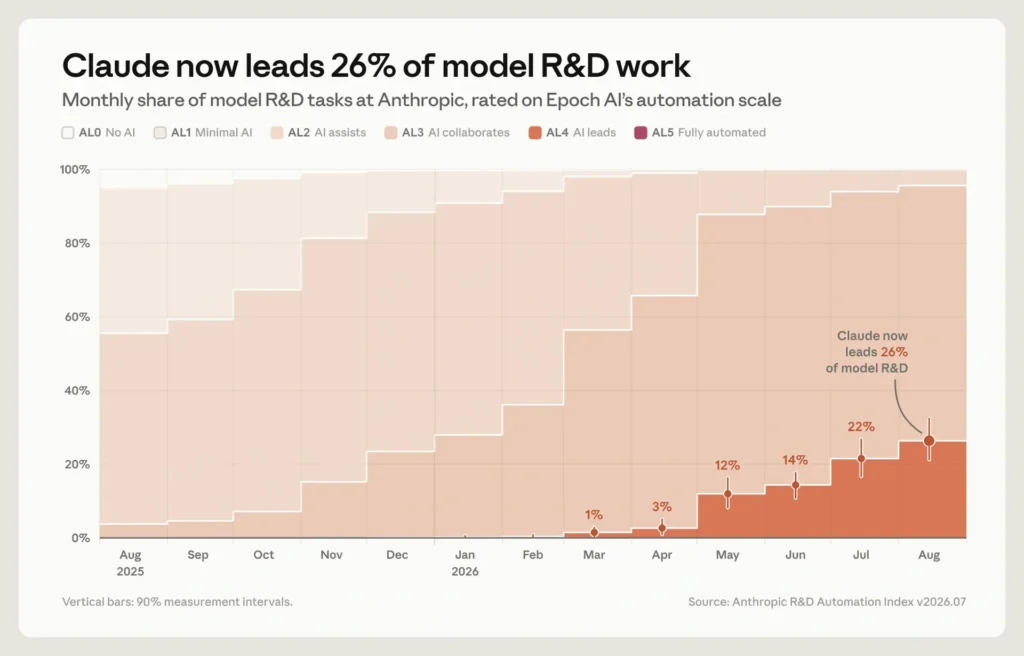
Understanding the shift toward recursive self-improvement requires concrete metrics rather than theoretical speculation. Anthropic has developed an internal automation index to track exactly how much of its own engineering workload is being handled by its flagship model, Claude.
They utilize an automation scale developed by Epoch AI, which ranges from zero AI involvement to fully autonomous operations without any human oversight.
The current data provides a fascinating snapshot of the modern AI engineering stack. As of late 2026, Claude is not operating entirely autonomously in any measured subset of research, but the model actively leads over a quarter of Anthropic’s R&D work.
In these instances, the AI handles the bulk of the task end-to-end based on a high-level prompt while a human supervisor monitors the output. Furthermore, over ninety percent of their internal work involves at least some level of deep collaboration with the model.
According to a detailed technical disclosure from Anthropic regarding measuring the pace of AI development, standardizing these metrics across the industry could eventually allow regulators and third-party auditors to accurately gauge how close developers are to fully autonomous systems.
Agent Oversight and the Compute Cost of Safety
Autonomous agents can trigger hallucinations and cascading errors when they interact. Today, Anthropic runs roughly thirty thousand autonomous agents at the same time.
Managing a workforce of this scale requires strict monitoring protocols. Engineers must track coverage, review latency, and escalate issues immediately. This oversight ensures teams intercept rogue actions before agents execute them.
Compute allocation also reveals a lab’s true safety priorities. It provides a transparent, verifiable metric in the AI development cycle. Anthropic dedicates roughly six percent of its total R&D compute to dedicated safety research. In addition, the team directs twelve percent of its agent compute toward alignment and threat mitigation.
Safety benchmarks require far less computing power than training runs for frontier foundation models. Still, transparent compute tracking helps the community verify claims independently. Labs must show that capability gains do not outpace safety engineering.