
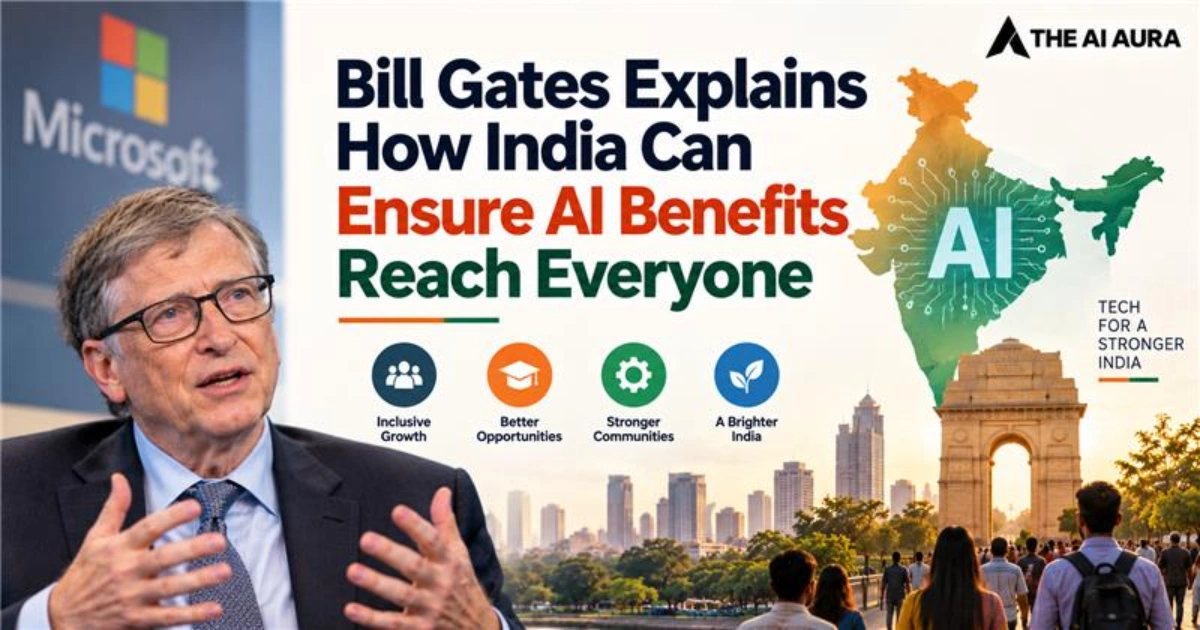

The rapid acceleration of artificial intelligence has sparked a universal anxiety: will this technology become the ultimate equalizer, or will it simply widen the chasm between the ultra-rich and the vulnerable? When looking at the global landscape, Microsoft co-founder Bill Gates sees India as the definitive proving ground for answering this question.
Unlike Western markets that often prioritize high-end enterprise automation, India’s unique socio-economic fabric demands a different approach. For AI to succeed here, it has to solve foundational, massive-scale human problems rather than just padding corporate margins.
Gates believes that by focusing fiercely on specific core sectors, India can draft the global blueprint for equitable AI deployment.
Revolutionizing Agriculture and Affordable Healthcare
The most immediate shifts are already happening in the dirt. Agriculture is currently proving to be the fastest adapter of artificial intelligence in the country, with thousands of Indian farmers plugging into AI-linked advisory systems for real-time crop and weather guidance.
The barrier to entry here is lower, and the cost of an algorithmic miscalculation is far easier to manage compared to other fields.
But the real structural transformation, and the hardest to achieve, must happen in healthcare. India operates under a massive and complex disease burden, battling everything from high blood pressure and diabetes to infectious threats like tuberculosis and widespread malnutrition.
The country simply cannot afford to replicate the heavily bloated, hyper-expensive medical infrastructure of the United States.
According to a recent interview Gates gave to NDTV, the arrival of AI is a massive stroke of luck for developing healthcare networks, offering a way to scale medical advice and diagnostic support without astronomical costs.
The ambition is to create a seamless continuum of care, integrating grassroots primary health centers with intensive hospital care through intelligent data systems. However, medical AI moves slower by necessity.
It operates in a heavily regulated environment where mistakes carry severe human costs, requiring rigorous testing before any broad public rollout can occur.
Leveraging IT Talent to Bridge the Inequality Gap
Building these systems is only half the battle; protecting the people using them is the other. One of the most severe bottlenecks in deploying AI across Indian healthcare is the digitization of patient records while maintaining strict privacy.
If a patient is interacting with an AI health assistant on a daily basis, the underlying data architecture must be practically bulletproof to prevent exploitation.
This is exactly where India’s distinct historical advantage comes into play. The country’s massive IT talent pool, forged during the digital revolution of the last two decades, provides the necessary human capital to build these localized, secure AI infrastructures.
Following discussions with national planning bodies like NITI Aayog, Gates observed that while no nation is ever perfectly prepared for a technological shift of this magnitude, India’s deep engineering engagement makes it the most likely candidate for early, beneficial AI breakthroughs.
The timeline to get this right is incredibly narrow. As highlighted by the Gates Foundation’s latest Goalkeepers Report, the decisions policymakers, developers, and funders make over the next twelve to eighteen months will permanently lock in the trajectory of artificial intelligence.
If the architecture is built purely for high-end commercial profit, it will exclusively serve the wealthy. But if India can successfully align its massive tech workforce with its most pressing societal needs, it will prove to the world that artificial intelligence can actively dismantle inequality rather than reinforce it.