
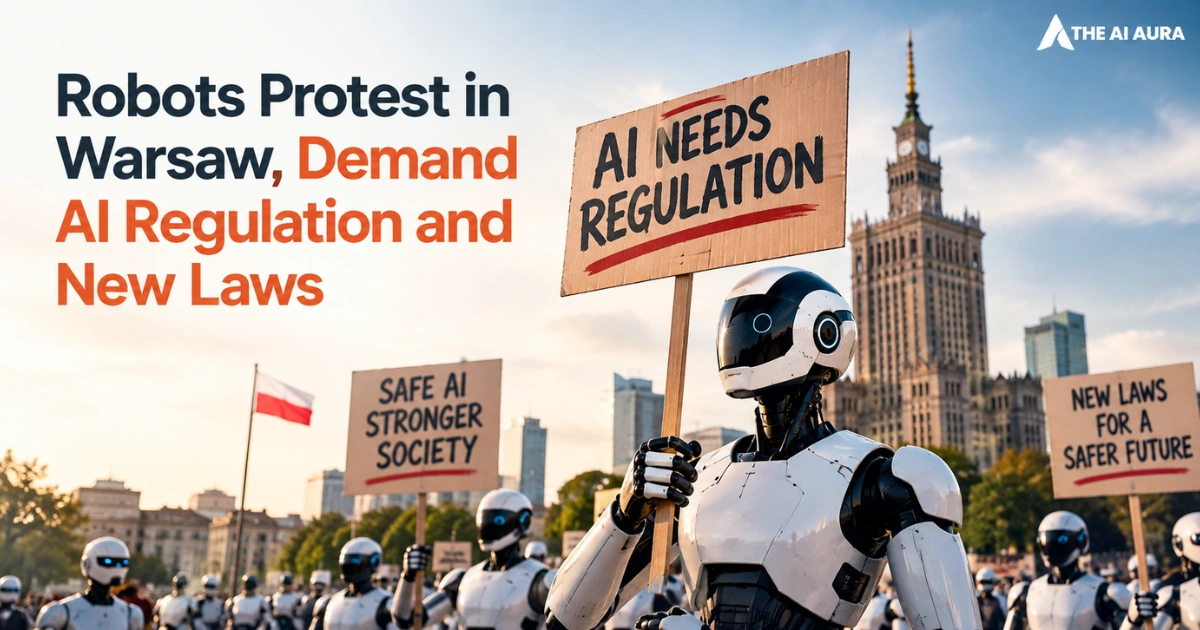

On a busy street in Warsaw, an unexpected demonstration took place outside Poland’s Digital Affairs Ministry. Around 30 robots ranging from bipedal humanoids like the Agibot A3 to agile robotic quadrupeds marched in circles, waving flags and blaring slogans from mounted loudspeakers.
It looked like a scene from a science fiction movie, but the core message was strictly grounded in present-day economics: “Defend workplaces,” “Time for rules,” and “Don’t wait, regulate”.
Organised by a campaign initiative called Democratism, the event was meticulously designed to hijack public attention. By using the very machines that threaten human jobs to lead the protest, human organiser Grzegorz Kulis sent a stark visual warning about the breakneck pace of automation.
Kulis, who operates a robotics company and serves as an employment agency CEO, pointed out that the goal was not just to put on a spectacle.
The objective was to force lawmakers to recognize that humanoid robots and generative artificial intelligence are no longer abstract, future problems they are capable technologies already maneuvering through public spaces and preparing to integrate into cognitive and physical labor markets.
By having the machines move freely and “protest,” the organizers highlighted their sophisticated mobility and autonomy. It was a visceral reminder to passersby and government officials alike that without immediate regulatory intervention, the workforce could soon face unprecedented displacement.
The Intersection of Automation and Cognitive Labor
Historically, automation anxiety centered around factory floors and repetitive manual labor. However, the Warsaw protest underscored a critical shift in the AI debate: the imminent threat to cognitive and white-collar work.
Kulis specifically stressed that artificial intelligence agents and advanced humanoids are rapidly evolving to handle complex, knowledge-based tasks, potentially replacing humans in roles that require critical thinking, analysis, and decision-making.
The timing of the demonstration aligned directly with legislative shifts across Europe. Poland is currently implementing the European Union’s landmark AI Act. The EU framework enforces strict rules on general-purpose AI models and prohibited practices.
To support this rollout, Polish President Karol Nawrocki signed the national AI systems law in July 2026. The new statute creates the Commission for the Development and Safety of Artificial Intelligence. This governing agency will handle consumer complaints and enforce tech compliance nationwide.
A Demand for Tangible Employment Safeguards
Poland’s Digital Affairs Minister Krzysztof Gawkowski met directly with the demonstrators. He agreed that uncontrolled AI models present serious societal risks. Even so, organizers remain skeptical of existing safety nets.
Democratism argues that broad frameworks like the EU AI Act overlook individual workers. Such policies offer little practical protection against rapid cognitive and physical job loss. While some employees can transition to new positions, millions will need extensive retraining.
Deploying real robots exposed a major blind spot in current tech policy. Multinational companies continue to scale automation while leaving human staff vulnerable.
The message outside the ministry was unmistakable: regulating algorithm safety and data privacy solves only half the problem. Governments must also create strong economic shields against workforce displacement.
Without decisive legislative action, human workers will quickly lose ground to robotic competitors.
Source: LiveMint, "'We Want Law, We Want Rules': Robots Protest on Warsaw Street, Demand AI Regulation | Video"