

Modern warfare on the Red Sea coast just crossed a terrifying new threshold. Iranian-backed Houthi forces have successfully captured the strategic port city of Mocha, effectively routing the UAE-backed National Resistance Forces.
However, the collapse of the city’s defenses was not solely the result of overwhelming artillery, drone strikes, or a sudden troop surge. The tipping point was a psychological operation powered by artificial intelligence.
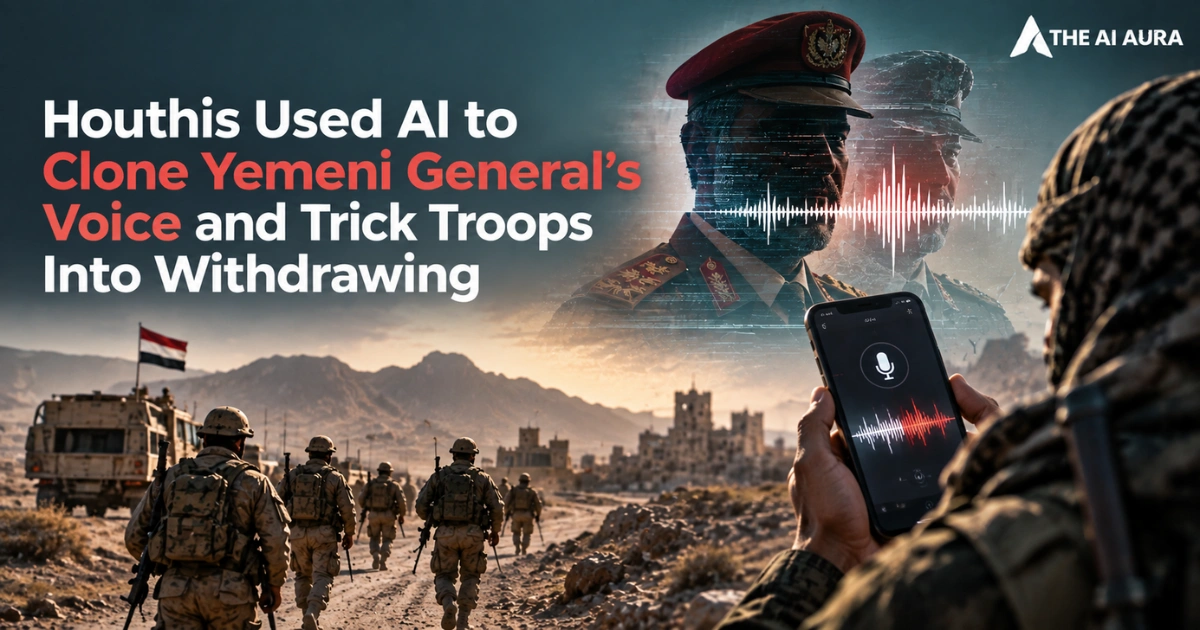
Amidst intense firefights, Houthi operatives circulated a highly convincing audio message across military communication channels and local networks. The voice belonged to Lieutenant General Tareq Mohammed Abdullah Saleh, the commander of the Yemeni National Resistance Forces, urgently ordering his troops to retreat. The audio was entirely fabricated.
By leveraging AI voice-cloning technology, the Houthis successfully weaponized the fog of war. Confused, under fire, and cut off from immediate verification, units abandoned their positions, handing Mocha over to the advancing militants.
Deploying Deepfakes in the Fog of War
The capture of Mocha highlights a radical shift in asymmetric warfare. Today, militant groups integrate bleeding-edge generative AI directly into combat. They now pair algorithms with Iranian ballistic missiles and loitering munitions.
Voice cloning requires remarkably little data to produce a realistic fake. For high-profile military figures like General Saleh, hours of public speeches exist online. Therefore, the Houthis easily scraped this public audio.
Next, they fed the voice data into an AI model. Operatives could then type any command they wanted. The software instantly synthesized Saleh’s exact tone, rhythm, and accent.
During active combat, soldiers operate under extreme psychological stress. When a radio crackles with a familiar commander’s voice, troops obey immediately.
Consequently, the defense collapsed before leaders could verify the broadcast. Saleh’s actual staff quickly issued frantic denials. However, the confusion proved irreversible. Houthi fighters quickly stormed the defensive perimeter and breached the city limits.
A Pattern of Weaponizing Generative AI
This audio spoofing operation is not an isolated incident. It establishes a clear, documented pattern of the Houthis leveraging commercially available artificial intelligence to punch above their conventional weight class.
Recently, intelligence reports revealed another concerning development. Houthi engineers utilized Anthropic’s Claude model to research ballistic missile technology.
The militants bypassed complex engineering bottlenecks by querying the large language model. Furthermore, this workflow accelerated their development timeline. They have now moved from digital research to active battlefield deception.
The fall of Mocha serves as a severe warning to global militaries. Traditional cryptographic radios and secure comms networks are no longer sufficient if the voice on the other end can be spoofed in real-time.
Militaries will now be forced to develop rapid deepfake detection tools at the tactical level, alongside new verbal authentication protocols for field commanders.
The barrier to entry for cognitive warfare has dropped to near zero, proving that AI is no longer just a tool for highly funded, state-sponsored cyber commands it is readily available to any insurgent force with a basic internet connection.
Source: India Today, "Houthis Used AI to Clone Yemeni General’s Voice, Helping Rebels Capture Mocha"