
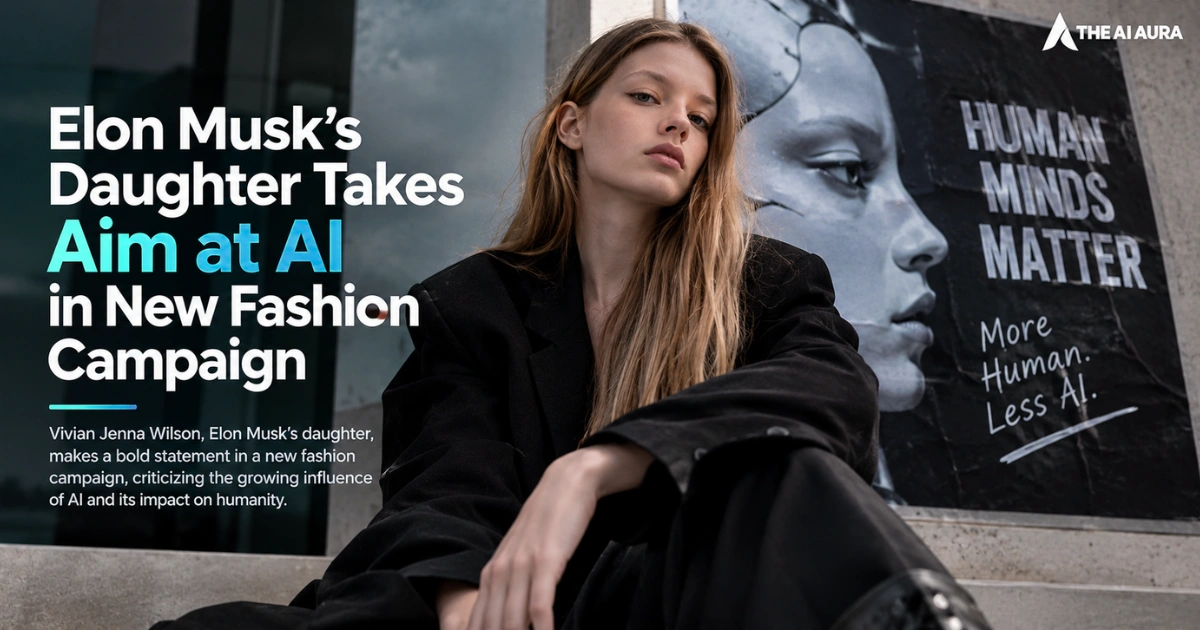

The fashion industry has always loved a rebel, but Spanish brand Desigual’s Fall 2026 campaign carries a uniquely personal sting. Titled “Born to Disobey,” the campaign stars 22-year-old model and activist Vivian Jenna Wilson in a direct visual confrontation with artificial intelligence.
She isn’t just modeling clothes; she is seen dragging a malfunctioning humanoid robot named DESI84 on a leash, using it as a golf tee, and mocking its inability to grasp human nuance.
While the striking imagery stands on its own as a critique of automation in creative industries, the campaign is impossible to separate from its cultural backdrop.
Wilson is the estranged daughter of Elon Musk the billionaire driving force behind Tesla, SpaceX, xAI, and the Optimus humanoid robot program. Without explicitly naming her father, Wilson has placed herself at the center of a cultural pushback against the very technological future he champions.
A Rebellion Against Algorithmic Obedience
At its core, the Desigual campaign rejects artificial perfection. Throughout the film, the DESI84 robot repeatedly short-circuits. It quickly breaks down whenever tasks exceed its rigid programming. The visual subtext carries immense weight. The machine shares an uncanny resemblance to Tesla’s Optimus prototype.
Wilson anchors the project with a defining line: “He was designed to obey. Not me.” Her statement delivers a sharp critique of modern algorithmic control. Today, tech platforms rely on algorithms to predict, optimize, and steer human behavior.
Wilson has repeatedly voiced deep concerns regarding AI in fashion. She argues that generative technology erases genuine artistic intention. Instead, software merely repackages existing shapes and colors.
To Wilson, true art demands emotion, which machines cannot replicate. The film ends with a firm rejection of tech solutionism. Wilson watches the robot collapse and declares, “Some things aren’t meant to be fixed.
The Personal Context Behind the Anti-Tech Stance
The campaign carries obvious weight due to Wilson’s public estrangement from Musk. Wilson began her gender transition at age 16. At 18, she legally adopted her mother’s surname. She also petitioned a court to sever all ties with her biological father.
Musk has frequently blamed what he terms the “woke mind virus” for their fractured relationship, while Wilson has openly criticized him for his behavior and absence during her childhood.
This personal history adds profound layers to the Desigual campaign. Musk is currently investing billions into artificial intelligence, pushing for a future heavily reliant on automation and humanoid robotics. In stark contrast, his daughter is fronting a campaign that champions unpredictability, chaos, and human flaw.
Desigual maintains that the robot is meant to represent broader societal conformity, and neither the brand nor Wilson has explicitly stated that DESI84 is a stand-in for Musk’s enterprises.
However, in casting the daughter of the world’s most famous tech billionaire to dismantle a humanoid machine, the brand has orchestrated an inescapable collision between the push for an AI-optimized world and the human right to remain fundamentally disobedient.
Source: The Times of India, "Elon Musk’s Estranged Daughter Takes Aim at Father and AI in a New Fashion Campaign: ‘He Was Designed to Obey. Not Me.’"