
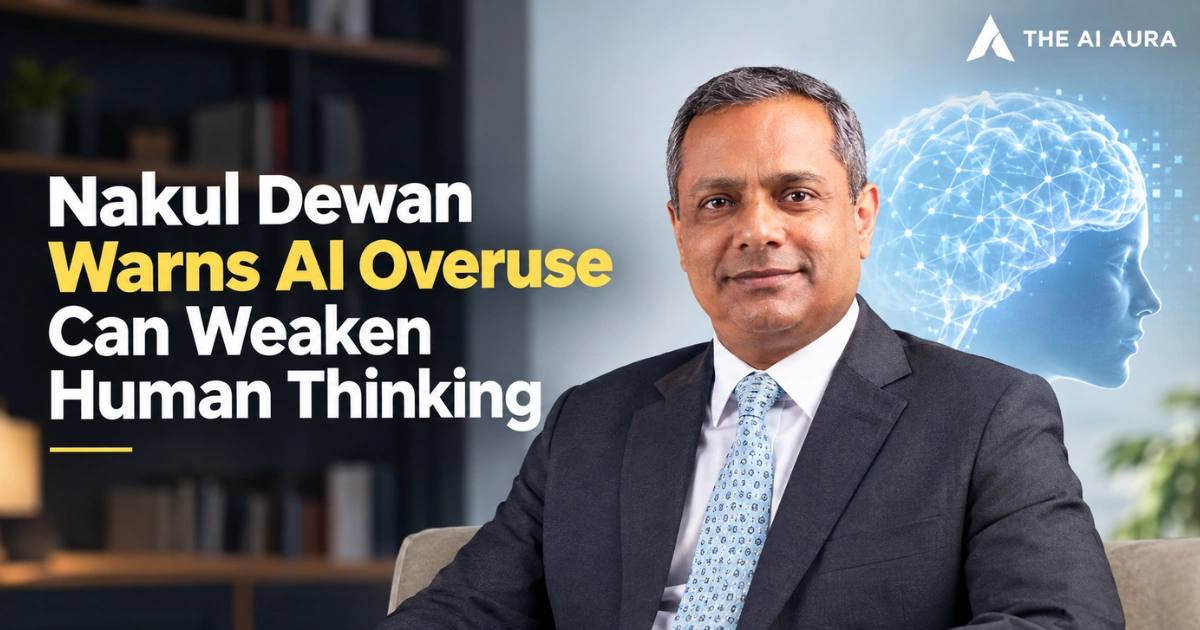

We live in an era of rapid automation. We constantly obsess over what artificial intelligence can do for us. However, we rarely consider what it does to us.
Senior Advocate Nakul Dewan highlighted this issue at the GHAC Arbitration Week 2026. He warned about the danger of outsourcing our intellect. This concern extends far beyond the courtroom.
Dewan issued a blunt warning. Legal professionals use AI to skip the hard work of deep analysis. This happens in many knowledge-based industries. These workers essentially sabotage their own cognitive capabilities.
Dewan described this exact risk in terms of “cognitive offloading”. This practice quietly reshapes how professionals approach problem-solving.
The Trap of Cognitive Offloading
How does the degradation of human thinking actually work in the age of generative AI? It doesn’t happen overnight. It starts with convenience. A lawyer might ask a large language model to summarize a 500-page precedent or draft a routine arbitration clause. That is harmless enough. The danger creeps in when the tool is tasked with connecting the dots.
True critical thinking requires friction. When you wrestle with conflicting case law, evaluate the credibility of a witness, or strategize a litigation loophole, your brain is firing on all cylinders to synthesize disparate pieces of information.
By handing that friction over to a machine, the mental muscles used for logic, deduction, and creative problem-solving begin to atrophy.
Dewan flagged this exact risk, noting that using technology to substitute your own brainwork is a fundamental problem.
An algorithm can predict the next logical word in a sentence based on training data, but it cannot read the room, understand the unwritten nuances of a judge’s temperament, or exercise moral judgment.
When we stop struggling through the dense material ourselves, we lose the deep, internalized understanding required to actually win arguments and solve complex human disputes. The AI provides an illusion of competence, giving you the answer without forcing you to understand how you arrived at it.
Preserving the Human Edge in a Machine Era
The solution is not to banish AI to the dark ages. Technology is a permanent fixture in modern practice, and refusing to use it just guarantees you will be outpaced by those who do. The trick lies in strictly drawing the line between execution and strategy.
Think of AI as a highly efficient paralegal with zero common sense. It is excellent at data retrieval, document sorting, and identifying patterns within massive volumes of text. You deploy it to clear the brush.
But once the raw materials are gathered, the human mind must take over to build the house. The formulation of legal theory, the structuring of cross-examinations, and the ultimate strategic decisions must remain exclusively human domains.
Dewan’s observations serve as a necessary reality check for an industry intoxicated by efficiency metrics. If all you bring to the table is information processing, a machine will eventually replace you.
But if you protect and cultivate your ability to think critically, navigate human emotions, and construct brilliant, unexpected strategies, your value becomes untouchable. The goal is to use the machine to buy yourself more time to think, not to stop thinking altogether.
Source: Bar & Bench, "If You Use AI to Substitute Your Own Brainwork, It Is a Problem: Nakul Dewan Flags 'Cognitive Offloading'"