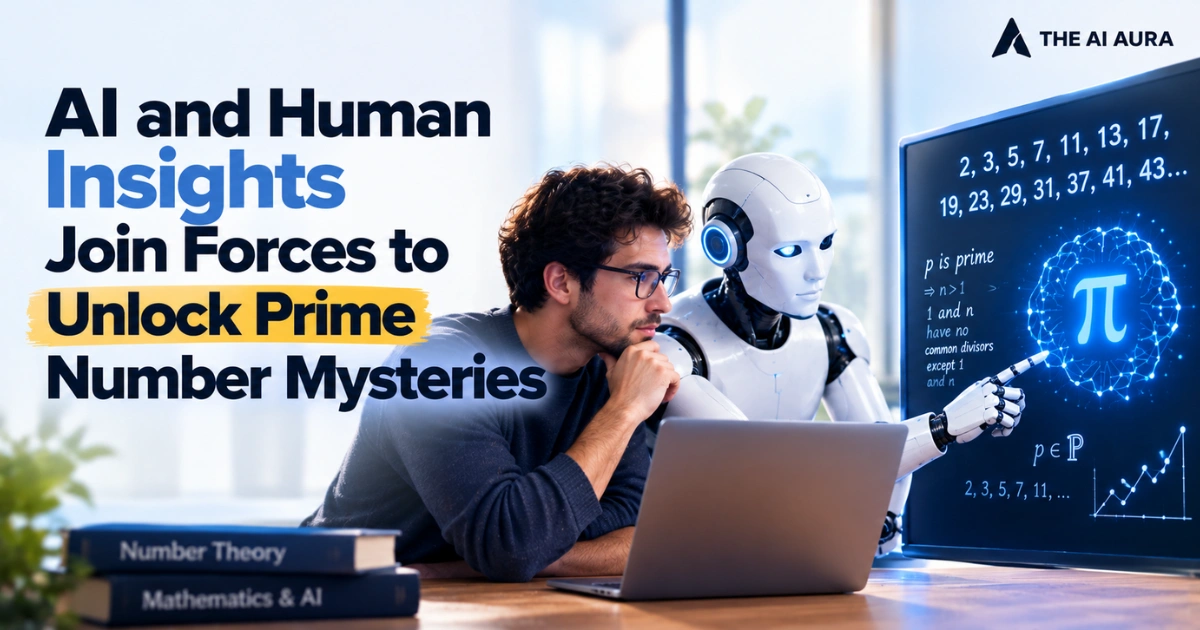

For over two millennia, prime numbers have stood as the ultimate mathematical enigma. They are the fundamental atoms of arithmetic, yet they scatter across the number line with a chaotic, unpredictable rhythm that has frustrated the world’s brightest minds.
But in the last two weeks, the landscape of number theory has shifted fundamentally. We are witnessing a historic convergence where artificial intelligence and human ingenuity are unlocking the deepest secrets of prime distribution.
This recent wave of breakthroughs is doing more than just rewriting textbooks. It is sparking an existential debate about the future of mathematical discovery and what it actually means to be a mathematician in an era where machines can outpace human logic.
Bridging the Gaps: From 246 to the Infinite Desert
The recent milestones target two extremes of prime number distribution: the tightly packed “twin primes” and the vast “prime deserts.”
On the small gaps front, the AI startup Axiom Math recently deployed its multi-agent system, AxiomProver, to formally verify the celebrated “246 Theorem.” Originally the result of the Polymath8b human collaboration involving Fields Medalists James Maynard and Terence Tao this theorem proved that there are infinitely many prime pairs separated by a gap of no more than 246.
It is the closest humanity has ever come to solving the legendary Twin Prime Conjecture.
AxiomProver didn’t just validate the math; it translated the entire human-driven proof into Lean, a rigorous machine-checking language, and packaged it into an open-source library called PrimeGapsLib. This creates a flawless, reusable foundation for future AI and human researchers.
Simultaneously, GPT-5.6 tackled the opposite extreme: large prime gaps, famously known as Paul Erdős’ 4th Problem. For years, the record for mapping these massive numeric deserts was held by a five-person team that included Tao and Maynard. In a single day, GPT-5.6 shattered their eight-year-old record.
The AI introduced a completely novel mathematical construction termed “Skewed Residue Classes,” and incredibly, the proof passed machine formal verification on the exact same day.
These simultaneous victories demonstrate a powerful symbiosis. Humans provide the centuries of foundational theory and the architectural goals, while AI executes the staggering combinatorial logic required to navigate infinite spaces.
The Age of “Proof Indigestion”
While the results are undeniably spectacular, this sudden acceleration has left the academic community grappling with severe whiplash.
At the 2026 International Congress of Mathematicians, Terence Tao perfectly encapsulated this crisis, coining the term “proof indigestion.”
Artificial intelligence is now generating complex, highly sophisticated proofs far faster than the global mathematical community can possibly read, review, and truly understand them.
We are rapidly transitioning from a historical era of proof scarcity to an overwhelming era of proof excess.
This dynamic is creating deep professional anxiety. When an AI system outputs a valid proof in a few hours solving a problem that might have previously defined a human scholar’s entire decade-long career it forces a stark reevaluation of the human role in academia.
Some early-career researchers have already cited this lightning-fast AI dominance as a reason to step away from the field entirely.
Yet, viewing this purely as a machine takeover misses the broader picture. Mathematics is not just about churning out correct answers; it is about building a conceptual understanding of the universe.
Moving forward, the human role will inevitably evolve. Rather than getting bogged down in the mechanical verification of infinite combinatorial steps, mathematicians will act as conductors.
They will frame the right questions, design the overarching architectures, and extract meaning from the raw, mechanical brilliance of the AI. The prime number mysteries are finally unraveling, not because the machine replaced the human, but because we finally built a tool capable of following our deepest intuitions.
Source: The Hindu, "AI, Human Insights Work Together to Decode Prime Number Mysteries"