
The narrative of India’s IT sector has long been one of exponential job creation, but a structural shift is rewriting the rules. Driven by the rapid implementation of artificial intelligence, India faces a critical labor transition.
According to government think-tank NITI Aayog, the tech workforce could shrink from up to 8 million in 2023 to just 6 million by 2031. Customer experience roles face a similar contraction.
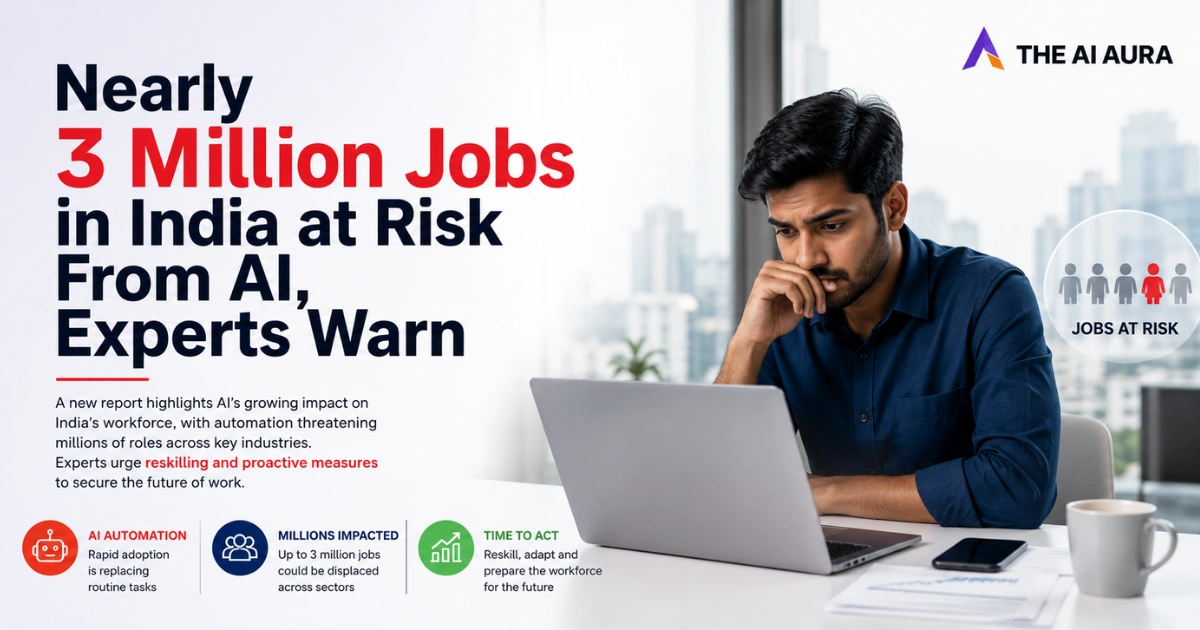
Looking at the broader economic impact, Bhaskar Chakravorti of Tufts University estimates that nearly 3 million gross jobs are at risk across the country over the next five years.
This displacement translates to an estimated $12 billion annual loss in wages. The disruption is no longer theoretical; it is actively visible in the balance sheets and hiring patterns of India’s largest corporations.
The Anatomy of Corporate AI Disruption
To understand how this job displacement is materializing, we have to look at how Indian enterprises are spending their technology budgets. The transition is not happening evenly.
A recent study by AIM Research on India’s top 35 listed companies shows a stark divide. Industry giants like Reliance Industries and HDFC Bank are already in the transformation stage, running native AI operations.
Meanwhile, many traditional firms are caught in a pilot-stage purgatory driven by the fear of missing out, throwing small percentages of their budgets at AI while fiercely protecting legacy systems.
Because corporate AI adoption directly targets operational efficiency, the immediate casualty is entry-level hiring. Foundational coding, basic debugging, and routine customer service tasks historically the entry points for thousands of fresh engineering graduates are being rapidly automated.
Data from Icrier reveals that 65% of IT companies have actively reduced entry-level hiring.
The industry’s biggest players reflect this freeze. The top five IT services firms, including TCS, Infosys, and Wipro, saw their overall headcount contract by nearly 7,000 in FY26.
This is a severe reversal from the previous year, which saw net additions of over 12,000. When automation handles the groundwork, the traditional pyramid model of IT staffing collapses.
The Reskilling Paradox and What Comes Next
The standard corporate response to automation is a promise to reskill the workforce. However, the economics of retraining present a massive hurdle. Nearly 68% of companies cite the high cost and uncertain return on investment as primary barriers to large-scale reskilling.
The harsh reality of corporate economics dictates that companies only invest in training the employees they intend to keep, not the ones they plan to displace. For mid-career professionals whose traditional IT skills are becoming commoditized, transitioning to complex AI architecture or machine learning roles is incredibly difficult.
If an enterprise is only seeing a 10% growth margin from AI efficiency, building a massive internal academy to retrain redundant workers simply does not make business sense.
Despite the grim short-term outlook, the AI transition is not purely destructive. It is driving immense demand for advanced, specialized capabilities. Enterprises in Western markets require massive infrastructure overhauls to support their own AI ambitions, creating a surge in demand for data engineering, AI governance, algorithmic auditing, and cybersecurity.
The fundamental issue is not that jobs will disappear entirely, but that the required skill profiles are fracturing. We are looking at a market that will aggressively reward a small pool of highly skilled AI practitioners while aggressively shrinking opportunities for traditional, routine IT workers.
The success of India’s tech sector will entirely depend on how quickly its workforce can bridge this widening skill gap.
Source: Rediff.com, "AI Effect: 'Nearly 3 Million Jobs Are At Risk In India'"