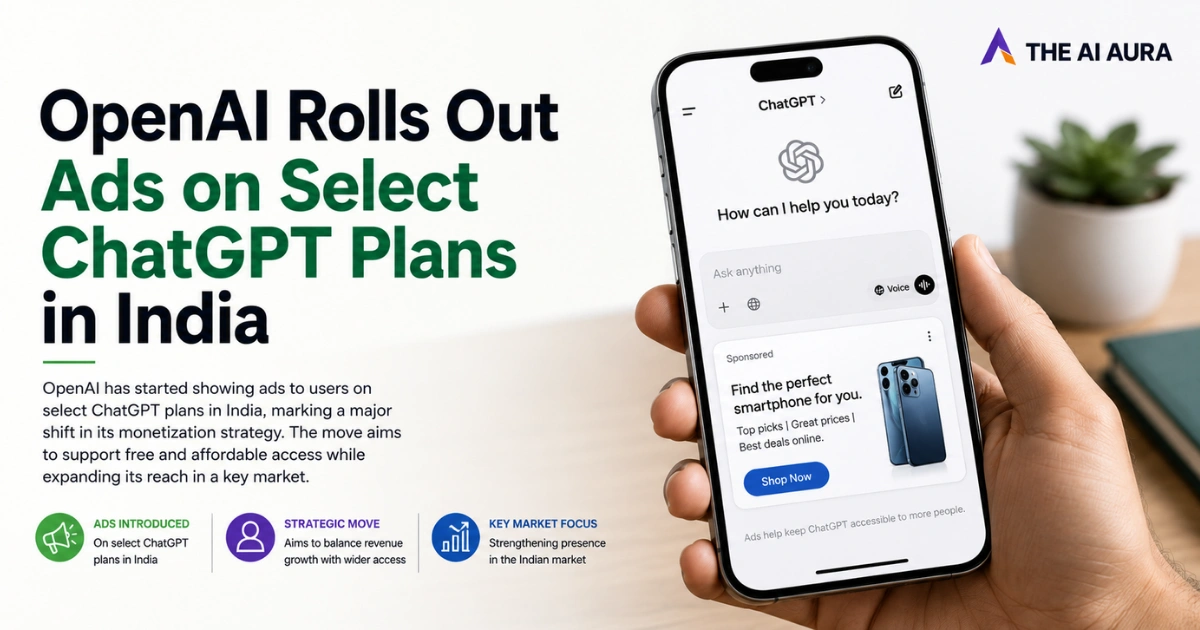

India has officially joined the growing list of nations where a query to ChatGPT comes with a commercial sponsor.
OpenAI has activated digital advertising on its generative AI platform for Indian users, signaling a strategic pivot to monetize its massive consumer base as the company prepares for a highly anticipated 2027 public listing.
The rollout specifically targets users on the free tier, alongside subscribers to the ₹399-per-month “Go” plan. For a company facing intense market pressure to justify an $852 billion valuation, introducing an ad model in one of its most active global markets is a calculated necessity.
While the advertising format is already active in 38 countries including the United States, Japan, and most of Europe the sheer volume of traffic originating from India makes this expansion a major financial milestone.
Balancing Consumer Growth and Compute Costs
Running a frontier AI model is notoriously expensive. Every time a user submits a prompt, OpenAI incurs massive backend computing and inference costs.
Until now, the company heavily relied on premium subscriptions and enterprise API usage to absorb these operating expenses. However, to maintain absolute dominance among everyday internet users, OpenAI needed a scalable way to subsidize its non-premium access tiers.
According to market intelligence analysts, digital advertising is the most efficient vehicle to monetize an individual consumer base at this magnitude. Global online ad spend currently sits at an estimated $1.18 trillion, with in-app advertising claiming a $400 billion slice of that pie.
By tapping into this ecosystem, OpenAI can partially offset the server costs required to generate AI responses while keeping the baseline product financially viable.
To prevent user alienation, the company has established strict interface guardrails. OpenAI representatives confirmed that advertisements are visually separated, clearly labeled, and placed entirely below the AI-generated responses.
The core integrity of the chatbot remains intact, with the company insisting that algorithmic independence is non-negotiable. Furthermore, the system is explicitly restricted from serving ads to users identified or predicted to be under the age of 18.
The Battle for AI Supremacy and Monetization
OpenAI’s push into digital advertising highlights a diverging philosophical split within the artificial intelligence sector. The company finds itself squeezed between two formidable competitors: Google, which effectively wrote the playbook on global consumer advertising, and Anthropic, an enterprise-focused rival that has aggressively criticized the ad-supported AI model.
Earlier this year, Anthropic made headlines by declaring its Claude chatbot would remain strictly ad-free, arguing that third-party product placements fundamentally compromise the neutrality of AI assistants.
Because Anthropic derives a significantly higher proportion of its revenue directly from enterprise contracts, it can afford to bypass the consumer ad market. OpenAI, conversely, holds a dominant grip on the retail consumer segment, making an ad-supported framework the most logical path to sustained profitability.
The initial phase of the Indian rollout relies on a managed advertising model, but the real test of its scalability arrives on September 4, when OpenAI launches its self-serve ad platform. This self-serve mechanism is the bedrock of modern digital monetization, allowing advertisers of all sizes to bid directly for user impressions.
For IT leaders, digital marketers, and tech analysts, this development is more than just a software update. It marks a maturation point in the generative AI boom. As the 2027 IPO target inches closer, OpenAI is proving it can build not just a revolutionary consumer product, but a sustainable business engine capable of competing in the traditional digital advertising arena.
Source: CNBC, "OpenAI Strategy in India, Anthropic IPO"