
Neurosurgery has always been an exercise in extreme precision, operating in millimeter margins where a fraction of an error can alter a life forever. For 48-year-old Rhys Hibbert, those stakes were incredibly high.
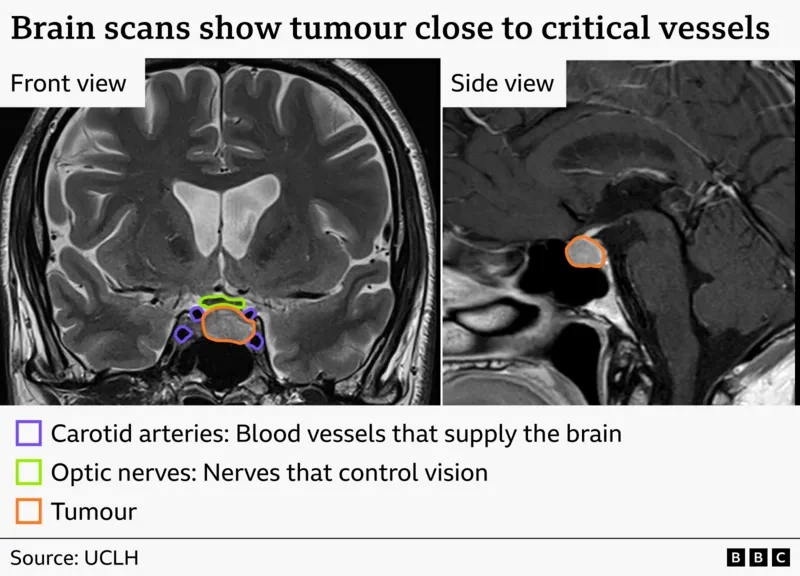
A previously healthy father of two, his reality fractured when a sudden seizure during a lunchtime walk revealed an 11mm non-cancerous tumor on his pituitary gland.
Located at the base of the skull, this marble-sized gland sits precariously close to the optic nerves and carotid arteries. As the mass grew, it began stealing his peripheral vision and draining his physical energy.
Therefore, the surgical team at University College London Hospital (UCLH) offered Hibbert a unique proposition. They asked him to undergo surgery using a pioneering, live artificial intelligence tool.
Recognizing the broader implications for medical science, he agreed without hesitation. Ultimately, the operation became a global first.
The team successfully removed the tumor. In addition, the procedure immediately restored his sight. The underlying story highlights how this specific technology fundamentally changes the operating room.
Mapping the Unseen Anatomy
Pituitary surgery typically involves threading an endoscope a slender camera through the nasal cavity to reach the base of the skull. The primary challenge isn’t just reaching the tumor.
The mass is often barricaded behind layers of tough membrane and bone, and because every patient’s internal anatomy varies slightly, surgeons are essentially navigating a complex maze. The walls of this maze conceal critical blood vessels and nerves that cannot be damaged.
Traditionally, surgeons rely heavily on pre-operative scans to build a mental map of the surgical site. The new AI system, however, introduces live, dynamic guidance.
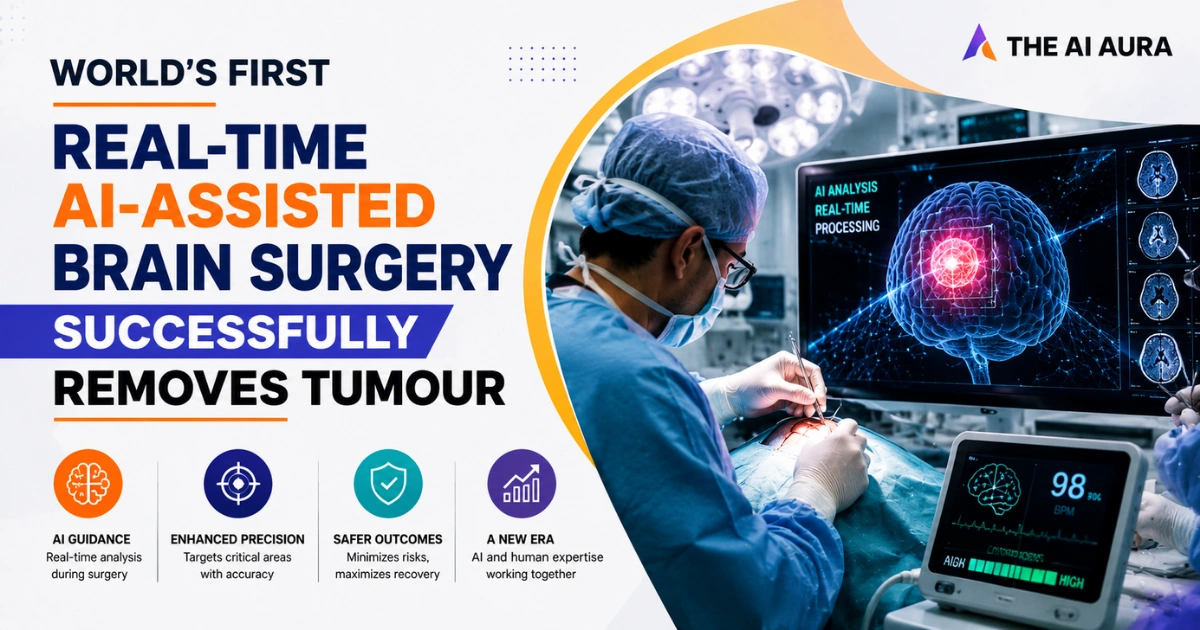
Functioning on a secondary monitor alongside the primary endoscopic feed, the software tracks the surgical instruments in real-time. It actively anticipates and marks the safest zones for tissue removal, overlaying digital boundaries that highlight exactly where hidden anatomical structures are most likely located.
Professor Hani Marcus, part of the surgical team, noted that the software was trained on hundreds of recorded pituitary surgeries.
Researchers meticulously annotated these videos, teaching the system to recognize crucial structures. Because of this massive data intake, the AI has effectively “seen” more of these specific procedures than the average surgeon might perform in an entire career.
The Future of Surgical Collaboration
Professor Hani Marcus, part of the surgical team, explained the system’s background. Researchers trained the software on hundreds of recorded pituitary surgeries. They meticulously annotated these videos.
Consequently, they taught the system to recognize crucial structures. Because of this massive data intake, the AI possesses vast experience. Indeed, it has effectively “seen” more specific procedures than an average surgeon performs in a career.
Crucially, we must understand the hierarchy in the operating theater. This technology acts strictly as an assistant. It does not replace the human surgeon. The human operator retains absolute control at all times. UCL researchers developed the tool with backing from Google and the NIHR.
They designed the software to systematically reduce inherent brain surgery risks. Historically, tumor removal carries a 25 to 50 percent chance of leaving fragmented tissue.
Additionally, patients face a smaller, yet catastrophic, risk of major vessel rupture. By providing real-time spatial awareness, the AI significantly mitigates these variables.
The success of Hibbert’s surgery paves the way for what the research team envisions as a highly specialized “Surgical ChatGPT”. The long-term goal is to develop an interactive AI that surgeons can consult mid-operation.
If a complex anatomical anomaly presents itself, the surgeon could theoretically cross-reference their approach against a massive, real-time dataset of similar cases instantly.
Following this initial success, the UCLH team is preparing for larger clinical trials. For patients like Hibbert, who noted his vision clearing the moment he opened his eyes post-surgery, the technology has already proven its worth.
It represents a vital evolution in medicine where AI acts as the ultimate safeguard, ensuring complex procedures become consistently safer.
Source: BBC News, "World’s First Patient to Undergo Live AI-Assisted Brain Surgery Has Tumour Removed"