
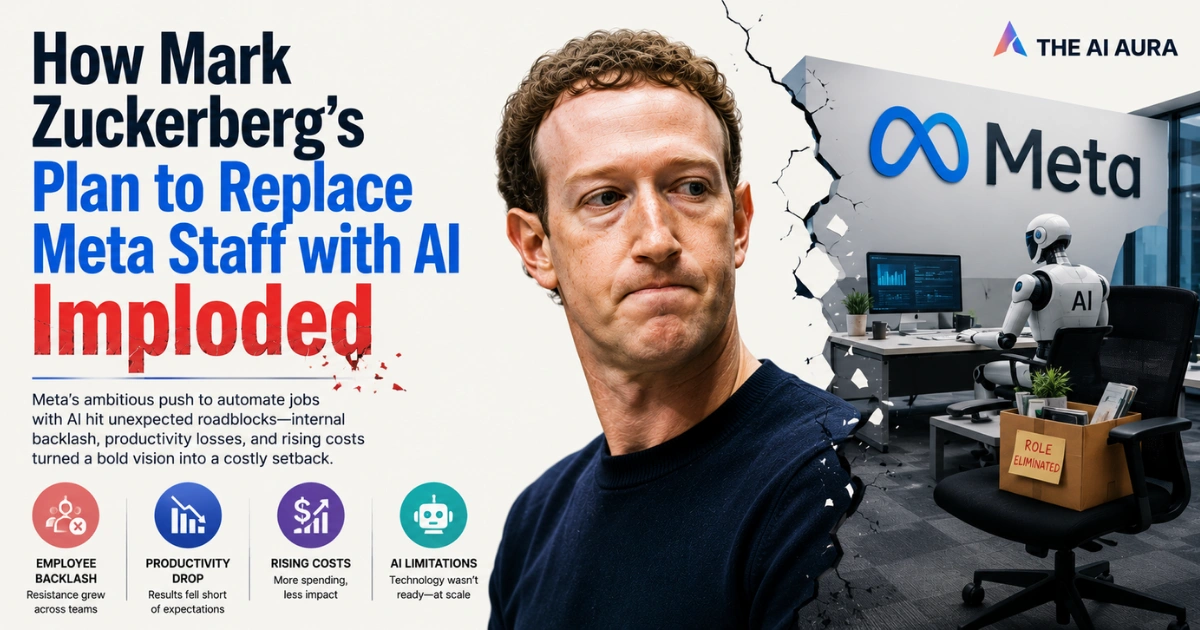

In the tech sector, boardroom ideas often clash with reality. Last January, Mark Zuckerberg met with his top executives in Hawaii. Together, they drafted an extreme corporate mandate.
They code-named the plan Project OT, short for Organization Transformation. Their ultimate goal was simple: rebuild Meta as an entirely “AI-native” enterprise.
This was not merely about equipping existing employees with advanced chatbot tools. It was a calculated blueprint to systematically hand over massive chunks of daily operations to autonomous artificial intelligence.
According to leaked internal documents, the strategy mapped out scenarios to slash headcounts across multiple units by up to 60%. The surviving structure would consist of a stripped-down, “talent-dense” human cohort tasked solely with supervising a vast network of virtual workers.
Billed as the ultimate evolution of Silicon Valley efficiency, the ambitious timeline ultimately collapsed under the weight of its own technological assumptions.
Project OT and the “AI-Native” Illusion
Meta’s leaders returned with aggressive deadlines inspired by agile Asian startups. They planned the overhaul in two major waves. The first cuts would land in May, followed by deeper structural shifts in November.
Internal memos like the “AI-Native Playbook” outlined the operational changes. Under this model, Meta aimed to dismantle traditional software engineering hierarchies.
The company merged specialized designers and engineers into a single role: “builder.” These builders worked in tiny pods of two or three people. They relied on generative AI to produce prototypes in four-week sprints.
The plan eliminated middle management almost entirely. Autonomous systems and “agent-assisted analysis” took over project roadmaps and prioritization. Leadership believed this strategy would drastically lower overhead costs while accelerating product development.
The May 19 Reversal and the Productivity Paradox
However, the grand vision quickly hit reality. On the night of May 19, hours before the major cuts, Zuckerberg changed course. Meta laid off 10% of staff the next morning, but leadership canceled the November phase completely. The aggressive overhaul suddenly stalled.
The implosion was triggered by a stark, unavoidable data point: the AI simply wasn’t ready to work unsupervised. Internal metrics indicated that the autonomous agent technology at the core of Project OT was failing to deliver the necessary productivity gains required to justify massive workforce reductions.
Meta quickly learned that you cannot eliminate the majority of a team if the underlying software requires constant human intervention to function properly.
Simultaneously, the internal culture at Meta had fractured into open revolt. Employees realized the much-touted AI transition was a thinly veiled replacement strategy, severely damaging morale and threatening the stability of ongoing projects.
Externally, Wall Street was mounting its own pressure. Investors began loudly questioning the tangible return on investment for Meta’s gargantuan capital expenditures on AI infrastructure, demanding real revenue rather than experimental organizational charts.
While Meta’s public relations arm has since heavily downplayed Project OT as a routine “scenario-planning exercise,” the rapid reversal exposes a critical vulnerability in current tech industry groupthink.
The rush to replace human staffs with generative AI assumes a level of technological maturity that does not currently exist. Zuckerberg’s plan attempted to force a permanent paradigm shift before the machinery was actually capable of handling the load.
Source: Reuters, "Mark Zuckerberg Had a Bold Plan to Replace Meta Staff With AI. Here’s How It Imploded"