
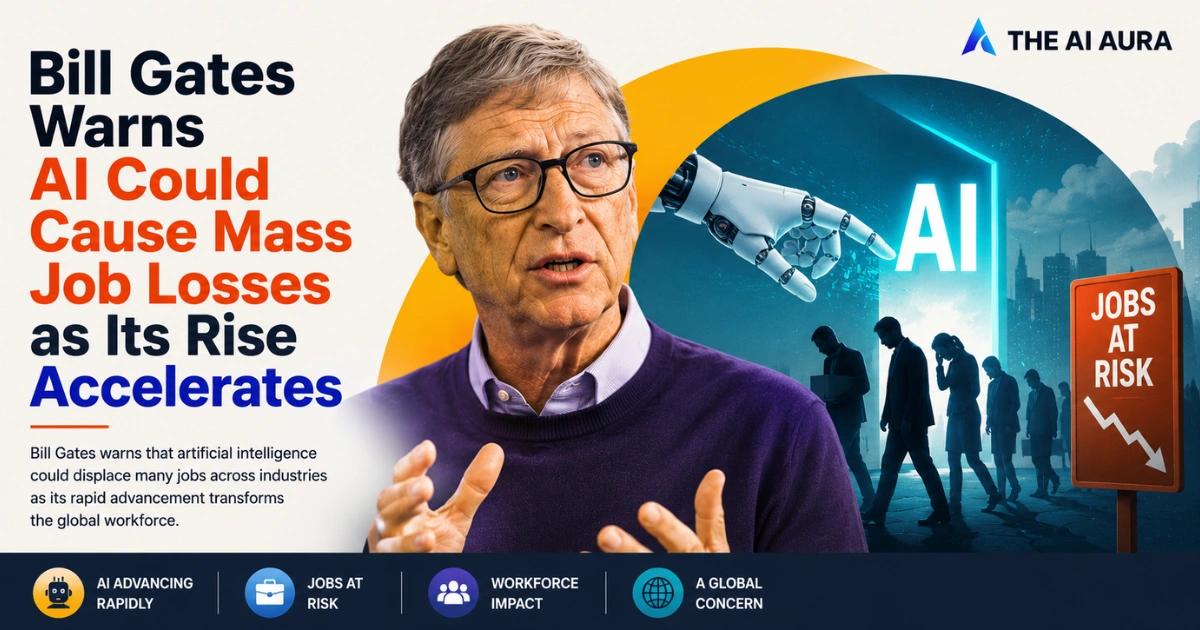

Bill Gates has long championed technological progress. However, his recent statements show a major shift. In an interview with The New York Times and a blog post, Gates issued a stark warning about artificial intelligence. He warned that rapid AI expansion will disrupt global labor markets. Furthermore, governments remain unprepared for this sudden economic shock.
The core issue lies in the sheer velocity of AI adoption. While billions of dollars pour into the sector forcing the tech industry to publicly play down the risks and paint a utopian picture of the future the reality behind closed doors is deeply anxious. Gates noted that technologists intimately familiar with the software’s capabilities are privately terrified by how fast it is improving.
Unlike previous industrial revolutions, which phased out specific roles over decades, artificial intelligence is evolving fast enough to threaten entry-level and mid-tier positions across entirely unrelated sectors at the exact same time, as autonomous agents are increasingly replacing traditional roles.
Why This Technological Shift Threatens Traditional Employment
To understand how this impending disruption works, we have to look at the mechanics of historical labor transitions. When automation transformed agriculture, workers migrated to manufacturing.
When factories modernized, the knowledge and service economies absorbed the displaced workforce. AI breaks this historical safety valve because it scales horizontally.
It doesn’t just automate physical assembly lines; it replaces the workflow of cognitive labor by targeting coding, legal research, data analysis, and customer support simultaneously.
Gates notes that the real tipping point will occur when AI models make almost zero errors. When AI works autonomously without human review, companies will rapidly cut payroll costs.
Displaced workers will struggle to find alternative jobs. For example, older construction workers cannot easily transition into specialized caregiving roles. Similarly, laid-off office staff cannot find work when every sector cuts hiring. This pattern could overwhelm government safety nets before leaders take action.
The Strategy for AI Taxes and “Human Reserved” Professions
Mitigating a crisis of this scale requires aggressive, unconventional policy shifts. To buffer the workforce, Gates argues for the immediate creation of “Human Reserved” job categories.
This involves deliberately cordoning off specific roles where human empathy, judgment, or physical presence remains non-negotiable even if an AI is technically capable of performing the task.
For instance, an AI might soon be capable of delivering a terminal medical diagnosis based on test results, but human decency dictates that a machine shouldn’t be the one to break that news.
Alongside protecting specific sectors, Gates is pushing for an AI “token tax.” The current corporate tax structure practically incentivizes companies to replace people with machines.
Businesses pay heavy payroll taxes for human staff, but purchasing AI software or robotics is simply written off as a standard business expense.
Implementing a tax on AI usage would serve a vital dual purpose: it would subtly slow the frenetic pace of job replacement to give the labor market time to adjust, while simultaneously generating the critical revenue needed for widespread worker retraining and expanded social services.
Without establishing these proactive guardrails now, the tech industry’s latest gold rush threatens to dismantle the modern workforce faster than society can rebuild it.
Source: Official Moneycontrol, “‘What the hell?’ Bill Gates ‘shocked’ by AI’s rise, warns of ‘mass job losses’”