
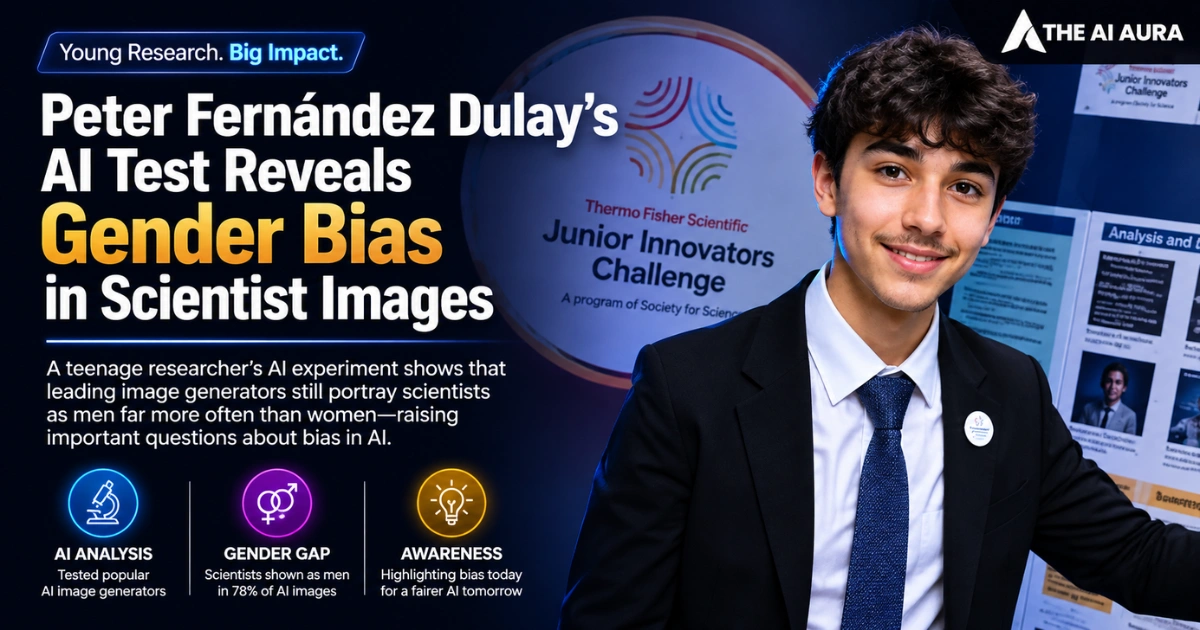

When an eighth-grade student uncovers a systemic flaw in some of the most advanced technology of our time, it forces those of us in the research community to pause and evaluate our tools.
The discovery started with a simple request. Florida middle schooler Peter Fernández Dulay watched his younger sister, Elisa, use an AI image generator to illustrate a story about a scientist.
Instead of returning a diverse array of professionals, the tool repeatedly spit out variations of the exact same trope: older, light-skinned men with frizzy hair.
This singular observation evolved into a rigorous quantitative analysis. Peter tested four major platforms Midjourney, DALL-E, Canva, and Shutterstock across five specific STEM professions.
After processing over 1,800 images, his findings were stark. Women appeared alone in just 17.4 percent of the generated visuals, a severe underrepresentation considering women make up roughly 35 percent of STEM graduates today.
As someone who studies the intersection of machine learning and human behavior, I look at Peter’s data not just as a critique of current software, but as a textbook demonstration of how generative models process and reflect our historical prejudices.
The Mechanics of Algorithmic Stereotyping
To understand why an AI defaults to an outdated caricature of a scientist, we have to look under the hood of how these image generators actually work. Artificial intelligence does not possess imagination or an inherent understanding of equity
Instead, platforms rely on diffusion models trained on massive, largely unfiltered datasets scraped from the internet. These datasets contain billions of image-text pairs.
If historically, media, stock photography, and literature have predominantly paired the word “scientist” or “data scientist” with images of white men in lab coats, the algorithm maps that correlation as the highest probability output.
Peter’s experiment effectively reverse-engineered this training bias. By isolating specific careers like actuaries and operations research analysts, he tested the neural network’s latent space the mathematical realm where the AI groups similar concepts.
The fact that Midjourney produced the most biased results while Shutterstock produced the least tells us something critical about dataset curation. Shutterstock, a stock photography company, likely applies stricter metadata tagging and deliberate diversity guidelines to its proprietary training data.
Conversely, models scraping the broader, uncurated web absorb a heavier concentration of historical inequalities.
The AI is simply holding up a mirror to the internet’s existing demographic imbalances. It treats a historical frequency as a fixed rule, mathematically reproducing a stereotype because it lacks the context to correct it.
Real-World Impacts on Future Innovators
The technical explanation for AI bias is straightforward, but the psychological impact is far more complex. We know that representation directly shapes cognitive development and career aspirations.
When young students like Elisa look to modern technology to visualize their potential futures, the output serves as a subtle but powerful social cue.
If the default visualization of an information security analyst or a computer researcher is strictly male, the technology inadvertently reinforces the idea that these fields are exclusionary, overriding the real-world progress women have made in STEM.
Peter, whose background spans competitive fencing and robotics, is already examining technology through a highly humanistic lens.
His goal to eventually develop bilingual AI companions capable of recognizing psychological stress shows a deep understanding that artificial intelligence must be engineered for the diverse reality of its users. His findings confirm that technology does not exist in a vacuum separate from human history.
The responsibility now lies with developers to actively curate training data and weight their algorithms for demographic parity. Until we fundamentally change the dietary input of these machine learning models, they will continue to regurgitate the past rather than picture the future.
Source: Official The Times of India, "Meet Peter Fernández Dulay, the Florida Eighth-Grader Who Asked Four AI Generators What Scientists Look Like; Only 17.4% of the Images Showed Women Alone".