

Michael Polansky is widely recognized in two highly visible circles: as a seasoned Silicon Valley investor and as the partner of Stefani Germanotta, better known as Lady Gaga.
Yet, for the past few years, he has quietly operated entirely under the radar, spearheading a biotechnology breakthrough.
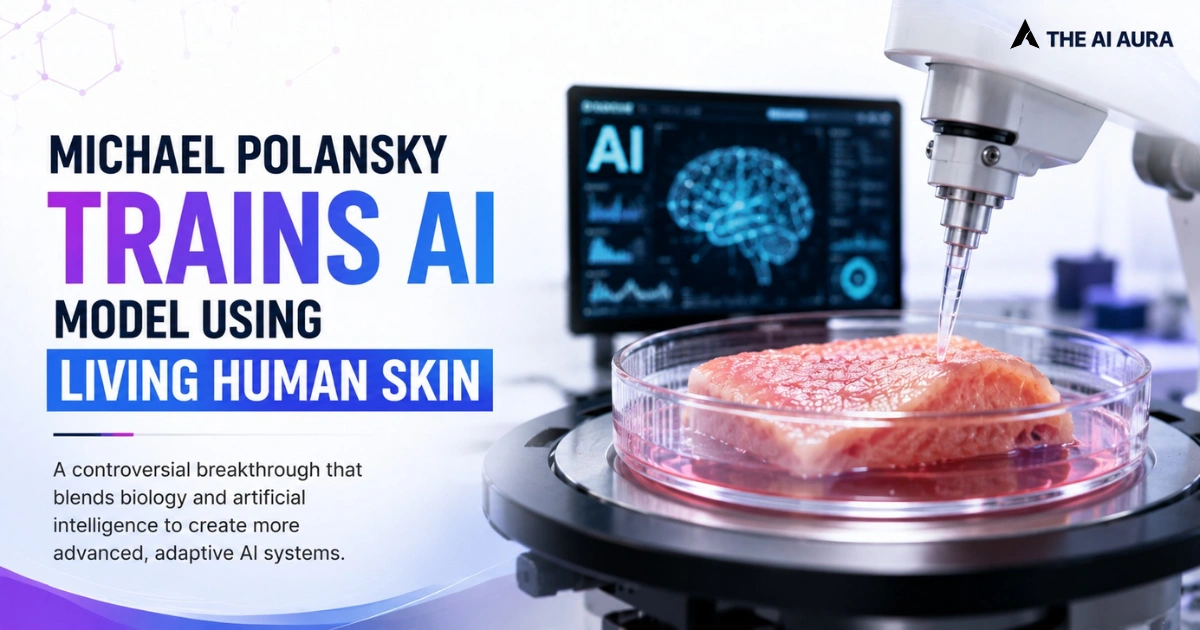
As the CEO and co-founder of Outer Biosciences, Polansky is doing what was previously thought impossible: keeping discarded human skin alive outside the body for over a month to train an advanced AI model.
Sustaining Living Tissue to Replace Synthetic Proxies
For decades, biological and cosmetic research has relied on imperfect proxies like animal testing, lab-grown organoids, or simplified cell cultures. These workarounds exist because running direct experiments on living humans is ethically fraught.
Outer Biosciences took a radically different route. Instead of engineering synthetic models, the startup sources actual human skin primarily discarded tissue from plastic surgeries through vetted, government-funded biobanks operating with strict donor consent.
The industry standard for keeping excised human tissue viable hovers at just a few days, which is barely enough time to test for acute chemical toxicity.
It falls completely short for observing slower processes like collagen remodeling or barrier repair.
Polansky’s team engineered a proprietary support system that continuously feeds the living human skin nutrients while filtering out metabolic waste.
This innovation extends the tissue’s lifespan to an unprecedented 30 days, preserving its day-zero molecular and immune architectures. For the first time, researchers can observe slow-moving biological events in real time.
They can induce UVB damage and track the nuanced inflammatory and recovery responses of a sunburn over a matter of weeks, gathering exact biological data rather than guessing based on static, short-term observations.
A Closed-Loop AI Model for Skincare Discovery
The true potential of this sustained tissue lies in how it interacts with artificial intelligence. Unlike tech startups that simply scrape the internet for existing information, Outer Biosciences is building its own foundational data.
There is no existing biological database to train a specialized AI on how human skin truly reacts over a month.
The operation works as a self-reinforcing, closed-loop system. The AI model predicts which untested chemicals will trigger beneficial reactions for specific skin functions.
Those chemical candidates are then applied directly to the living tissue. Regardless of whether the AI’s prediction succeeds or fails, the resulting biological data is fed right back into the system. Every physical experiment drastically refines the model’s next round of hypotheses.
This integration of AI and living biology has supercharged the pace of cosmetic discovery.
While early brute-force methods yielded only a few leads over 18 months, the company now generates a highly viable candidate every six weeks.
To put this in perspective, the current universe of scientifically backed, FDA-approved active skincare ingredients is surprisingly small, hovering around just 200. Outer Biosciences already has six active leads in its pipeline, with four nearing commercialization.
Backed by $23 million in funding, the 19-person startup has no immediate plans to launch a direct-to-consumer brand. Instead, they will license their safety-tested ingredients to major pharmaceutical and beauty companies.
By replacing imperfect synthetic proxies with an AI trained on actual, living human skin, Polansky’s team is opening up a rate of discovery in dermatology that simply did not exist before.
Source: Official TechCrunch, "Michael Polansky Is Training an AI Model on Skin That’s Still Alive"