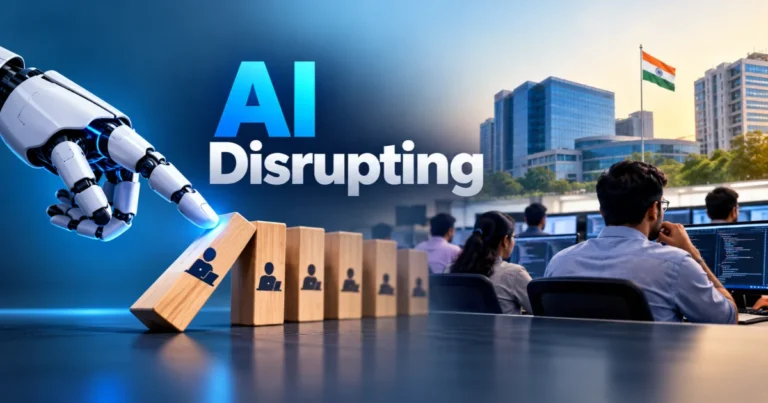
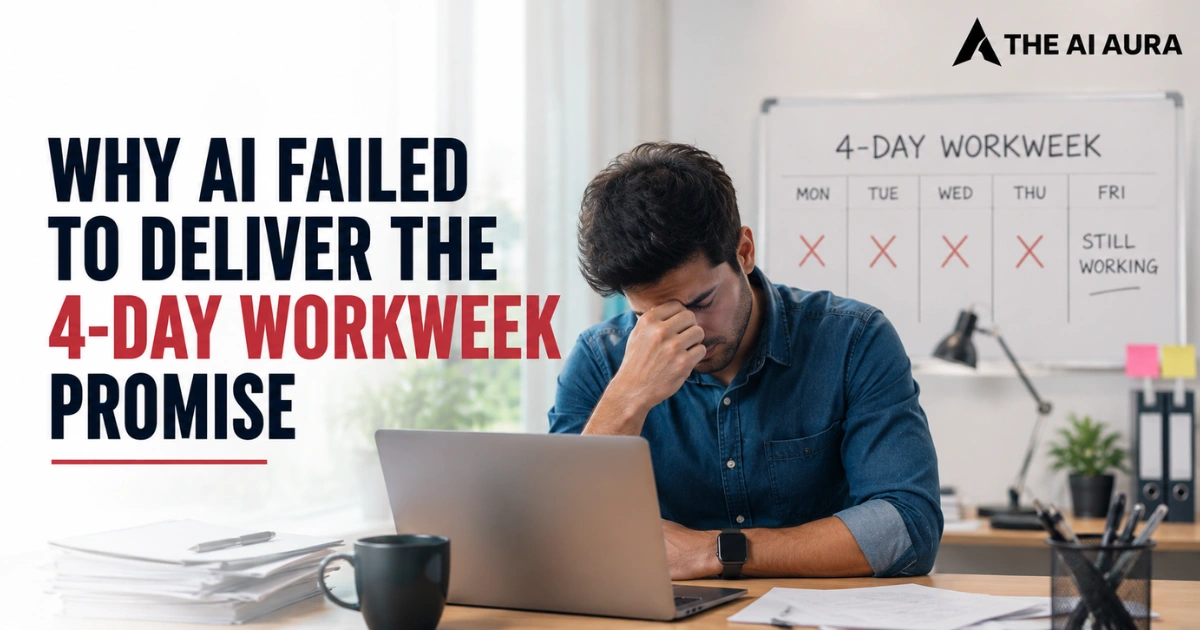

A few years ago, the tech elite sold us a compelling, borderline utopian vision of the future workplace. Bill Gates mused that a two-day workweek was within reach. Steve Cohen and Mark Cuban echoed the sentiment.
They promised that the rapid evolution of artificial intelligence would wipe out mundane tasks. Consequently, this would allow us to clock out on Thursday afternoon without sacrificing our salaries.
The logic felt entirely sound. If intelligent machines take over the heavy lifting, humans get their time back.
Yet, as AI integrates deeply into our daily corporate workflows, the weekend hasn’t grown by a single hour.
Instead, the generative AI boom has followed the standard path of corporate technology. It hasn’t shortened the race.
Rather, it has merely sped up the treadmill. We aren’t working less. Therefore, we are just cramming significantly more output into the exact same five-day sprint.
The Efficiency Trap: Raising the Baseline
The tech leaders actively building these AI models are already quietly walking back the four-day workweek narrative. For instance, OpenAI CEO Sam Altman recently admitted he doesn’t expect AI to shrink our workweeks. He noted that technology simply keeps us busy at a higher tier of output.
Similarly, Meta’s CTO Andrew Bosworth shares a pragmatic view. To him, productivity gains aren’t a free pass for time off. Instead, they are a mandate to build more products and hit larger strategic goals.
Furthermore, this shift is glaringly obvious inside the modern office. Workplaces aren’t emptying out on Fridays.
On the contrary, they are just getting denser with action. As Vijay Sharma points out, AI has raised the bar for what constitutes a productive day.
Organizations are operating leaner teams. Consequently, physical offices are evolving into hyper-efficient hubs for rapid decision-making.
The data clearly exposes the reality of this transition. Recently, a Bank of Korea study revealed the “AI productivity disconnect.” When workers utilized generative AI, they completed tasks roughly 3.8 percent faster. As a result, they saved about an hour and a half a week.
However, researchers found virtually zero correlation between that saved time and an actual reduction in working hours. Workers just finished a task faster, only to immediately face the next one.
Thus, the fundamental law of corporate life remains intact. Work expands to fill the time allotted. If drafting a quarterly report now takes twenty minutes, management doesn’t send you home. Instead, they simply ask for five reports.
The Profit-and-Loss Reality
The fatal flaw in the four-day workweek theory was a naive assumption. Many falsely assumed businesses would view employee time as a shared dividend. Sidharth Thakur accurately notes that the early billionaire predictions were just predictions.
Moreover, they predominantly came from American executives talking about an American context.
They failed to account for global corporate culture. In highly competitive markets like India, for example, corporate leaders aren’t entertaining shorter weeks. Instead, many actively lobby for longer ones to outpace global competitors.
When a company discovers it can suddenly produce more with a leaner, AI-assisted workforce, that efficiency translates directly into the profit and loss statement.
It shows up as widened margins and reduced overhead, not as an extra weekend day for the surviving staff. The time you save utilizing an AI tool isn’t deposited into your personal leisure account; it is reallocated by the business toward another deadline, client, or project.
Technology is entirely neutral regarding how its benefits are distributed. An algorithm cannot decide who gets the hour it just saved. Right now, companies are overwhelmingly choosing growth, scale, and operational leanness over employee rest.
Until the fundamental structure of corporate compensation and labor leverage shifts, AI will remain a highly effective tool for extracting more output from a five-day week, rather than the key that unlocks a four-day one.
Source: Official NDTV, "'Billionaires Were Wrong': Why AI Didn't Live Up To The 4-Day Work Promise"