
Software development is undergoing a massive shift, and the historical barrier to entry has essentially vanished. We are rapidly moving away from syntax-heavy programming toward intuitive, natural language instruction.
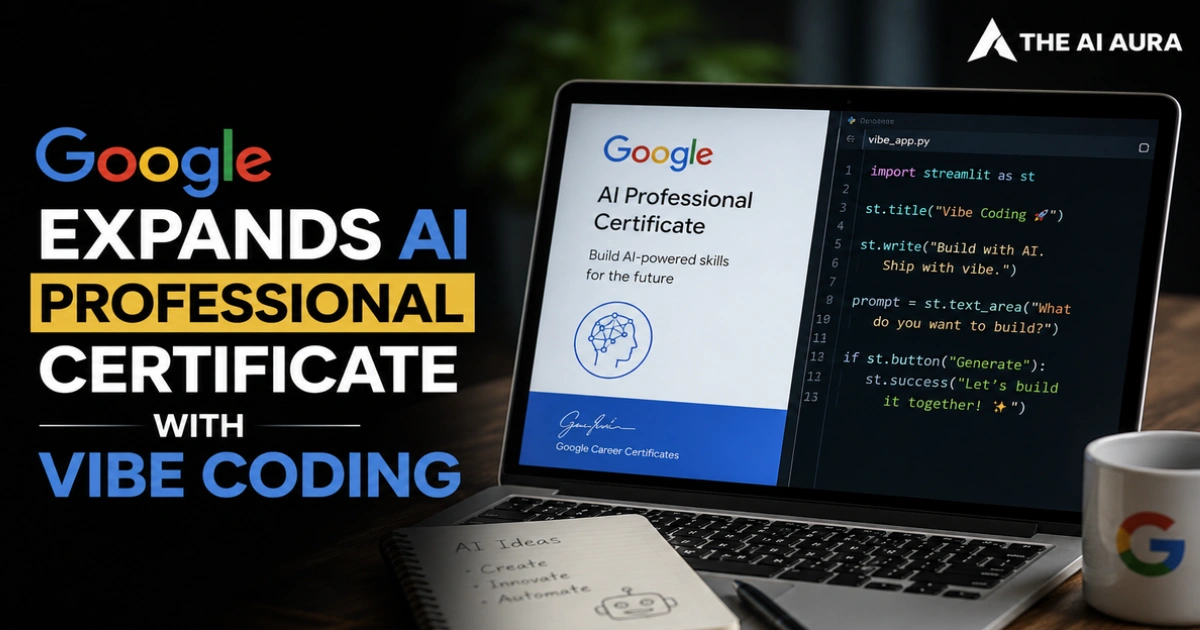
Catching this wave, Google recently announced a significant update to its educational lineup: Google expands AI Professional Certificate with vibe coding.
Having tracked the evolution of generative AI tools over the past few years, I view this as a necessary enterprise pivot rather than a simple curriculum update. Since its initial launch in February, Google’s AI certificate has already dominated platforms like Coursera.
But the tech market moves relentlessly. People no longer just want to understand artificial intelligence theoretically; they want to actively build with it.
While “vibe coding” might sound like a passing internet buzzword, the underlying mechanism is actually profound.
At its core, the concept represents the ability to articulate a complex problem in plain English and have an advanced AI model handle the entire backend logic, syntax generation, and deployment.
U.S. search interest in the exact term has spiked by 140% over the last year, signaling a clear shift in how individuals approach digital problem-solving.
Google’s integration of this specific concept into a formal professional certificate validates natural language development as a legitimate, scalable skill for the modern workforce.
The Mechanics of Natural Language Development
Traditional software engineering requires spending years learning specific languages such as Python, JavaScript, or C++ and adhering to strict syntactical rules. Vibe coding bypasses this syntax barrier completely.
Instead of writing code line by line, you take on the role of the product architect and project manager, while the AI operates as your developer
In this newly added course module, Google focuses on the entire lifecycle of application development through conversational instructions. You are not just typing a vague prompt and hoping for a usable output.
The training specifically covers how to plan an application’s core architecture, meticulously test the generated code, debug errors when the AI misinterprets your instructions, and finally deploy the working tool to end users.
This structured, methodical approach is exactly what separates casual chatbot prompting from actual software creation. You learn how to communicate complex logical workflows directly to a machine.
For instance, if you need to build a customer intake tool or automate a tedious internal data workflow, you simply describe the parameters, data inputs, and desired outputs. The AI handles the heavy technical execution.
Real-World Adoption and Market Shift
The true value of any emerging tech skill is proven on the ground floor, and enterprise adoption of natural language development is already accelerating.
When employees can build their own localized solutions without waiting months in an IT department backlog, massive operational bottlenecks instantly disappear.
Google highlighted a prime example in their latest announcement with a former Walmart truck driver who successfully transitioned into a logistics load manager role.
Without possessing a traditional computer science background, he utilized these exact AI skills to design four custom enterprise applications. One specific app drastically condensed daily reporting meetings into brief 15-minute huddles while efficiently coordinating driver shifts across multiple states.
That represents a massive operational win driven entirely by a non-technical associate. Verizon is adopting a similar strategy, utilizing the Google AI Professional Certificate to rapidly upskill its workforce.
Their corporate employees are now moving past simple tasks like drafting emails and are instead building highly customized internal tools, such as virtual quoting assistants for their teams.
When everyday workers are equipped with the autonomy to solve their own localized challenges, company-wide efficiency scales organically.
This initiative isn’t just about making software development slightly easier; it is about completely decentralizing who holds the power to create technology.
Source: Official Google, "Expanding the Google AI Professional Certificate With Vibe Coding"