
The demand for product managers who understand artificial intelligence is growing. Knowing how to prompt a chatbot is no longer enough. Business schools are now rewriting their curricula to meet this demand.
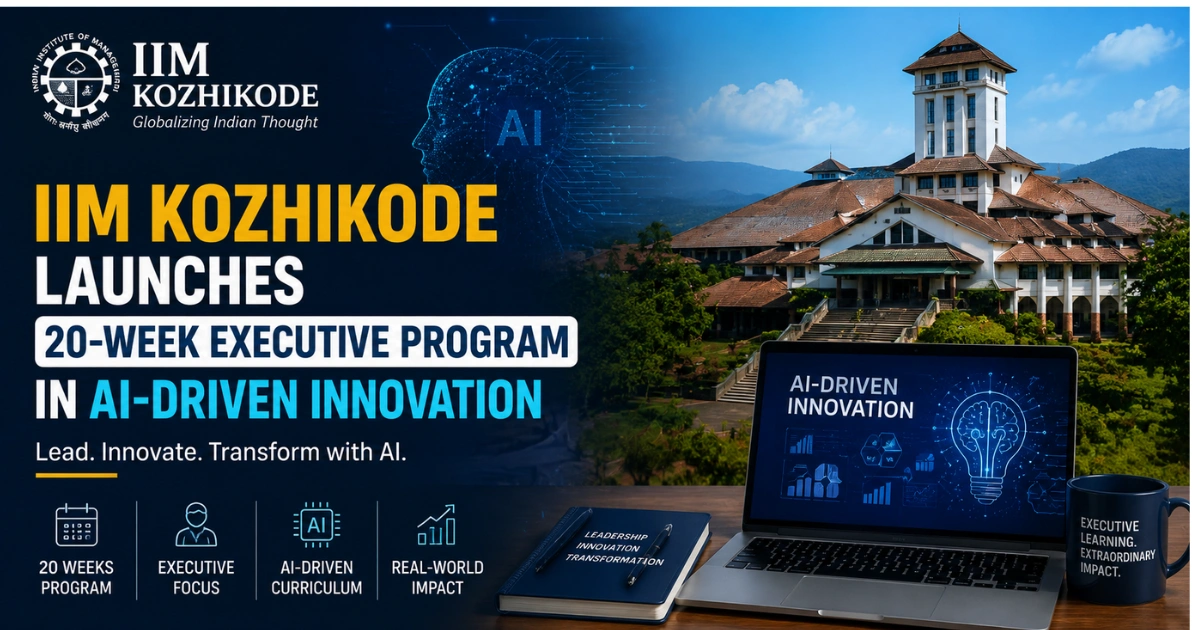
IIM Kozhikode recently announced a 20-week “Executive Programme in Product Innovation with AI & Agentic AI.” The program is designed for working professionals. It goes beyond basic generative AI usage and focuses on building AI-native products from the ground up.
Companies are rapidly integrating AI into their core operations. As a result, the traditional product development cycle is changing.
Traditional frameworks often fall short when dealing with autonomous agents and non-deterministic software. This newly launched program reflects that shift in executive education.
Modern product managers need hands-on experience with specific technology stacks. They also need a deeper understanding of human-AI interaction to remain competitive in the job market.
Decoding the Curriculum: From Concept to Capstone
What makes this program structurally different from standard business management courses is its heavy bias toward execution. The curriculum is mapped directly against the product development lifecycle.
Participants don’t just study management theory; they follow the exact pipeline from spotting market opportunities and analyzing customer needs to prototyping, launching, and iterating based on real user feedback.
To bridge the gap between business strategy and technical reality, IIM Kozhikode has structured the 20 weeks heavily around applied learning. Students are required to complete five distinct mini-projects and one comprehensive capstone project.
These assignments act as practical challenges designed to simulate the messy, everyday reality of AI product management.
The tooling ecosystem covered in the course is particularly telling about how the program works. Rather than keeping things abstract, the syllabus forces participants to get their hands dirty with over 20 industry-standard applications.
This includes design and wireframing software like Figma, Miro, and Uizard, alongside heavy-hitting product analytics platforms such as Amplitude, Mixpanel, and Google Looker Studio.
Furthermore, learners are trained on workflow automation through n8n and interact directly with leading large language models like ChatGPT and Anthropic’s Claude.
By making these specific tools a core requirement, the program ensures that graduates can immediately apply their skills to their current roles without a steep technical onboarding curve.
The Shift Toward Agentic AI and Real-World Application
Perhaps the most compelling aspect of this launch is its explicit focus on Agentic AI. The tech industry is moving away from passive AI tools that wait for human prompts and toward autonomous systems that can execute complex, multi-step workflows independently.
Building products that manage these independent agents requires an entirely different approach to user experience, system architecture, and risk management.
To address this complexity, the program relies on current industry practitioners. IIM Kozhikode faculty provide the academic and strategic foundation.
The course also includes four live masterclasses led by experts building AI products in the field. These sessions focus on practical areas such as AI-native product architecture and human-AI interaction.
They also cover the deployment of agentic systems and emerging technical trends. This dual-instructor model helps keep the course practical and relevant throughout the 20-week program.
For those looking to network beyond the digital cohort, the program offers an optional one-day campus immersion. This addition gives professionals a physical space to sit down with the faculty and their peers.
Ultimately, IIM Kozhikode is offering a practical and technically grounded path for the next generation of product leaders. The program reflects a broader reality: staying competitive in today’s tech industry requires hands-on AI skills.
Source: NDTV, "IIM Kozhikode Launches 20-Week Executive Program In AI-Driven Innovation"