

Years ago, keeping 20% to 30% of your engineering staff on the bench was standard practice for Indian IT majors.
It was a strict strategic necessity. Companies such as Tata Consultancy Services (TCS), Infosys, Wipro, HCLTech, and Tech Mahindra needed a large reserve of immediately deployable talent. This helped them secure and execute large-scale legacy contracts.
The “bench” essentially served as a paid waiting room for employees on the payroll. These workers were not attached to active, billable projects.
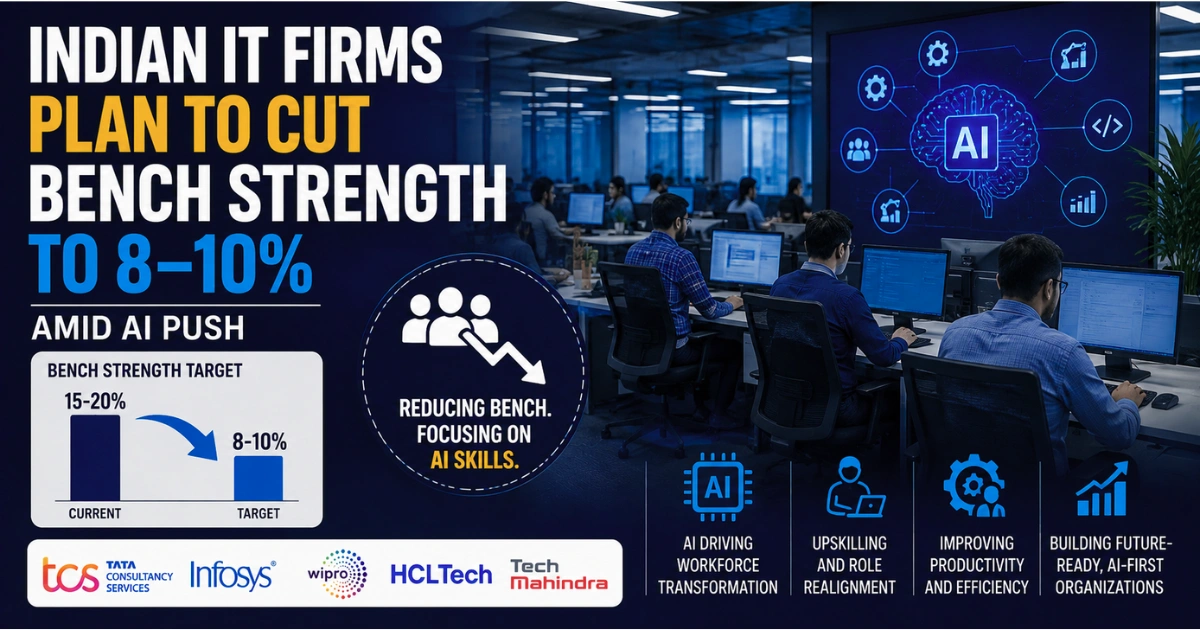
Today, that traditional playbook is being rewritten. Artificial intelligence is being integrated aggressively across development pipelines. As a result, bench strength at India’s top tech firms has quietly fallen into the single digits. It reached a maximum of around 12% over the last three years.
Staffing data from TeamLease Digital suggests that this reserve could shrink further. By FY27, bench strength may fall to just 8% to 10%. This shift is changing how the outsourcing model operates.
How AI is Rewriting Employee Utilization
The basic math of the IT services industry used to be highly linear: acquiring more client projects meant you had to hire a proportionately larger number of people. You built a sprawling bench because onboarding, training, and deploying talent for a sudden client demand took months.
If an overseas client suddenly scaled up an enterprise software integration, you needed hundreds of coders ready to bill by the following Monday.
Artificial intelligence has aggressively broken that linear relationship between headcount and revenue generation. Generative AI tools and advanced machine learning models are altering how code is written, tested, and shipped.
Tasks that once required a team of junior developers working for a full week such as debugging legacy infrastructure, writing boilerplate scripts, or running quality assurance protocols can now be executed by a leaner team augmented with AI copilots in a fraction of the time.
Consequently, IT firms are dramatically improving their employee utilization rates. They no longer need a massive backup pool of dormant talent waiting for the next big deal because the existing workforce is delivering much higher output per capita.
Operating with a sub-10% bench is no longer a warning sign of talent scarcity; it is a deliberate, algorithmic optimization of human capital designed to protect profit margins in a highly competitive global market.
What a Leaner Bench Means for Tech Workers
For everyday tech professionals, this transition signals the end of the “hiding in plain sight” era. Historically, the bench provided a comfortable buffer between projects. Employees could use this time to upskill or wait for management to assign them to a new portfolio.
That luxury is disappearing. Companies are restructuring their workforces to operate leaner than before. As a result, performance expectations are rising for both active and benched employees.
You are no longer expected to know only Java, Python, or standard cloud architecture. Companies increasingly want workers who can use AI tools and adapt to AI-driven development workflows
Firms are pushing time-bound, rigorous upskilling mandates, practically forcing benched employees to master data engineering or generative AI deployment within weeks rather than months.
An 8% projected bench for FY27 means companies are actively trimming excess staff. They are retaining employees who can quickly adapt to complex, automated environments.
The Indian IT sector is moving away from a high-volume body-shopping model. It is becoming a high-value consulting industry. The decline of the massive bench reflects this broader shift.
Source: Moneycontrol, "Indian IT Firms Set to Pare Bench Strength to 8–10% in FY27 Amid AI Push"