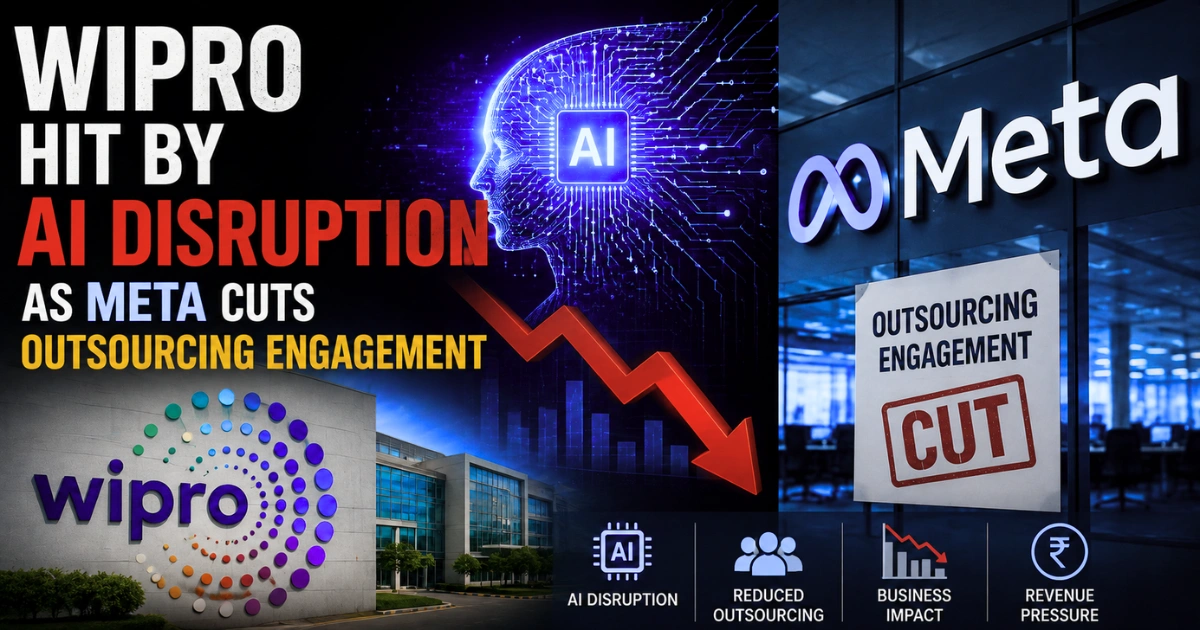

The global IT services sector is experiencing a structural shift. The impact is already visible in Wipro’s recent client adjustments. Meta has significantly reduced its outsourcing engagement with the Bengaluru-based tech giant.
The move is expected to remove approximately $25 million in annual revenue for Wipro. The company historically generated around $100 million annually from Meta, placing the social media giant among its top 20 accounts.
This is more than a routine cost-cutting measure. It reflects a fundamental change in how major technology companies manage their operations.
The pullback directly affects at least 200 Wipro employees based in Gurugram. These workers primarily handled IT support, customer service, and digital marketing integrations.
These workers have been moved to the bench, awaiting redeployment in an increasingly hostile demand environment.
Coupled with Wipro’s recent loss of a massive Estée Lauder contract to Accenture, the Meta reduction highlights a systemic shift in enterprise tech spending.
We are witnessing the rapid acceleration of AI-driven insourcing, a mechanism where advanced machine learning models directly replace offshore human capital.
To understand the gravity of this shift, one must look at the mechanics of the traditional IT outsourcing model and how artificial intelligence actively dismantles it.
For decades, companies relied on labor arbitrage moving repetitive, high-volume digital tasks to geographies with lower operational costs.
Today, algorithms running on dedicated servers are simply cheaper, more accurate, and faster than offshore manual labor.
The Mechanics of AI-Driven Insourcing
The core of Wipro’s lost revenue involves digital marketing operations, specifically integrating ads for Meta’s clients across its platforms, alongside routine customer service and content enforcement. Historically, these processes required massive human oversight.
Workers had to manually review visual content, triage user support tickets, and map advertising assets into backend systems.
Meta is now deploying proprietary AI systems directly across its applications. These systems are designed to handle specific workloads internally.
Large language models and computer vision algorithms have moved beyond the experimental stage. They can now identify illicit content, manage adversarial activity, and handle repetitive graphic reviews more efficiently.
By integrating these AI systems into its core infrastructure, Meta can eliminate the need for external vendors. The workflow no longer requires an integration ticket to be routed to an offshore facility in India.
Instead, the AI system can execute the task autonomously within milliseconds. This shift from human-led outsourcing to AI-led insourcing is reducing the billable hours that traditional IT service providers depend on for revenue growth.
Margin Pressures and the Bench Reality
The immediate operational fallout for Wipro is the displacement of a specialized workforce. Benching 200 employees creates a sudden margin liability. In traditional IT service operations, the “bench” acts as a temporary holding area between client projects.
However, the current macroeconomic environment and the nature of this technological disruption make rapid redeployment highly challenging.
When a client pulls back $25 million in revenue due to automation-led productivity gains, those specific low-level roles do not reappear elsewhere in the market. The jobs are structurally eradicated.
For IT vendors, this creates a dual crisis: a shrinking pipeline for conventional digital operations and an urgent need to retrain benched talent for higher-order, complex engineering tasks that AI cannot yet solve. Tech giants are actively redirecting their capital expenditures.
Meta is currently pouring billions into AI infrastructure doubling its computing power to 7 gigawatts this year alone while ruthlessly trimming operational excesses, including legacy outsourcing contracts.
Wipro, and the broader $300 billion Indian IT sector, now face an existential mandate.
Providers must evolve from supplying manual labor for basic process execution to engineering the highly complex AI systems their clients demand, or risk permanent revenue attrition as silicon permanently replaces the offshore office.
Source: LiveMint, "AI Disruption Hits Wipro as Meta Trims Outsourcing Engagement"