
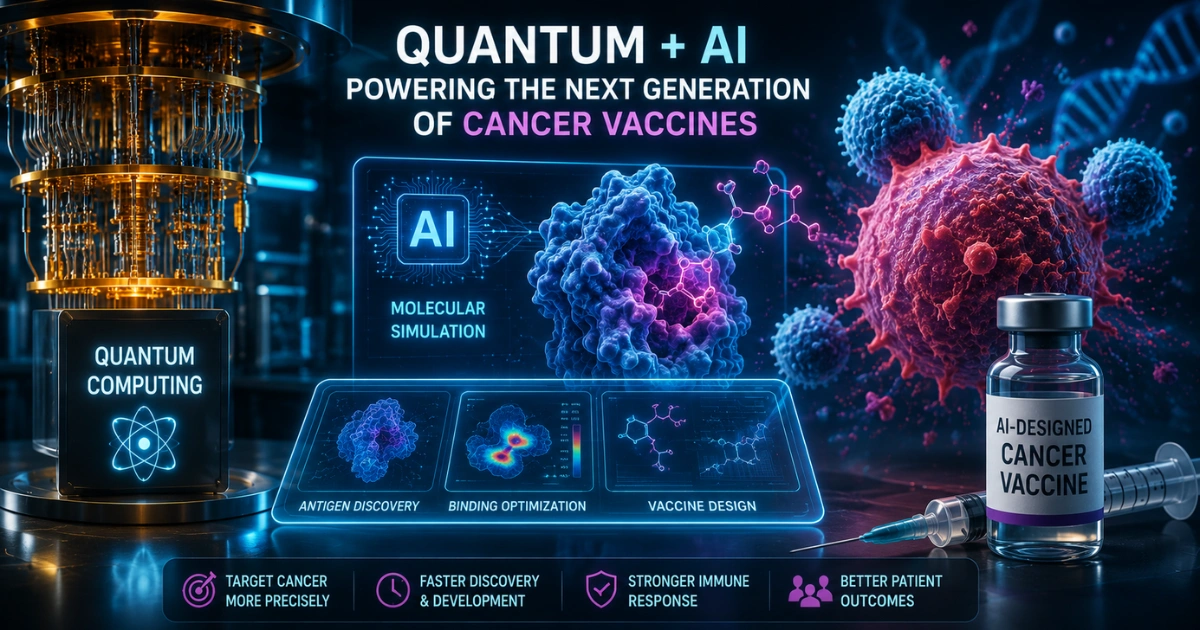

Designing a cancer vaccine is as much a mathematical hurdle as it is a biological one. For decades, immunologists have struggled with the sheer scale of the microscopic search space.
To train the human immune system to recognize and attack a diseased cell, we rely on peptides—short chains of amino acids. These peptides must bind perfectly with Human Leukocyte Antigen (HLA) molecules on a cell’s surface. Think of HLA proteins as display windows.
If a peptide cannot anchor itself stably into that window, patrolling immune cells will never notice the threat.
The mathematical bottleneck arises because there are hundreds of billions of possible peptide sequences, yet only a microscopic fraction will successfully bind to a specific person’s unique HLA profile.
Artificial intelligence has made incredible strides in navigating this data haystack, but it frequently hits a wall when dealing with rare or highly specific immune types.
This is exactly where a recent proof-of-concept study from the Technical University of Denmark (DTU) alters the trajectory of personalized oncology.
By integrating a photonic quantum computer with an AI generative model, researchers haven’t just accelerated the design process—they have fundamentally changed how the AI “thinks” at the starting line.
How Photonic Quantum Computing Rewires AI Design
Every generative AI model requires a seed of randomness to begin proposing new designs. In classical computing, this randomness is flat and uncoordinated. It is the equivalent of asking a room full of musicians to play completely independent notes, hoping a coherent melody emerges by sheer volume.
A photonic quantum processor operates on a completely different physical principle. It utilizes individual particles of light (photons) acting as qubits. Because of quantum interference, these photons interact and blend. Handing this specific, quantum-derived randomness to an AI model is akin to giving it a structured, orchestrated chord rather than white noise.
The DTU study revealed that feeding the AI these richly correlated starting points pushes the algorithm entirely out of its comfort zone. Instead of converging on safe, familiar peptide structures that already dominate existing medical databases, the AI begins exploring a much wider, unconventional range of molecular designs.
This isn’t about raw processing speed, nor does it claim absolute “quantum advantage”—the state where quantum machines execute the computationally impossible.
Rather, it is a strategic swap of raw materials. The quantum hardware provides a textured mathematical foundation that a classical machine struggles to emulate, prompting the AI to uncover highly effective peptides that standard computational models would likely miss.
Closing the Data Gap in Personalized Immunology
The true breakthrough in this methodology is deeply personal. HLA genes are among the most varied in the human genome. Because we inherit these genes, different global populations carry distinct immune profiles.
Current AI prediction tools are heavily biased toward common, well-documented HLA types simply because they rely on massive existing datasets to learn.
If you possess a rare immune profile—which is often the case for individuals from underrepresented genetic populations—traditional AI-driven vaccine design frequently fails you.
The quantum-assisted AI successfully bypassed this barrier. When tasked with designing peptides for data-poor, difficult-to-predict HLA types, the algorithm thrived.
These theoretical designs were then rigorously validated in physical laboratory assays. Researchers synthesized the top quantum-designed peptides and tested them against real human cells, proving that the molecular structures successfully stabilized the target HLA complexes.
For the most chemically challenging immune type tested, nearly 75 percent of the AI’s proposals successfully bound to their targets.
We are still years away from clinical trials, as synthesizing a peptide that binds in a laboratory is merely the first milestone on the road to triggering a functional immune response in a living human.
However, as quantum hardware scales up and integrates with increasingly sophisticated AI systems, this methodology maps out a concrete future.
It proves that personalized cancer vaccines and neoantigen therapies do not have to be reserved solely for those with the most common genetics but can eventually be rapidly engineered for anyone.
Source: The Indian Express, "Can Quantum Computing Make AI Better at Designing Cancer Vaccines? A Scientist Explains"