

Most major technology waves follow a remarkably predictable arc. AI technologies often begin as theoretical concepts in well-funded research labs. They gain momentum through venture capital funding before eventually facing market reality.
From research labs to billion-dollar investments, every technology eventually reaches the same defining moment: proving it can solve real-world problems.
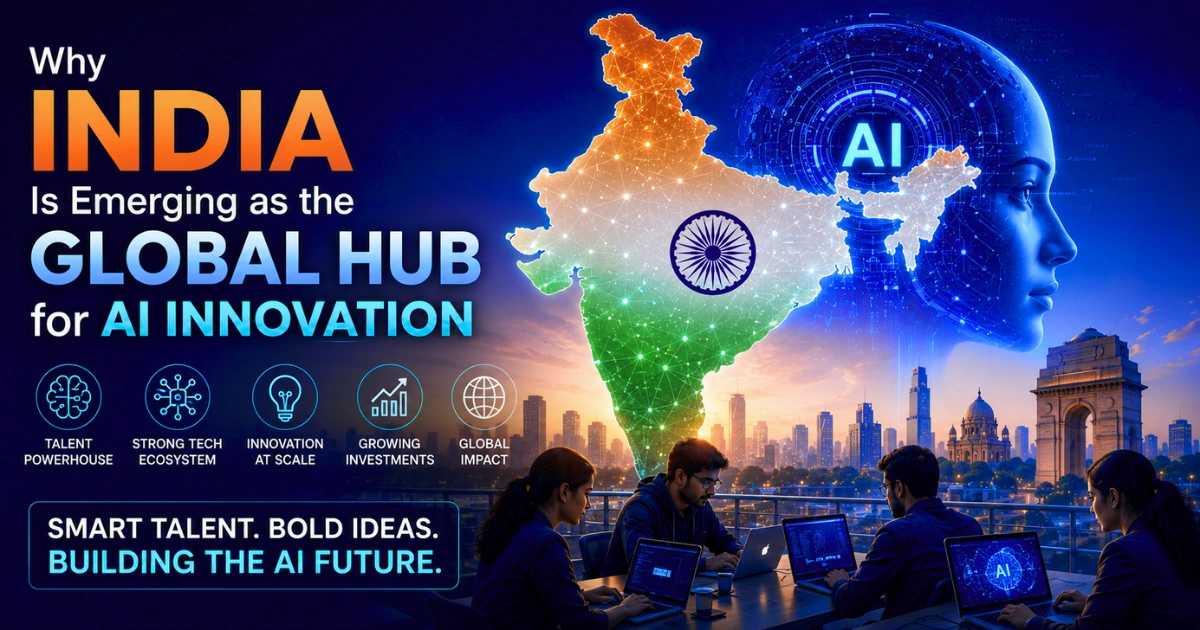
This is precisely why India is quietly positioning itself as the global hub for AI innovation. The conversation here is no longer just about writing backend code.
The real opportunity lies in deploying AI in one of the world’s most complex environments—because technology that succeeds here can scale confidently across global markets.
The Ultimate Stress Test for Algorithms
For the past few years, the global AI narrative has been dominated by Silicon Valley’s race to build massive foundational models.
But building a trillion-parameter large language model is fundamentally a capital and computing challenge. Deploying an LLM application to production successfully to generate actual economic value on the ground is a completely different problem.
India offers an environment that no sterile lab in California can replicate: a market defined by extreme friction and unfathomable diversity.
Consider the operational reality. India’s digital economy serves nearly one billion internet users. It spans dozens of official languages, thousands of dialects, and a wide socio-economic spectrum.
AI systems must accurately interpret Hindi-English voice prompts. They also need to process unstructured agricultural data from rural Tamil Nadu and analyze credit histories for first-time digital borrowers, even on unreliable internet connections.
Beyond the sheer demographic challenge, there is India’s robust Digital Public Infrastructure. The success of the Unified Payments Interface (UPI) showed that India can build interoperable digital infrastructure at massive scale.
Indian startups are now building AI on top of this established infrastructure. This approach avoids the legacy enterprise software that often slows AI adoption in many Western markets.
Engineering for Frugal Scale
There is a highly distinct philosophy governing how technology gets built in this part of the world. Historically, Western tech hubs have prioritized computational power and theoretical perfection.
Indian engineering, born out of resource constraints, has always been forced to prioritize efficiency, frugality, and immediate real-world utility. Today, this mindset is a massive strategic advantage.
The global AI industry is struggling with rising cloud computing costs and growing energy demands. Meanwhile, developers in Bengaluru and Pune are focused on building more efficient AI systems.
Rather than building bigger models, they are creating smaller, open-source, domain-specific models that deliver higher efficiency.
They are training AI to detect diabetic retinopathy from low-cost smartphone scans. They are also building voice-first interfaces that help rural farmers navigate complex crop insurance programs.
This pivot from theoretical elegance to applied scale changes the global dynamic. Multinational corporations are realizing that the Indian tech workforce is no longer just executing outsourced IT requests. They are actively architecting the commercial application layer of artificial intelligence.
The sheer engineering density in the country means that whenever a breakthrough AI paper is published globally, there are dozens of teams here immediately tearing it apart to commercialize it for a fraction of the cost, demonstrating firsthand how to build scalable AI systems that don’t fail in production.
The global race to dominate artificial intelligence is frequently framed as a straightforward battle between the United States and China. That geopolitical lens completely misses the reality of how software actually scales.
The global conversation often centers on who can build the smartest AI. India is showing that an equally important challenge is making that intelligence useful, accessible, and scalable.
The ability to absorb immense complexity and output affordable utility is what ultimately decides who wins a technology cycle.
Source: The Economic Times, "India Is Where AI Gets Figured Out"