
Something odd happened at Google DeepMind over six days in June 2026. Four senior researchers walked out the door, and two of them weren’t just any researchers — one had a Nobel Prize, the other co-invented the architecture that every large language model on the planet now runs on.
Noam Shazeer, co-lead of Gemini and one of the original authors of the “Attention Is All You Need” paper, left for OpenAI. Two days later, John Jumper, who shared the 2024 Nobel Prize in Chemistry for AlphaFold, announced he was headed to Anthropic.
Then Jonas Adler and Alexander Pritzel — both AlphaFold collaborators of Jumper’s — reportedly followed him out. Alphabet’s stock dropped several percent within days of the news breaking.
That’s a lot of institutional memory leaving a building in less than a week. And it’s not really about salary. People at this level get counteroffers that most of us can’t imagine. So what actually pushed them out?
What the ‘London Rule’ Actually Refers To
According to Bloomberg, Google reassigned compute resources from one of Noam Shazeer’s projects to a London-based DeepMind team shortly before he announced his departure.
Google said the move would consolidate pretraining work and improve collaboration across teams.
Unofficially, it reads like a researcher losing the chips he needed to do his job, right before he decided to leave for a rival.
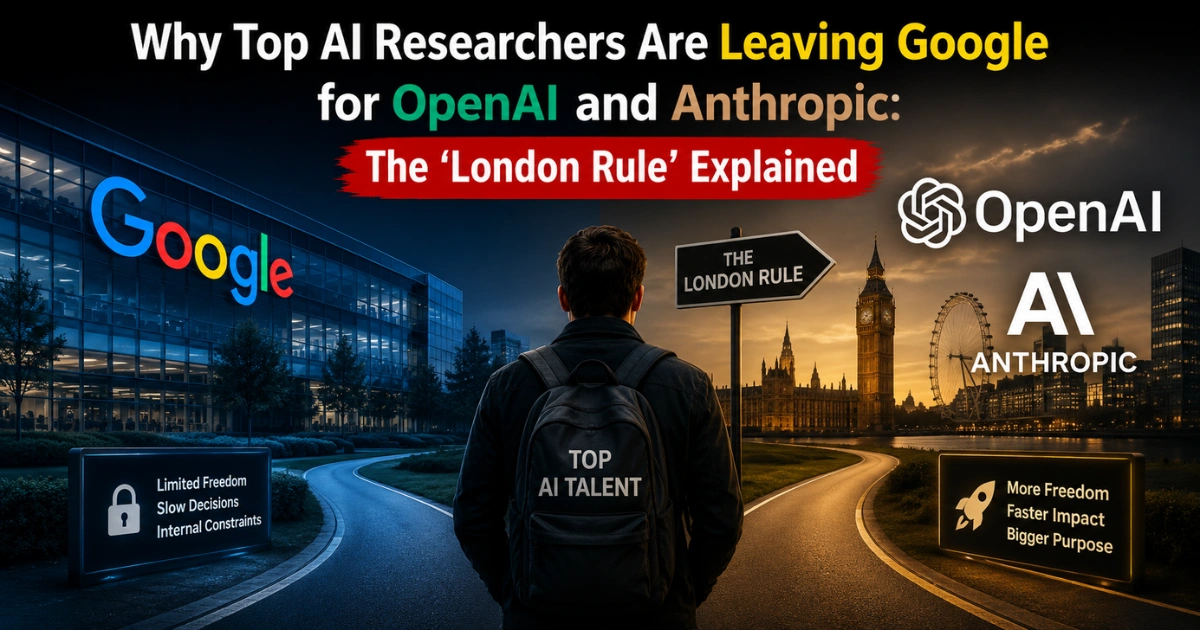
That’s the “London Rule” people are talking about — not a formal HR policy, but a pattern where internal compute allocation shifts toward London-based teams at the exact moment certain projects or leads seem to be falling out of favor.
Whether it’s a deliberate strategy or just how a very large company juggles a very scarce resource, the optics are bad.
Researchers who lose access to critical compute resources often begin exploring other opportunities.
Compute is the actual currency in frontier AI labs right now, arguably more than salary. For senior AI researchers, losing access to GPU resources can send a stronger signal than a formal performance review.
Why Anthropic and OpenAI Are Winning This Round
Timing matters here too. Both companies are edging toward what could be the largest IPOs tech has seen — Anthropic recently closed a funding round near a $965 billion valuation, and OpenAI has reportedly filed confidentially to go public.
Pre-IPO equity is a once-in-a-career kind of payday, and that alone is enough to pull senior people who might otherwise stay loyal.
There’s also a research-fit angle. Jumper’s protein-folding work lines up neatly with Anthropic’s stated push into AI for science and healthcare. Adler and Pritzel worked alongside him on exactly that.
This isn’t poaching at random — it looks like Anthropic built a specific pitch around people who already trust each other and share a research direction.
Google, for its part, says this is normal churn in a hot market, and DeepMind CEO Demis Hassabis has pointed out the lab still has the deepest bench in the industry by headcount. That’s true.
But losing the person who invented the Transformer and the person who won a Nobel Prize for the same product line, in the same week, isn’t the kind of churn any company shrugs off easily — especially with Gemini’s next major model reportedly still being fine-tuned for release.
Source: The Times of India, "'London Rule' That May Explain Why Top AI Researchers Are Leaving Google for Its Biggest Rivals Anthropic and OpenAI"