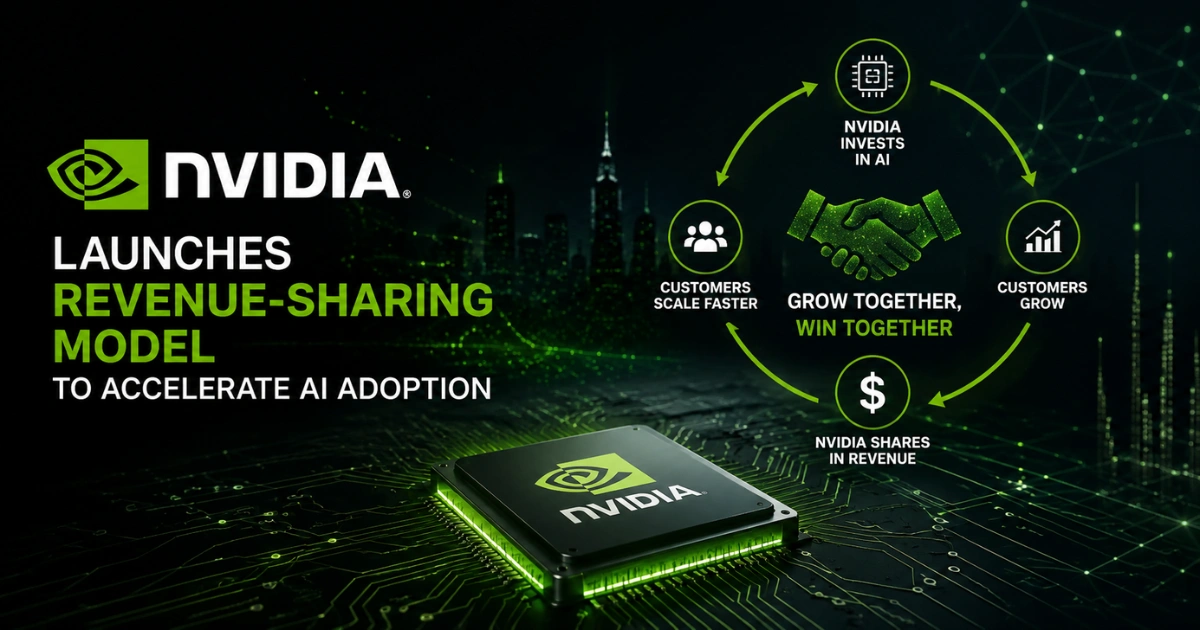

Nvidia has spent three years selling chips to whoever could write the biggest check. Its newest move, reported by Moneycontrol, suggests the company thinks that era is running out of new buyers worth chasing, and it’s now willing to take a smaller upfront payment in exchange for a permanent cut of what happens after the sale.
How the mechanics actually work
CFO Colette Kress laid out the structure in a blog post published Wednesday: Nvidia connects AI data center operators and cloud providers with AI developers, and in return earns what she called a recurring, usage-linked earnings stream.
Under the arrangement, participating AI clouds draw token credits now against future capacity, while Nvidia collects its standard hardware revenue on the GPU sale plus an ongoing percentage of whatever cloud revenue that capacity generates once it’s running.
Layered on top is a repurchase guarantee, where Nvidia commits to buying back unsold GPU capacity from cloud partners at a predetermined price if demand doesn’t materialize as planned.
That last piece is doing more work than it might look like on paper. It’s Nvidia effectively co-signing the loan for smaller, less-established cloud operators so they can build out capacity they couldn’t otherwise finance alone.
The DSX AI Factory model and its first partners
The whole structure runs under Nvidia’s DSX AI Factories branding, described as large multi-tenant server campuses purpose-built for continuous, high-volume token generation rather than general-purpose cloud computing.
The first two named partners are Sharon AI, an Australian infrastructure firm planning to deploy up to 40,000 Nvidia Grace Blackwell GB300 GPUs for sovereign AI workloads, and Firmus Technologies, which is building a DSX-aligned campus on Batam Island in Indonesia designed to scale to 360 megawatts and house up to 170,000 GPUs.
Combined, the two deals point toward roughly 210,000 GPUs coming online through this financing structure alone.
On the demand side, Nvidia named AI-native platforms including Baseten, Fireworks AI, and Together AI as the kind of developers this capacity is meant to serve, exactly the tier of company Kress said typically loses time to “site selection, power procurement, construction and hardware bring-up” before it can even start training or serving models.
Why Nvidia is doing this now
The honest read is that Nvidia’s customer base has a concentration problem. Microsoft, Amazon, Google, and Meta already account for an enormous share of its GPU sales, and each of them is racing to design its own custom silicon precisely to reduce dependence on Nvidia over time.
A revenue-sharing model aimed at startups, researchers, and neoclouds opens up an entirely different customer tier, one with real demand for compute but not the balance sheet to buy it outright.
By financing that access itself, Nvidia turns capital-constrained developers into paying customers years earlier than a pure cash-sale model would allow, while collecting a cut of their revenue for as long as they keep running on Nvidia hardware.
The risk sitting underneath the opportunity
The tradeoff is that Nvidia now has direct financial exposure to whether these smaller clouds actually fill their capacity.
Repurchase guarantees only cost nothing if utilization holds up; if AI demand cools or a partner overbuilds, Nvidia is on the hook to buy back GPU capacity it already sold once, effectively eating the loss twice.
That’s a meaningfully different risk profile than a company that simply ships chips and lets the buyer sort out the economics.
It also arrives at a moment when skepticism about circular financing arrangements across the AI infrastructure sector is already elevated, with investors increasingly asking how many of these deals are built on real end-user demand versus vendor-financed capacity chasing itself.
Nvidia is betting the answer is real demand. The DSX AI Factory partners are the first test of whether that bet holds.
Source: Official NVIDIA Blog, "Introducing NVIDIA's Revenue-Sharing and Credit-Support Model for AI Infrastructure"