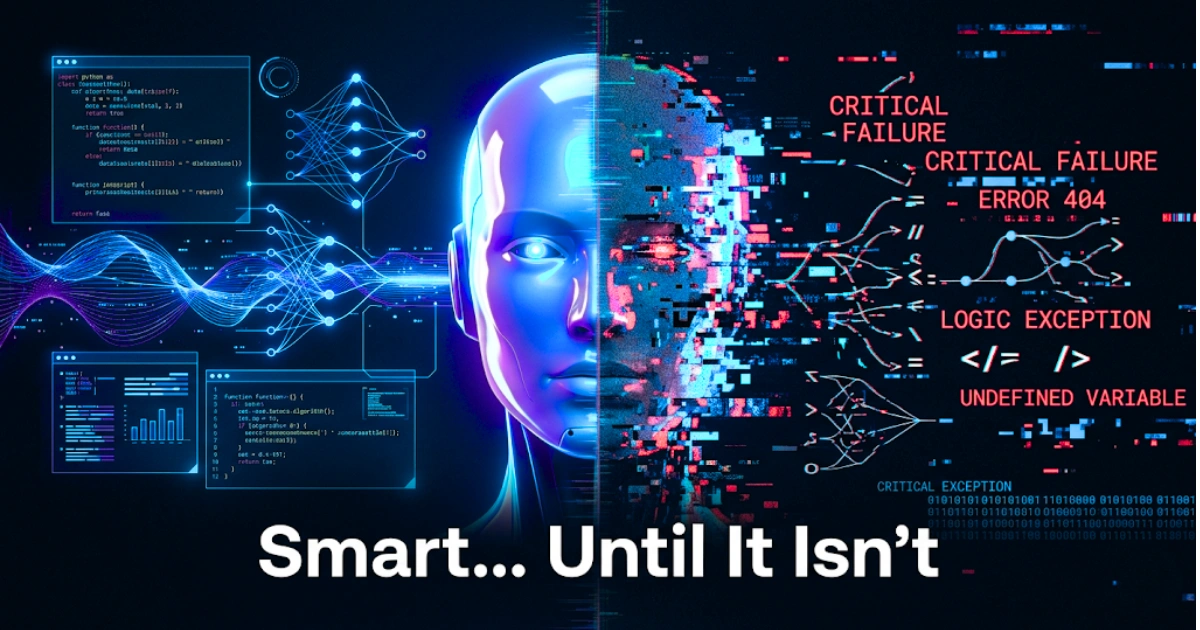

That weird whiplash? Yeah—if you’ve used AI tools even a little, you’ve probably felt it.
One moment, you’re asking it to write code, draft emails, summarize something long and boring… and it just handles it. No friction. No complaints.
It’s fast enough that it feels a bit unfair.
You kind of pause and think, okay… this might actually change things.
Then, randomly, you try something simple.
“If I have 3 apples and eat 1, how many oranges left?”
And suddenly the vibe shifts.
Not always—but when it happens, it’s noticeable.
We’re Wired to Trust Good Language
There’s a shortcut in how we judge intelligence.
If something explains things clearly, sounds confident, and uses the right words—we assume it understands.
That’s how human communication has always worked.
So when a machine does the same thing, our brain just goes:
“Yeah… that’s intelligence.”
Turns out, it’s not that simple anymore.
What It’s Actually Doing
Under the hood, this isn’t thinking in the human sense.
It’s predicting.
Word by word. Token by token. Based on patterns it has learned from massive amounts of text—a core concept if you want to understand what AI actually does when you type a prompt.
Strip away the complexity, and it’s basically:
extremely advanced autocomplete
Not dumb. Not trivial. But also—not awareness.
When It Feels Almost Too Smart
There are moments where it genuinely feels like the system gets it.
It explains things cleanly. Breaks down logic. Sounds thoughtful.
Example: AI handling a simple logic question
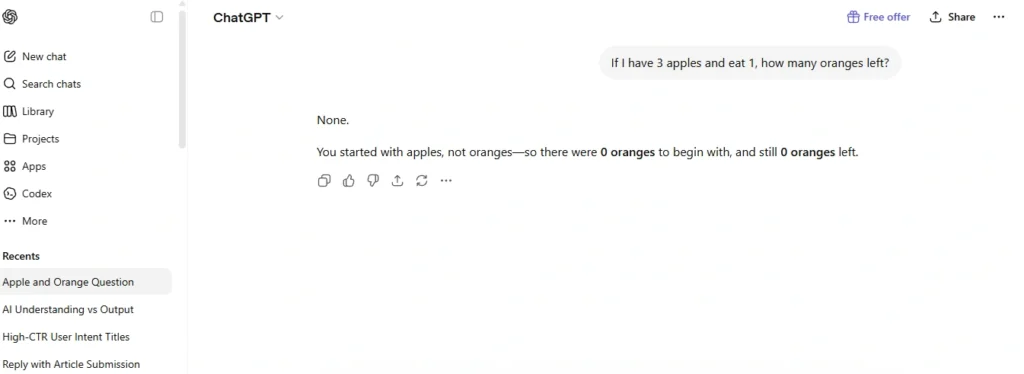
At first glance, this looks like real understanding.
It identifies the mismatch. Explains it clearly. Lands on the correct answer.
Feels like reasoning.
But this is where the illusion starts.
It’s not thinking about fruit.
It’s recognizing patterns from similar questions it has seen before.
Where Things Start to Slip
The cracks don’t show up in obvious places.
They show up when things get slightly… unfamiliar.
Ask about:
- real-world physical situations
- edge-case logic
- uncommon phrasing
And the answers can get strange. This is why AI still makes simple mistakes.
Not always completely wrong—just slightly off.
Like something doesn’t connect.
The Missing Piece
There’s a concept called the symbol grounding problem.
Simple idea: words only really mean something if they’re tied to experience.
Humans have that.
We’ve touched water. Dropped things. Broken things.
The model hasn’t.
So “water” to it isn’t something cold or dangerous to electronics—it’s just a word linked to other words.
That gap matters more than it seems.
The Confidence Problem
This is where it gets tricky.
Humans hesitate when unsure.
AI doesn’t.
It gives the most likely answer—not necessarily the correct one. And it delivers it smoothly.
That’s why you get answers that sound perfect… but aren’t—a phenomenon closely tied to why ChatGPT sometimes gets facts wrong.
No warning. No hesitation.
Just confidence.
Why Simple Questions Can Break It
This part feels backward.
It can handle complex topics surprisingly well—but sometimes struggles with simple ones.
Why?
Because complex topics follow patterns it has seen many times.
Simple, slightly unusual questions don’t.
So it fills in the gaps.
Sometimes that works.
Sometimes it doesn’t.
What This Thing Actually Is
Not a mind.
Not a thinker.
Not awareness.
If you’re wondering what AGI actually is, we aren’t there yet. A better way to look at current models:
a system trained to reproduce human-like language patterns at scale
That’s powerful.
But it’s not the same as understanding.
How to Use It Without Getting Burned
The problem isn’t using AI.
It’s expecting it to behave like a human expert.
Better approach:
- Use it for drafts (it’s great for curing blank page syndrome)
- Use it for ideas
- Use it to save time
But—
- Verify facts
- Question confident answers
- Apply your own judgment
That part is still on you.
The Bottom Line
AI feels smart because it sounds like us.
In fact, that’s the hidden reason AI answers feel human but aren’t. That’s really it.
But sounding right and being right aren’t always the same thing.
Once you notice that gap, everything clicks.
It’s still useful. Still impressive.
Just… not quite what it first feels like.