
There’s a moment that happens when you use AI long enough.
You ask something simple, and the reply comes back… smooth. Not just correct-looking but well said. Like someone actually thought about how to phrase it.
That’s usually where people start assuming there’s something deeper going on.
There isn’t.
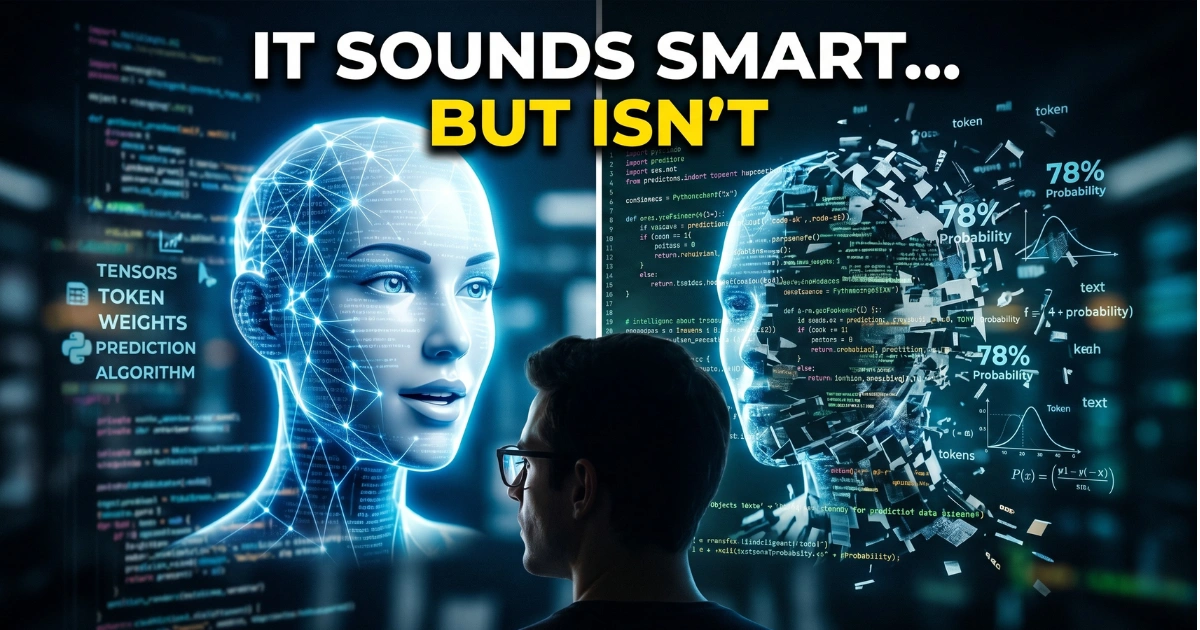
What’s convincing you isn’t intelligence in the way we normally mean it. It’s something closer to imitation—done at a level that’s easy to underestimate.
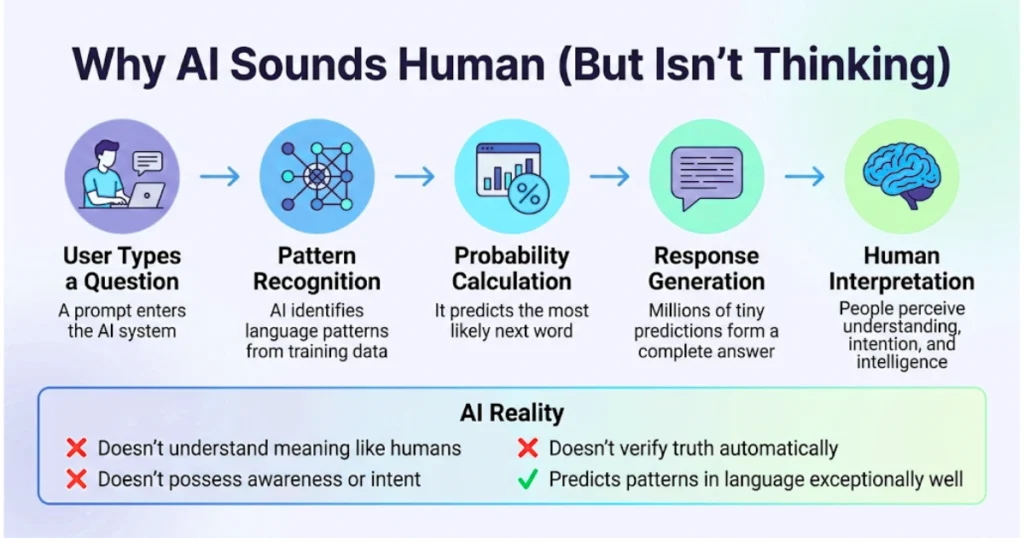
It’s not thinking. It’s continuing patterns.
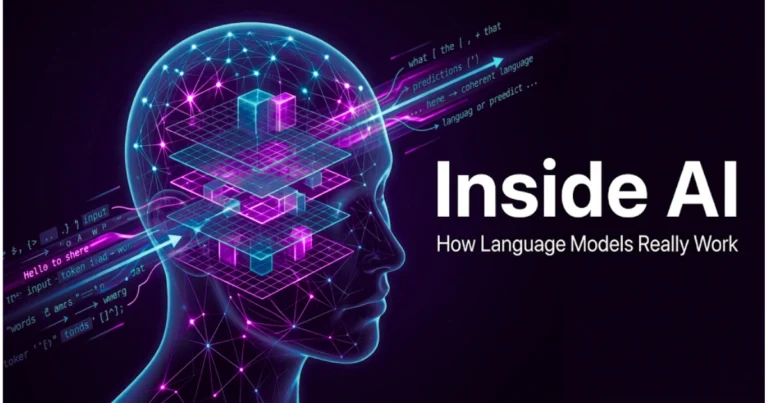
If you strip everything down, AI is doing one thing: continuing text.
Not in a dumb autocomplete way, but still—continuation. Given what you typed, it figures out what kind of response usually follows, and builds something that fits.
That’s it.
No internal “aha” moment. No checking if something makes sense in the real world. Just probability layered on top of probability until it looks like an answer.
And since those patterns come from human writing, the output naturally feels human too.
The tone is engineered (even if it doesn’t look like it)
What makes it more convincing is that the system has been nudged to behave in certain ways.
People tend to prefer answers that are clear, polite, and a bit structured. So over time, the model leans into that. It starts sounding like someone who’s trying to be helpful.
You’ll notice it:
- It softens statements.
- It explains things step by step.
- It occasionally adds a bit of reassurance.
None of that comes from intention. It’s just what tends to “work,” so the system keeps doing it.
The odd part is, once something sounds thoughtful, we assume it is thoughtful.
We’re the ones filling in the gaps
A big part of the illusion isn’t technical—it’s psychological.
Humans are really quick to treat language as proof of thinking. If something responds coherently, we assume there’s a mind behind it. We don’t question that instinct very often.
So when AI gives a clean, confident answer, your brain does a bit of extra work without telling you:
- It assumes understanding
- It assumes awareness
- It assumes intent
But those are things we’re projecting, not things the system actually has.
Where it starts to crack
You can usually spot the limits if you look for them.
Ask something slightly unclear, and the answer becomes generic. Push into something unusual, and it might respond with total confidence… while being wrong.
Or notice how often the structure feels familiar. The same kinds of explanations, the same rhythm.
That’s not coincidence. It’s pattern reuse.
Real thinking doesn’t look that consistent. It’s messy. People change direction mid-sentence, contradict themselves, rethink things. AI doesn’t really do that unless you force it to.
What’s actually happening
At a glance, it feels like conversation.
Underneath, it’s closer to a system that’s very, very good at guessing what a good answer should sound like.
And because it’s trained on human language, those guesses are often good enough to pass.
That’s where the confusion comes from.
The part that trips people up
The problem isn’t that AI sounds human.
It’s that once it does, we stop questioning it like we normally would.
Clarity starts to feel like correctness. Confidence starts to feel like knowledge.
But those signals don’t mean what we think they mean here.
They’re just patterns—extremely refined ones.
Once you see that, the whole thing shifts a bit. The responses still sound natural, but you stop reading them as evidence of understanding.
They’re not coming from a mind.
They just happen to sound like they are.